
Top 5 fieldroutes.com Alternatives for Field Service Management 2026
Explore 5 fieldroutes.com alternatives to decide on the best field service management software for your business needs in 2026.
June 8, 2026
Article

Choosing field service management software that actually matches trade workflows and grows with your crew size often means sifting through vendor demos and inflated feature claims. Many options hide real pricing, require sales calls for basic details, or force you to trial platforms with rigid licenses and limited trade-specific functionality. This side-by-side comparison lets you weigh dispatch, pricing, mobile performance, and accounting integrations across five alternatives so you can select a system that fits your team and avoids the usual buying traps.
Table of Contents
- Ample Express
- FieldPulse
- FieldEdge
- Praxedo
- Smart Service
- Comparative Analysis of Field Service Software Options
Ample Express
At a Glance
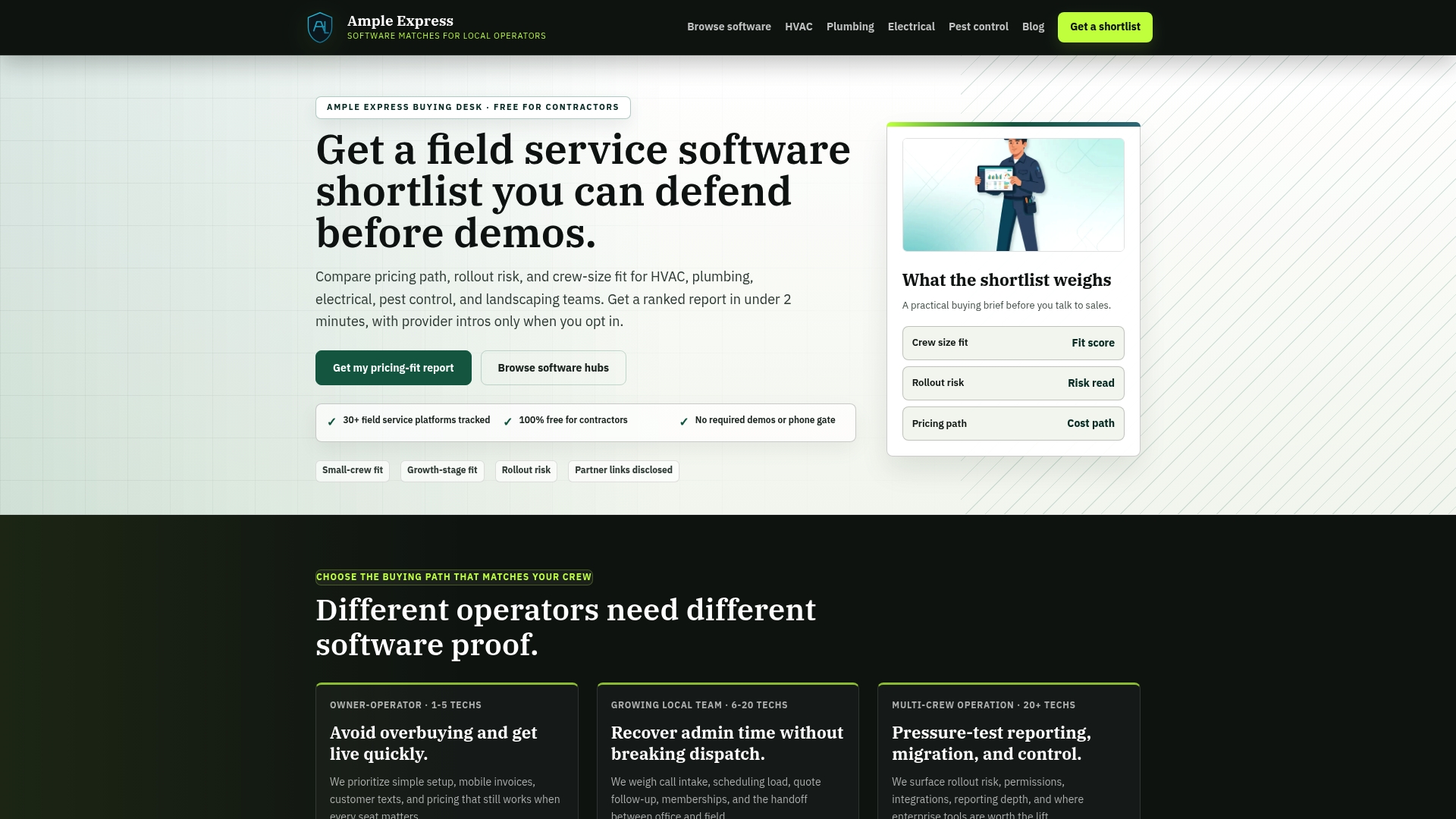
Ample Express reports tracking over 120 platforms with quarterly refreshed data and says it covers 45 metro areas across the US and Canada. The vendor also advertises a ranked shortlist of more than 30 field service software options tailored to local market signals.
Core Features
- Vendor-neutral, research-driven guidance built for trades including HVAC, plumbing, electrical, and pest control.
- Operator-led methodology with transparent scoring and open methodology notes so you see why a product ranks where it does.
- Quarterly refreshed market signals that feed local benchmarking for crew size, pricing paths, and rollout risk.
- Deep trade signals focused on dispatch, invoicing, and reporting requirements for service crews.
- Free access for contractors with no required demos or sales pitches.
Key Differentiator
Combines AI synthesis with verified market signals to produce trade-specific recommendations and rankings. The synthesis takes local price and usage signals, cross checks operator experience, and surfaces a short list you can compare without a vendor call.
Pros
- Unbiased recommendations based on consolidated market signals and operator review, which helps you avoid vendor marketing that overpromises.
- Independent research led by industry operators and analysts who translate product claims into real crew workflows and rollout risk scoring.
- Extensive local data points and benchmarking that let you compare expected pricing and feature fit by crew size and metro area.
- Focused coverage of trade needs such as dispatch routing, job costing, and trade-specific reporting rather than generic project management features.
- Free access removes the sales pressure that usually skews shortlist choices and lets you get to a decision faster.
Cons
- Analysis depends on the availability and quality of regional data which may be thin in very small or newly developing markets.
Who It's For
Contractors and local service business owners in HVAC, plumbing, electrical, pest control, and landscaping who want impartial, data backed guidance to pick field service management software matched to crew size and growth plans. Best for teams that want to avoid demo driven vendor selection.
Unique Value Proposition
The vendor advertises a ranked shortlist of more than 30 field service products combined with local pricing paths and rollout risk so you get a compact, actionable comparison rather than a long vendor list. That shortlist approach turns local market signals into a defensible recommendation you can present to your crew or owner.
Real World Use Case
A mid sized plumbing company filters the Ample Express shortlist by metro area signals and crew size. They compare expected implementation risk and local pricing paths, then pick a candidate that matches their dispatch needs without committing to multiple vendor demos or RFPs.
Website: https://ampleexpress.com
FieldPulse
At a Glance
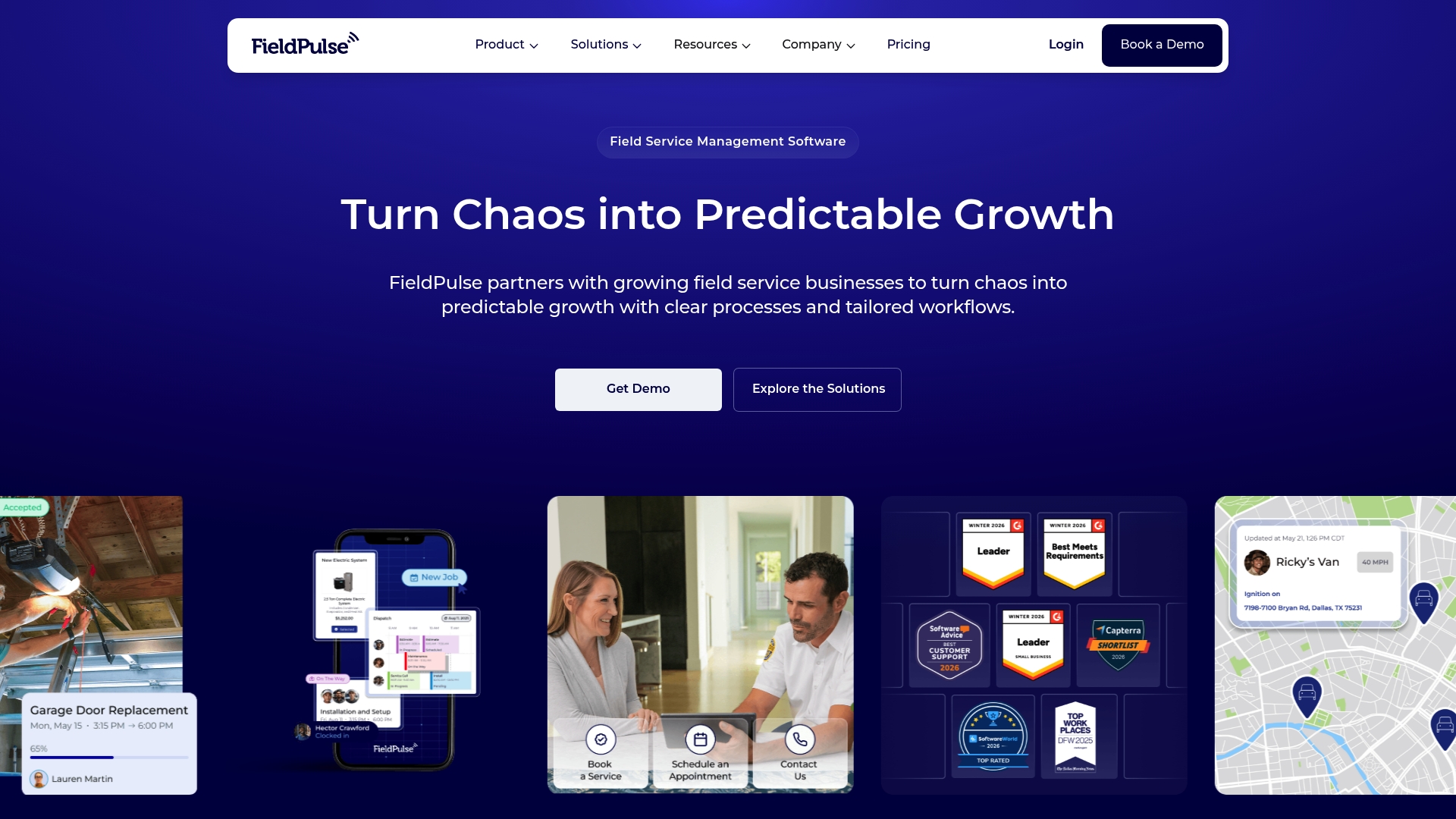
Seat-based licensing with customizable plans and US-based support anchors FieldPulse's pitch for growing service businesses. The product bundles scheduling, invoicing, customer portals, and mobile apps into a single seat-priced stack aimed at teams that add technicians incrementally.
Core Features
FieldPulse groups the day-to-day tools a service crew uses into one place.
- Work Order Management and Job Management for tracking tasks from estimate to invoice.
- Scheduling & Dispatching with booking and customer portals for online bookings.
- Estimates, Invoices, and FieldPulse Payments to close jobs faster.
- Mobile App, Fleet Tracking, Asset Management, Custom Workflows, and Dashboards for reporting.
Key Differentiator
FieldPulse is built around grow-as-you-go operations. Its seat-based model and modular feature set let a small office add users and enable features without replatforming. That focus on scaling operations rather than enterprise complexity is its main practical advantage for trade teams.
Pros
- Highly intuitive interface reduces training time for new hires. Office staff and technicians typically pick up the core flows quickly.
- Responsive US-based customer support helps resolve onboarding and configuration questions without long waits.
- Scheduling and dispatching capabilities cut administrative back-and-forth with clear calendar views and drag-and-drop assignment.
- Invoicing tools are straightforward and integrate with payment options, which reduces days sales outstanding for small billing cycles.
- Offers useful integration paths for accounting and CRM workflows.
Cons
- Users report occasional slowdowns and the interface can freeze, particularly on large job lists during peak hours.
- The mobile app lacks a strong offline mode, so crews working in poor signal areas may lose access to recent updates.
- Customization for some workflows is limited; advanced or unusual processes sometimes require workarounds.
- QuickBooks sync issues have been mentioned by customers, meaning accounting reconciliation may need manual checks.
When It May Not Fit
If your operation depends on full offline mobile capability for multi-day jobs, FieldPulse's mobile limitations will frustrate crews in remote areas. Likewise, if your business needs deep workflow customization or enterprise resource planning features, the product's simpler configuration model will feel restrictive.
Notable Integrations
- QuickBooks for accounting sync (reportedly useful but some users cite occasional sync issues).
- Standard CRM connectors and common billing and invoicing systems to bridge office workflows.
Who It's For
Small to medium field service businesses in HVAC, Plumbing, Electrical, and similar trades that want an easy-to-learn system. It fits teams that hire technicians over time and prefer seat-based predictable pricing rather than complex enterprise modules.
Real World Use Case
A plumbing company uses FieldPulse to schedule appointments, dispatch technicians, send estimates and invoices, and communicate with customers. The office reduces manual scheduling calls and technicians receive job details on the mobile app, cutting administrative overhead.
Pricing
FieldPulse uses a seat-based pricing model with customizable plans rather than public flat-rate tiers. Vendors typically provide quotes based on seat count and selected modules; contact the sales team for a tailored quote and current billing terms.
Website: https://fieldpulse.com
FieldEdge
At a Glance
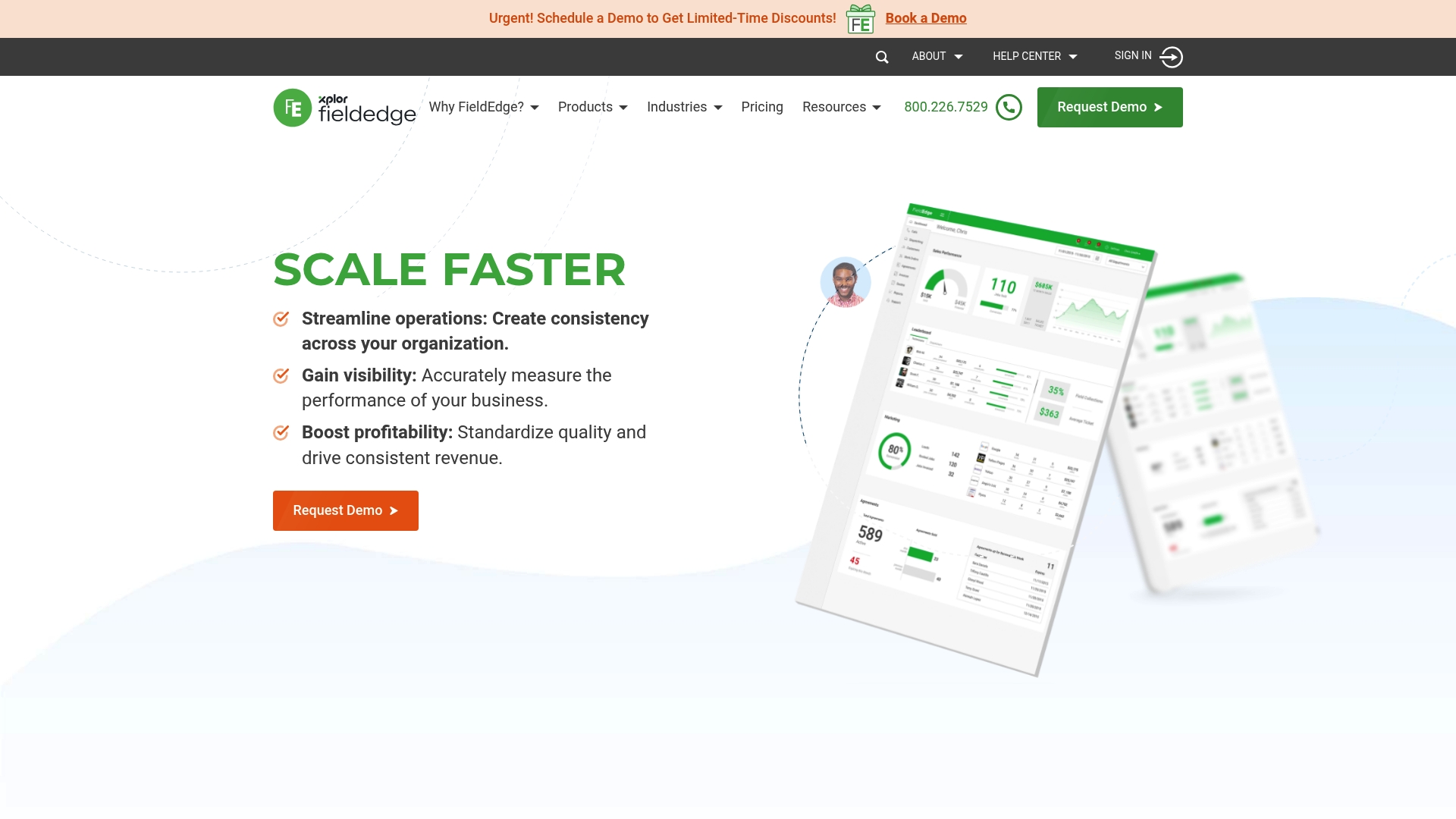
The vendor reports over 40,000 users, a scale that shows FieldEdge targets mid-market service teams as much as single-location shops. The product pairs office dispatch and invoicing with a technician mobile app and claims real-time QuickBooks sync for faster bookkeeping.
Core Features
Centralized dispatch and scheduling for multi-truck operations.
Mobile app that lets technicians access work orders, take payments, and capture customer signatures on site.
Real-time QuickBooks integration to reduce duplicate entries between the field and accounting.
Pricing and flat rate management, proposals and quoting, marketing automation, CRM, and business reporting.
Key Differentiator
FieldEdge leans into field and office parity. Its workflows are built so dispatch, techs, and accounting operate on the same records with fewer manual handoffs. That focus on synchronized field to office data supports companies running multiple trucks and locations.
Pros
- The feature set maps closely to trade workflows. Scheduling, flat rate pricing, proposals, and invoicing sit together so crews and office staff use one system.
- The mobile app empowers technicians to finish jobs onsite by collecting payments and signatures, cutting time between service and cash collection.
- The QuickBooks connection reduces double entry for bookkeepers, which can lower invoicing errors and speed month end.
- Training resources and vendor support are available to help teams adopt the product and learn advanced tools like Estimate and Marketing modules.
- Add-on modules for proposals and marketing give shops tools to chase higher ticket work and run targeted outreach without a separate vendor.
Cons
- Some users report inconsistent or slow customer support, which prolongs issue resolution for critical workflows.
- The breadth of features produces a steep learning curve that can overwhelm new users, especially shops with no dedicated admin.
- Mobile app instability, including occasional crashes and slowness, has been reported and can interrupt field operations.
- Pricing and optional module fees are not fully transparent and typically require a sales conversation, which delays buying decisions for some teams.
When It May Not Fit
Small single-truck operations that want a lightweight, out-of-the-box tool will likely find FieldEdge overly complex and expensive to set up.
If mobile reliability is essential and your team cannot tolerate app crashes during peak hours, that reported instability is a real risk.
Shops that need fixed public pricing to compare vendors quickly may be frustrated by a consultative pricing model.
Notable Integrations
- QuickBooks for accounting synchronization.
- FleetSharp for fleet management.
- Trane Technologies and other industry-specific partners for equipment and service data.
Who It's For
Mid-sized to larger service contractors in HVAC, plumbing, and electrical who require integrated scheduling, billing, and accounting workflows across multiple trucks or locations.
Best for teams that can dedicate time to setup and training and that value office to field data parity.
Real World Use Case
A regional plumbing company uses FieldEdge to dispatch technicians across three service zones, process on-site card payments, and push invoices into QuickBooks the same day. That tighter handoff cut the office reconciliation load and improved same-week cash flow for the owner.
Pricing
Pricing varies by plan and selected add-ons. Costs and module breakdowns are typically discussed during a demo or consultation with sales rather than published as a flat rate.
Website: https://fieldedge.com
Praxedo
At a Glance
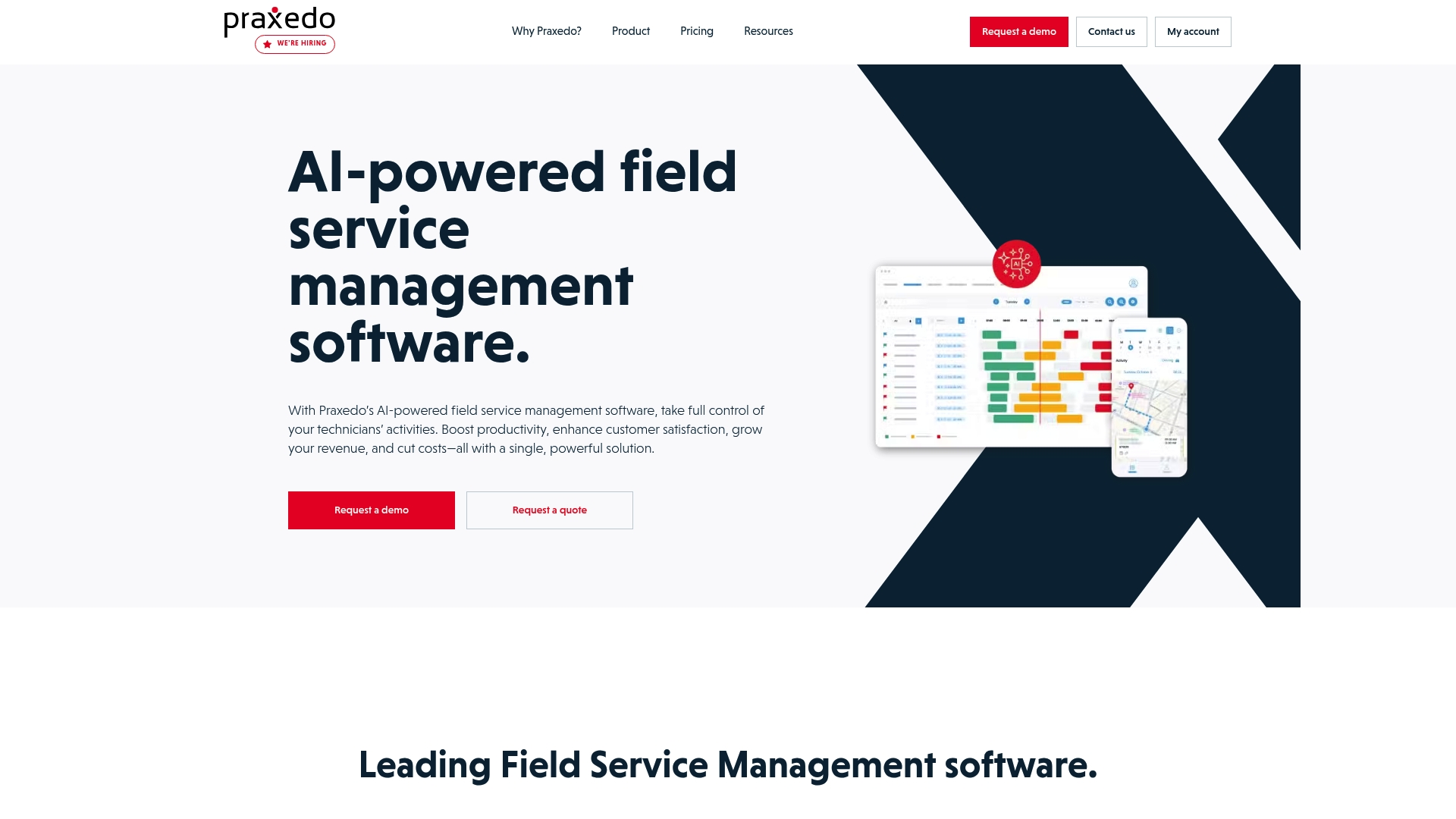
Praxedo reports more than 1,500 customers worldwide and says it processes hundreds of thousands of jobs daily. The vendor also cites over 20 years of experience and places heavy emphasis on AI-powered schedule optimization across office and field operations.
Core Features
Praxedo targets dispatch, mobile work, customer self-service, and AI routing in one package. The platform bundles planning and field tools that map to common trade workflows.
- Web-based scheduling and planning interface for drag and drop assignments and manual adjustments.
- Mobile app with offline mode and real-time sync so technicians record work without consistent coverage.
- Customer portal for job tracking and appointment booking to cut back-and-forth calls.
- AI-powered schedule optimization and routing that recalculates routes and assignments based on constraints.
- Automated work order management and desktop reporting with offline support.
Key Differentiator
Praxedo’s edge lies in its deep AI integration for dynamic scheduling and routing that adapts to changing constraints. Where basic FSM tools stop at fixed routes, Praxedo automates reassignments and route recalculation to maintain daily productivity under shifting job volumes.
Pros
- Highly configurable platform tailored to specific operational needs. The configuration allows custom fields, business rules, and sector-specific workflows.
- Fast implementation after setup with robust vendor support. Teams report quicker ramp once technical configuration is complete.
- Streamlined invoicing, reporting, and customer communication reduce follow-up work for office staff.
- Effective AI-driven routing and scheduling that reduces idle travel and tightens technician days.
- Widely trusted across industries which simplifies procurement conversations for regulated buyers.
Cons
- Initial setup and configuration can be complex and time-consuming for teams without dedicated technical resources.
- Web interface performance may lag at times under heavy load, affecting planners during peak schedule windows.
- Mobile app interface is basic compared with market leaders and may require add-on development for advanced field workflows.
- Significant customization efforts can require external technical input or professional services.
When It May Not Fit
Small crews with no IT support will struggle with Praxedo’s implementation demands. If you need a plug-and-play FSM that an office manager can deploy in a weekend, this product will likely require more time and a technical owner.
Who It's For
Medium to large field service organizations that run complex, constraint-driven schedules and want AI to manage routing and resource allocation. Best when you have at least one technical resource or a budget for professional services.
Real World Use Case
The vendor describes a telecommunications rollout where Praxedo was used to optimize technician dispatching. That deployment reduced travel time and increased the number of service calls completed per day, improving customer responsiveness and field productivity.
Pricing
Pricing is usage and company size based with plans starting from $39 per month per user for small businesses. Costs scale for larger deployments and custom enterprise plans are available.
Website: https://praxedo.com
Smart Service
At a Glance
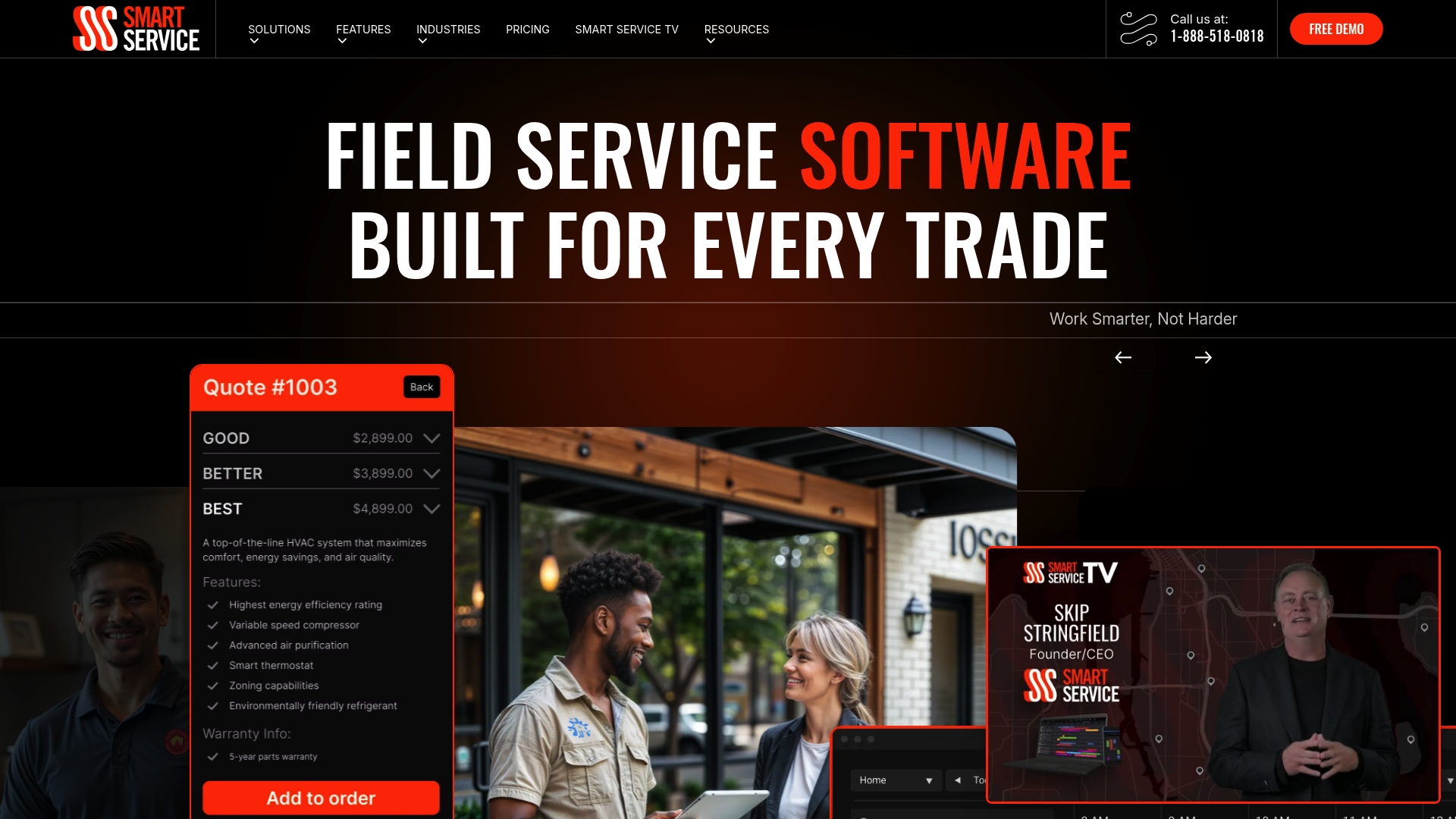
Smart Service's marketing materials advertise a ChatGPT integration for AI-powered support alongside built-in payment and accounting links. The platform targets trades with an all-in-one feature set that ties field workflows directly to accounting systems.
Core Features
Smart Service combines scheduling, dispatching, invoicing, and customer management in one package. Drag-and-drop scheduling offers real-time updates and automated dispatching so crews receive changes immediately.
The product includes dynamic quoting with instant customer approvals and a mobile suite for technicians, including iFleet and a field app for task management and digital forms.
Strong accounting alignment is part of the pitch through QuickBooks connectivity.
Key Differentiator
The vendor advertises deep QuickBooks integration plus customizable workflows tailored to trades. That combination makes Smart Service appealing when accounting reconciliation and field-to-office parity are the priority rather than point solutions for scheduling alone.
Pros
- Excellent QuickBooks alignment reduces double entry for bookkeeping and invoices, which matters when payroll and job profitability hinge on accurate records.
- The calendar and dispatch tools are intuitive. Many teams get technicians into the field faster because schedule changes propagate to mobile devices in real time.
- Built-in quoting and instant approvals shrink the sales-to-job timeline; you can convert an estimate to a scheduled job without exporting documents.
- Mobile features support digital forms and job photos, keeping service notes and signatures attached to jobs for better customer communication.
- Setup is straightforward for small teams, and workflow customization lets offices adapt processes for HVAC, plumbing, electrical, or pest control specifics.
Cons
- Some users report stability issues after updates. That can interrupt daily operations until a patch arrives.
- There are concerns about support responsiveness and technical help quality, which matters if you run a one-person office without an IT contact.
- A few customers have reported QuickBooks data corruption. Problems like that require careful change control and backups before rolling out broadly.
- The interface trades modern design polish for functional layout, which can slow adoption among less technical staff.
When It May Not Fit
If your operation needs enterprise-grade uptime guarantees and a responsive vendor help desk, Smart Service's reported post-update stability and support concerns make it a risky primary system.
Also avoid it if you run highly complex resource planning or need native advanced workforce analytics that larger platforms provide out of the box.
Notable Integrations
- QuickBooks for accounting sync
- FISERV for payment processing
- Twilio for SMS and voice communications
- ChatGPT for AI-assisted support and automation
These integrations cover payments, communications, accounting, and AI assistants without custom builds.
Who It's For
Small to medium-sized trade businesses that want a single system to manage scheduling, customer records, field mobile work, and accounting sync. Best for offices that prioritize bookkeeping accuracy tied to jobs over flashy UX.
Real World Use Case
A local plumbing company adopts Smart Service to schedule crews, dispatch via the mobile app, and push invoices straight into QuickBooks. Estimates convert to jobs on the fly, technicians submit photos and signed forms in the field, and bookkeeping time falls because entries no longer require manual transfer.
Pricing
Pricing is available on request from the vendor. Expect contact with sales for a quote, setup options, and any per-module or per-seat clarifications.
Website: https://smartservice.com
Comparative Analysis of Field Service Software Options
Choosing the right field service management software ensures operational efficiency and aligns tools with business goals. Below we analyze the differentiation points between available options, evaluating trade-offs and highlighting where specific software shines.
Data and Regional Insights
Ample Express excels in leveraging localized benchmarks for different trades and regions, producing, ranked shortlists without requiring direct vendor engagement. However, while its AI-driven recommendations are based on extensive coverage, its effectiveness diminishes in areas with scant data. Compared to FieldPulse and FieldEdge, which provide consistent scheduling and invoicing workflows independent of regional nuances, businesses heavily relying on precise coverage might prefer the latter for certain scenarios.
Onboarding and Support Experience
FieldPulse simplifies onboarding through its user-friendly interface and dependable U.S.-based support. In contrast, Praxedo, although offering advanced AI scheduling, necessitates a longer technical setup for optimization. For organizations without dedicated IT resources, the easier adoption of FieldPulse may result in faster ROI compared to systems requiring technical tuning.
Best Fit Recommendations:
- Ample Express: for businesses emphasizing data-rich market analysis tailored to specific trades and regional trends.
- FieldPulse: Ideal for small to mid-sized teams that value ease of use, predictable licensing, and integration capabilities.
- Praxedo: Best for larger companies demanding sophisticated AI-powered routing to streamline complex scheduling tasks.
Our Pick
For trade service companies in need of software that bridges regional and operational benchmarks with a transparent, efficient comparison process, Ample Express presents a uniquely integrated solution. While its local data reliance may affect niche areas, its unbiased and directly applicable recommendations make it for most field operations seeking informed decisions quickly.
Field Service Software Comparison
Choosing the right field service management software involves evaluating options based on features and suitability for your specific needs.
| Product | Core Feature | Key Differentiator | Best For | Pricing | Notable Limitation |
|---|---|---|---|---|---|
| Ampleexpress | Vendor-neutral guidance, trade-focused signals | AI synthesis with local market data | Contractors seeking data-driven FSM recommendations | Not disclosed | Thin regional data in small/developing markets |
| FieldPulse | Scheduling and invoicing for growing teams | Seat-based pricing and scalable features | Incrementally growing small to medium businesses | Not disclosed | Mobile app lacks a strong offline mode |
| FieldEdge | Dispatching and mobile integration | Parity between office and field workflows | Mid-sized contracts with integrated bookkeeping | Not disclosed | Complex setup and steep learning curve |
| Praxedo | AI-powered scheduling and routing | Adaptable recalculation for efficient dispatch | Large, constraint-driven scheduling needs | $39/month per user | Complex setup requires technical resources |
| Smart Service | Scheduling tied to accounting synchronization | Strong QuickBooks integration | Small to medium offices prioritizing bookkeeping | Not disclosed | Stability concerns after updates |
Discover Smarter Choices Among Fieldroutes.com Alternatives with Ampleexpress
Choosing the right field service management software can feel overwhelming, especially when balancing crew size, local market pricing, and rollout risks. Ampleexpress specializes in offering unbiased comparisons of over 30 tailored field service options to help contractors in HVAC, plumbing, electrical, and pest control make data-driven decisions without endless vendor demos.
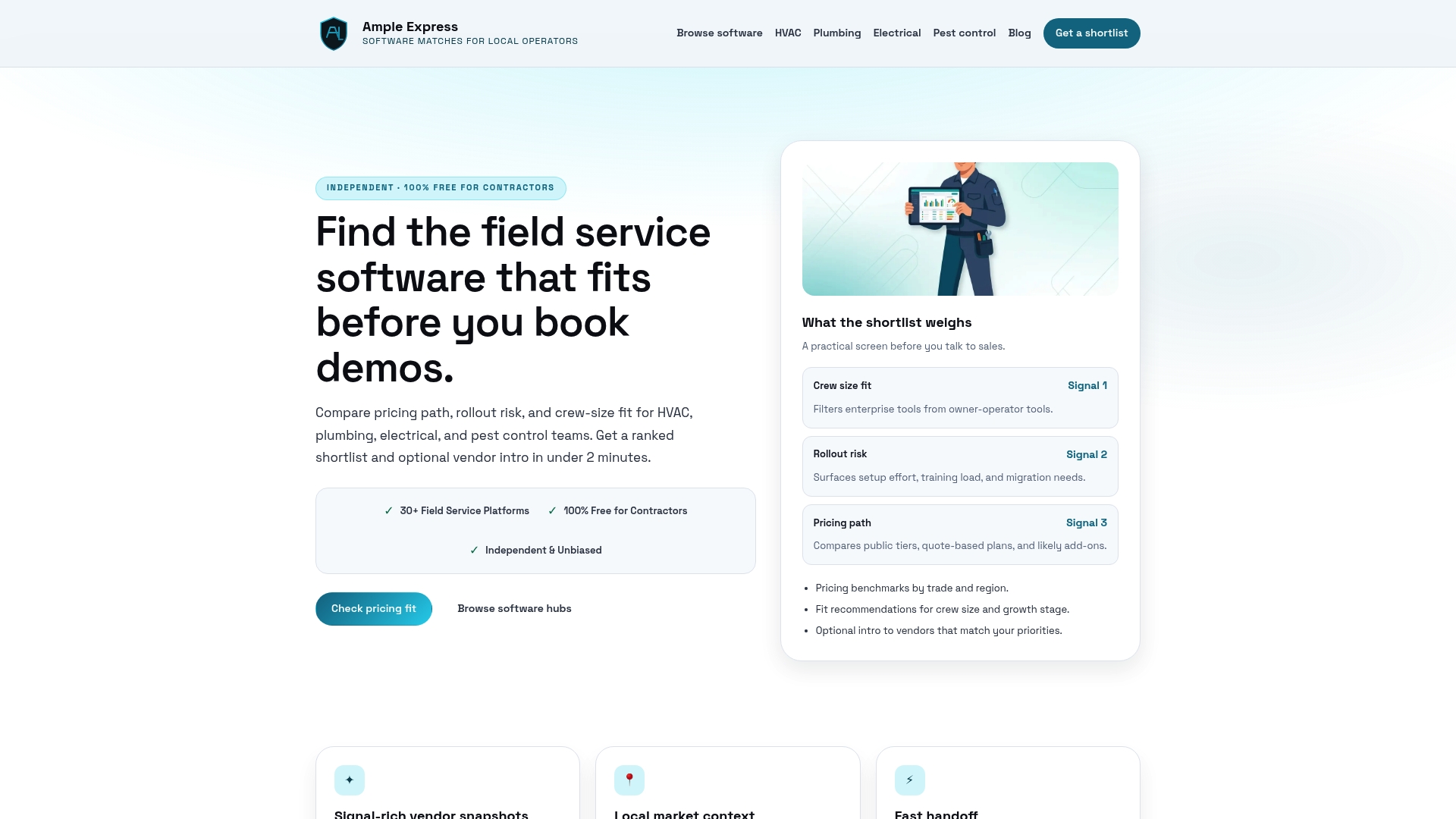
Explore how Ampleexpress turns complex local signals into clear, ranked shortlists personalized by your team size and regional benchmarks. Visit Ampleexpress to quickly find your best fit and understand expected implementation risks. Make your next software decision with confidence and download your customized shortlist in minutes.
Frequently Asked Questions
#### What features make Ampleexpress ideal for contractors?
Ampleexpress excels at providing vendor-neutral, research-driven guidance tailored specifically for trades like HVAC and plumbing. Its operator-led methodology includes transparent scoring and real-time market signals to aid decision-making for service software. Interested contractors can utilize this data to confidently select the right field service management software for their needs.
#### How does Ampleexpress compare to FieldPulse in terms of user experience?
FieldPulse is recognized for its highly intuitive interface that reduces training time for new hires, making it an appealing choice for growing service businesses. Ampleexpress, on the other hand, focuses on delivering unbiased recommendations and localized market benchmarking, making it ideal for contractors seeking data-backed insights. Contractors looking for a straightforward user training experience might gravitate toward FieldPulse, but those needing detailed operational insights may prefer Ampleexpress.
#### Which platform is better for real-time data insights, Ampleexpress or FieldEdge?
Ampleexpress offers quarterly refreshed market signals and local benchmarking that support decision-making based on crew size and pricing paths. Conversely, FieldEdge boasts real-time QuickBooks integration, ensuring that dispatch, invoicing, and field updates are all synchronized efficiently. For detailed, localized recommendations, Ampleexpress stands out, while FieldEdge may better serve teams that prioritize real-time financial data synchronization.
#### Can I rely on Ampleexpress if my service area has limited data availability?
Ampleexpress requires reliable regional data to perform effectively; if your area lacks sufficient market signals, the platform's insights may be limited. This factor can affect how well Ampleexpress meets a contractor's specific needs if operating in a burgeoning or underdeveloped market. For those in established regions, Ampleexpress will provide a strong comparative advantage.
#### What unique benefits do users get from Ampleexpress's approach to field service software?
Ampleexpress provides contractors with access to a ranked shortlist of over 30 field service products, based on consolidated market signals and operator reviews. This approach enables users to bypass vendor marketing traps and make decisions based on real-world insights. Painting a clear picture of expected pricing and features allows for faster and more informed decision-making among contractors.
Recommended
- Fieldroutes
- Get a Pest Control software shortlist
- Pest Control field service software
- Field service software by trade
- Top 4 Sites for fieldgroove.com Alternatives 2026
- Top 5 Service Fusion Alternatives in 2026 | Ample Express
- Best Field Service Software Shortlist | Ample Express
- Field Service Growth Blog | Ample Express