
Field Service Platform Pricing Models: 2026 Guide
Discover the best field service platform pricing models for 2026. Learn how to choose the right structure to optimize your costs and scalability!
June 4, 2026
Article

Field service platform pricing models define how you pay for software that manages dispatching, job tracking, and billing across your service team. Whether you run a five-person plumbing crew or a 50-technician HVAC operation, the pricing structure you choose directly controls your monthly software spend and your ability to scale. Platforms like Microsoft Dynamics 365 Field Service, ServiceTitan, and FieldBuddy each use different billing frameworks, and picking the wrong one can cost you tens of thousands of dollars in the first year alone. This guide breaks down every major model with real 2026 pricing data so you can match the right structure to your operation.
1. What are the main field service platform pricing models?
Field service software pricing falls into four primary structures: per-user subscriptions, per-job or per-visit fees, tiered packages, and flat-rate unlimited plans. Each model reflects a different assumption about how your team uses software and how costs should scale with your business.
The most common approach in 2026 is the subscription-plus-add-on model, which balances vendor revenue predictability with customer usage variability. This means you pay a base monthly fee per user or per tier, then purchase additional modules as your needs grow.
Here is a quick breakdown of the four core models:
- Per-user subscription: A fixed monthly fee per active user, billed monthly or annually. Common with platforms like FieldBuddy and Microsoft Dynamics 365.
- Per-job or per-visit pricing: You pay per completed service call or work order. This suits seasonal businesses with unpredictable job volumes.
- Tiered packages: Bundled plans at different price points, each unlocking more features and higher user limits. Most mid-market platforms use this structure.
- Flat-rate unlimited: One fixed monthly fee regardless of user count, with limits on service visit volume instead. FieldServicePro uses this model.
Pro Tip: Annual billing almost always unlocks a discount of 10 to 20 percent compared to month-to-month rates. If you are confident in a platform after a trial period, commit annually to reduce your total cost.
2. How tiered subscription models with add-ons work
Tiered pricing is the dominant structure among mid-market and enterprise field service platforms. You select a plan tier that matches your feature needs, then add modules on top as your operation grows.

FieldBuddy's 2026 pricing starts at €29 per user per month with a minimum five-user commitment, meaning your floor cost is €145 per month before any add-ons. Higher tiers, labeled Advanced and Pro, include advanced integrations and workflow automation. Premium support and customer portal access are sold separately. This modular design means you only pay for what you deploy, but it also means your bill grows as you add capabilities.
Microsoft Dynamics 365 Field Service takes a similar approach at a higher price point. The full license runs $105 per user per month billed annually, with a contractor-only license available at $50 per user per month. The Resource Scheduling Optimization add-on costs an additional $30 per resource per month. For a team of 10 technicians using the full license plus scheduling optimization, that is $1,350 per month before implementation or training costs.
Key factors to evaluate in any tiered model:
- Minimum user requirements: Some platforms require you to purchase five or ten licenses even if you only need three.
- Billing cadence: Annual contracts lock in your rate but reduce flexibility if your team size changes.
- Add-on dependencies: Some advanced features only work if you are on a higher tier, not just if you purchase the add-on.
- Integration costs: Connecting your platform to QuickBooks, Salesforce, or your parts inventory system may require a paid tier or a separate integration fee.
Pro Tip: Ask vendors for a modular pricing sheet before signing. Many will negotiate bundle deals that include two or three add-ons at a lower combined rate than purchasing each separately.
3. Flat-rate vs. per-technician pricing: a direct comparison
Flat-rate unlimited user pricing and per-technician subscription fees represent opposite ends of the cost-predictability spectrum. Understanding the trade-offs is critical before you commit to either structure.
FieldServicePro offers flat-rate plans with unlimited users at $199 per month for the Starter plan (up to 600 service visits per month) and $299 per month for the Growth plan (up to 1,000 visits per month), both with annual billing discounts. Dedicated onboarding support is included at no extra cost. For a growing team adding technicians, this model keeps your software cost fixed as long as your visit volume stays within the plan limits.
ServiceTitan uses per-technician pricing of $245 to $398 per month per technician, with a minimum 12-month contract required. A team of 10 technicians at the midpoint rate of $320 per month pays $3,200 per month in license fees alone. Add-ons like Marketing Pro cost approximately $2,000 or more per month on top of that. For a detailed breakdown of how these costs stack up for electrical contractors, the ServiceTitan pricing breakdown at Ampleexpress covers the full picture.
| Model | Example Platform | Base Price | User Limit | Contract Term |
|---|---|---|---|---|
| Flat-rate unlimited | FieldServicePro | $199/month | Unlimited users | Monthly or annual |
| Per-technician | ServiceTitan | $245–$398/tech/month | Scales with headcount | 12-month minimum |
| Per-user tiered | FieldBuddy | €29/user/month | Min. 5 users | Monthly or annual |
| Per-user enterprise | Microsoft Dynamics 365 | $105/user/month | No stated minimum | Annual |
Pro Tip: If you plan to add more than two technicians in the next 12 months, run the math on per-technician pricing at your projected team size, not your current one. A platform that looks affordable today can become your largest operational expense by year two.
4. Hidden costs that inflate your total field service software spend
License fees are only part of your actual field service cost structure. Implementation, onboarding, and add-on charges frequently exceed the first year's license cost for businesses moving to enterprise platforms.
Implementation and onboarding costs are the biggest hidden expenses, often surpassing license fees in year one for enterprise clients. ServiceTitan implementation fees range from $5,000 to $50,000 or more depending on your data migration complexity and the number of integrations required. Microsoft Dynamics 365 Field Service implementations can run $25,000 to $250,000 or more for complex deployments. FieldBuddy charges a one-time implementation fee starting at €2,000. FieldServicePro includes dedicated onboarding support hours in its base plans, which meaningfully reduces your first-year total cost.
Beyond implementation, watch for these recurring and one-time charges:
- Training fees: Many platforms charge per-seat or per-session training costs not included in the base license.
- Data migration: Moving job history, customer records, and parts catalogs from your old system to a new platform often requires paid professional services.
- API and integration fees: Connecting your dispatch tool to accounting software or a CRM may require a paid middleware subscription.
- Marketing and communications modules: ServiceTitan's Marketing Pro add-on costs approximately $2,000 or more per month, a cost that surprises many buyers who assumed it was included.
- Premium support tiers: Faster response times and dedicated account managers are often gated behind paid support plans.
ServiceTitan implementations can take 2 to 12 months to complete, which means you are paying license and implementation fees for months before you realize any operational benefit. Budget for this delay explicitly when calculating your ROI timeline.
Pro Tip: Before signing any contract, ask the vendor for a written list of setup deliverables, a phased rollout schedule, and a clear statement of which support hours are included versus billed separately. Vague answers here are a red flag.
5. One-time license models as an alternative to subscriptions
Not every field service software buyer wants a recurring subscription. One-time purchase licenses range from roughly $500 to $5,000 depending on business size, appealing to contractors who prefer capital expenses over ongoing monthly fees.
The trade-off is real. One-time license models typically offer fewer automatic updates, limited cloud functionality, and less flexibility to add users or features on demand. For a solo operator or a two-person crew running straightforward job types, a one-time license can cover core needs at a fraction of the long-term subscription cost. For teams that need real-time dispatch, mobile technician apps, and customer portal access, subscription models deliver far more operational value.
The software pricing benchmarks published by Ampleexpress show that most service businesses with five or more technicians find subscription models more cost-effective over a three-year horizon once you factor in update cycles and support access.
6. How to choose the right pricing model for your field service team
The right pricing model depends on three variables: your current team size, your projected growth rate, and the features you actually need versus the ones that look good in a demo.
Small teams of one to five technicians should prioritize flat-rate or low-minimum tiered plans. FieldServicePro's $199 per month Starter plan covers up to 600 service visits per month with unlimited users, making it a strong fit for small crews that want cost certainty. Growing companies adding technicians regularly should evaluate whether per-technician pricing will outpace flat-rate alternatives within 12 to 18 months. Large enterprises with complex scheduling, multi-location dispatch, and ERP integration needs will likely require a platform like Microsoft Dynamics 365, where the higher per-user cost reflects the depth of functionality.
| Team Size | Recommended Model | Example Platform |
|---|---|---|
| 1–5 technicians | Flat-rate unlimited | FieldServicePro |
| 6–20 technicians | Tiered subscription | FieldBuddy |
| 20+ technicians | Per-user enterprise or per-tech | Microsoft Dynamics 365 or ServiceTitan |
| Seasonal or variable volume | Per-job or per-visit | Varies by vendor |
For electrical contractors evaluating flat-rate alternatives, the Service Fusion pricing guide at Ampleexpress provides a useful side-by-side look at how flat-rate and per-user structures compare in practice.
Key takeaways
Choosing the wrong field service platform pricing model costs more in year one than most managers expect, primarily because implementation and add-on fees are rarely included in the advertised license price.
| Point | Details |
|---|---|
| Match model to team size | Flat-rate plans suit small crews; per-technician pricing scales better for large, stable teams. |
| Budget for implementation | Enterprise platforms like ServiceTitan and Dynamics 365 carry setup fees of $5,000 to $250,000+. |
| Add-ons change the total cost | Marketing, scheduling, and support modules can double your effective monthly spend. |
| Annual billing saves money | Committing annually typically reduces per-user or per-plan costs by 10 to 20 percent. |
| Growth trajectory matters | Calculate pricing at your projected 12-month team size, not your current headcount. |
What I've learned about field service platform pricing after years of vendor comparisons
The number that vendors advertise is almost never the number you pay. I have reviewed pricing structures across dozens of field service platforms, and the pattern is consistent: the base license fee is the floor, not the ceiling. Implementation, training, data migration, and add-on modules routinely push first-year costs two to three times higher than the monthly license rate suggests.
The most expensive mistake I see field service managers make is evaluating pricing at their current team size. A platform that costs $1,500 per month for 10 technicians costs $3,000 per month for 20. If you are growing, that math compounds fast. Flat-rate models like FieldServicePro's protect you from that scaling penalty, but they cap your visit volume, so you need to verify your monthly job count before committing.
My practical advice: treat any enterprise FSM software purchase like a project, not a software subscription. Budget and manage it with phased deliverables, assign an internal project owner, and hold vendors accountable to written timelines. Vendors who resist putting deployment milestones in writing are telling you something important about how they handle post-sale support.
Negotiate hard on implementation fees. Most vendors have flexibility there, especially if you are committing to a multi-year contract. Ask for phased rollouts that tie payment milestones to delivered functionality, not just calendar dates. That single negotiation tactic has saved field service businesses I have worked with tens of thousands of dollars.
— Blake
Find the right field service software for your trade with Ampleexpress
Sorting through pricing models, contract terms, and feature lists across 30-plus platforms takes time most field service managers do not have.
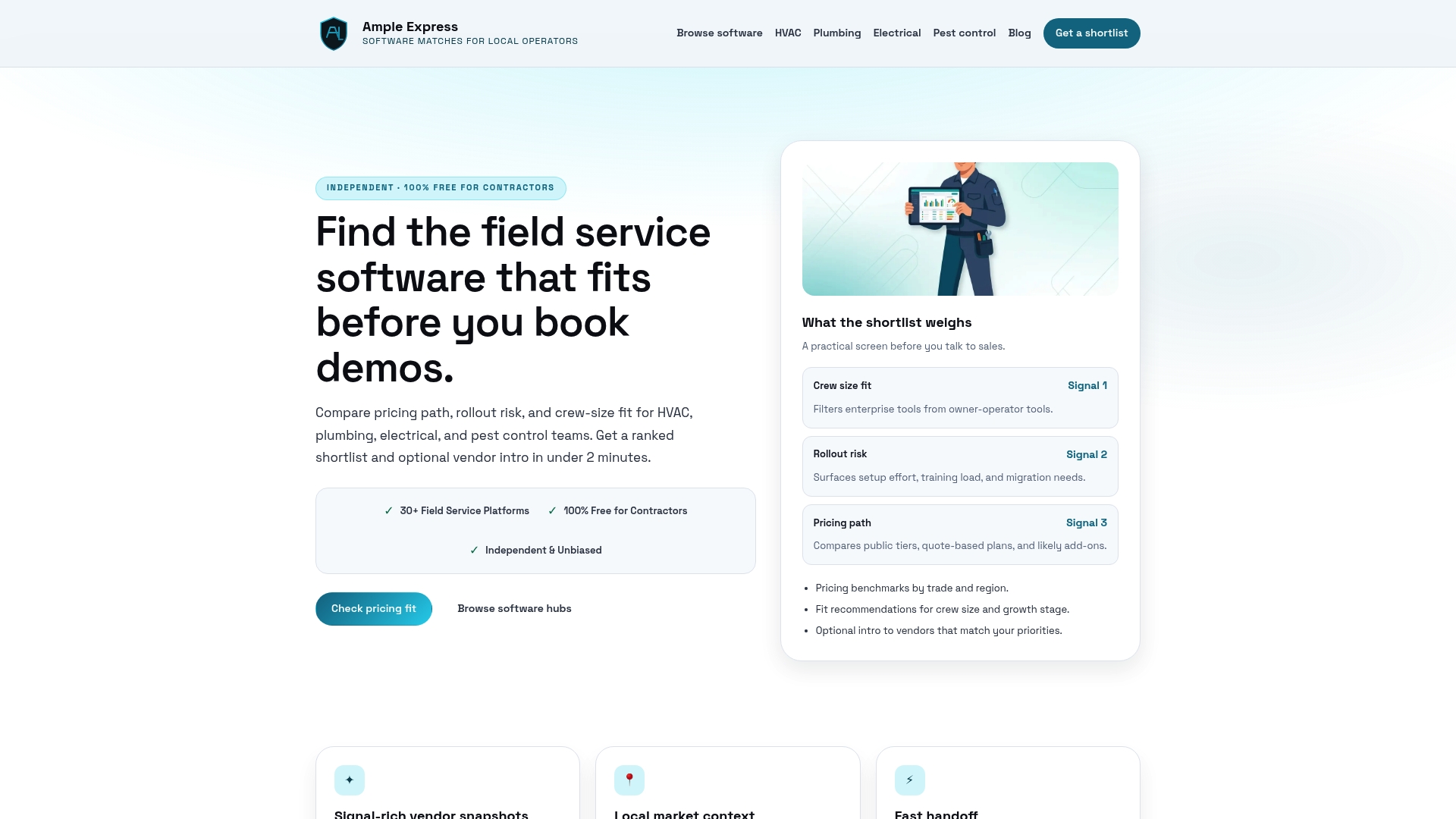
Ampleexpress does that work for you. The platform provides a ranked shortlist of field service software by trade, covering HVAC, plumbing, electrical, and pest control teams, with each option filtered by pricing model, crew size fit, and rollout risk. You can see which platforms use flat-rate versus per-technician pricing, which carry high implementation costs, and which are built for teams your size. Share your crew size and priorities, and Ampleexpress returns a shortlist tailored to your operation, not a generic top-ten list. Visit Ampleexpress to compare your options and get a fit recommendation built around your actual budget and team.
FAQ
What is the most common field service platform pricing model?
The subscription-plus-add-on model is the most common structure in 2026, combining a base per-user or tiered monthly fee with optional modules for scheduling, marketing, and integrations. Platforms like FieldBuddy and Microsoft Dynamics 365 both use this approach.
How much does field service software typically cost per month?
Costs range from $199 per month for flat-rate plans like FieldServicePro to $3,000 or more per month for per-technician platforms like ServiceTitan at scale. Enterprise platforms like Microsoft Dynamics 365 run $105 per user per month before add-ons.
What hidden costs should I budget for when buying field service software?
Implementation fees, data migration, training, and add-on modules are the most common hidden costs. ServiceTitan implementation alone can run $5,000 to $50,000, and enterprise platforms like Dynamics 365 can exceed $250,000 for complex deployments.
Is flat-rate pricing better than per-technician pricing?
Flat-rate pricing offers cost predictability and protects against scaling penalties as you add technicians. Per-technician pricing gives you more flexibility to pay only for active users but becomes expensive quickly as your team grows past 10 to 15 technicians.
How do I compare field service software pricing models effectively?
Calculate your total cost at your projected 12-month team size, not your current headcount. Include implementation fees, add-ons, and annual versus monthly billing differences. Use a comparison tool like Ampleexpress to filter platforms by pricing model and crew size fit.
Recommended
- Pest Control field service software
- Get a Pest Control software shortlist
- Software Pricing Benchmarks for Service Businesses (2026)
- Field Service Growth Blog | Ample Express
- Service Fusion pricing guide for electrical companies | Ample Express
- Service Fusion pricing guide for plumbing companies | Ample Express