
Plumbing Software ROI Calculation Guide for Contractors
Calculate plumbing software ROI from labor savings, inventory recovery, faster payments, and rollout costs before choosing a field service platform.
May 29, 2026
Article

Plumbing software ROI is defined as the measurable profit return generated when software investment reduces labor waste, closes billing gaps, and accelerates cash collection across your job volume. This plumbing software roi calculation guide gives you the exact cost components, formulas, and real-world benchmarks to determine whether a platform like ServiceTitan or InvoiceASAP pays for itself and by how much. The calculation covers both gross margin improvements at the job level and net margin gains after overhead, because both margins matter to your actual take-home profit.
What are the key cost components for calculating plumbing software ROI?
ROI analysis starts with an honest breakdown of what each job actually costs you. Without this baseline, any software benefit estimate is guesswork.
Direct job costs are the expenses tied to a specific work order:
- Labor: Total hours multiplied by your burdened labor rate, which includes wages, payroll taxes, workers' compensation, and benefits
- Materials and parts: Every fitting, pipe, valve, and consumable used on site
- Permits: Pull fees vary by municipality but belong in the job cost, not overhead
- Subcontractors: Any specialty trade work you pass through
- Equipment: Rental or depreciation on tools used for that specific job
Overhead costs are fixed and semi-fixed expenses that run regardless of job volume:
- Truck payments, fuel, and vehicle insurance
- Office rent and utilities
- Administrative staff salaries
- Marketing and advertising spend
- Software subscriptions and technology fees
- General liability insurance
Gross margin for plumbing jobs typically falls between 55% and 62%, but net margin after overhead can drop sharply depending on your fixed cost load. A shop running $40,000 per month in overhead needs to hit breakeven at roughly 48 jobs per month before any profit appears. At a normal volume of 160 jobs per month, that same shop can generate two to three times its breakeven profit. This gap between gross and net is exactly where software ROI lives.
Contractors often misread ROI because they measure only gross margin improvements without subtracting overhead costs including software subscription fees. Net margin is the honest number.
Pro Tip: Build a simple monthly overhead register in a spreadsheet before you model any software benefit. List every fixed cost line by line, total it, and divide by your average monthly job count. That per-job overhead figure becomes your ROI baseline.
How to quantify software benefits affecting margins
Software affects your margins through three primary channels: labor efficiency, inventory accuracy, and payment speed. Each one is measurable if you know what to track.
- Quantify labor efficiency gains. Pull your last 90 days of job records and calculate average labor hours per job type. After software deployment, track the same metric. Scheduling tools, mobile dispatch, and digital job history reduce drive time and eliminate duplicate data entry. Incremental labor savings of even 30 minutes per job scale to significant gross margin gains when multiplied across 160 monthly jobs. At a $75 burdened labor rate, 30 minutes saved per job across 160 jobs equals $6,000 in recovered margin every month.
- Measure inventory and parts recovery. Manual parts tracking creates two profit leaks: lost materials that never get billed and double purchases caused by poor stock visibility. Digital inventory tracking recovers 23% more material costs on average compared to manual methods. For a shop spending $15,000 per month on parts, that is $3,450 in previously unbilled or wasted materials now captured as revenue.
- Calculate faster payment impact. InvoiceASAP data shows invoice-to-payment time can drop from 15 days to 1 day when technicians collect payment on site. Faster collection reduces your working capital requirement and eliminates the cost of chasing receivables. Technician admin time also dropped 40% in the same case, freeing field hours for billable work.
- Include sales enablement gains. Software modules that coach technicians on upsells and service agreements directly increase average ticket size. Sales enablement ROI depends on close rate and ticket size improvements, not just admin time savings. Include both in your ROI worksheet.
- Factor in scheduling efficiency. Optimized routing cuts travel time. InvoiceASAP users reported travel time reductions of 20%, which translates directly into more jobs completed per technician per day without adding headcount.
Pro Tip: Track each benefit category separately for the first 60 days after software launch. Combining all gains into one number makes it impossible to identify which features are driving results and which need configuration adjustments.
Which formulas and metrics are essential for calculating plumbing software ROI?
The standard return on investment formula applies directly to software evaluation:
ROI = (Net Benefits Gained – Software Cost) / Software Cost × 100
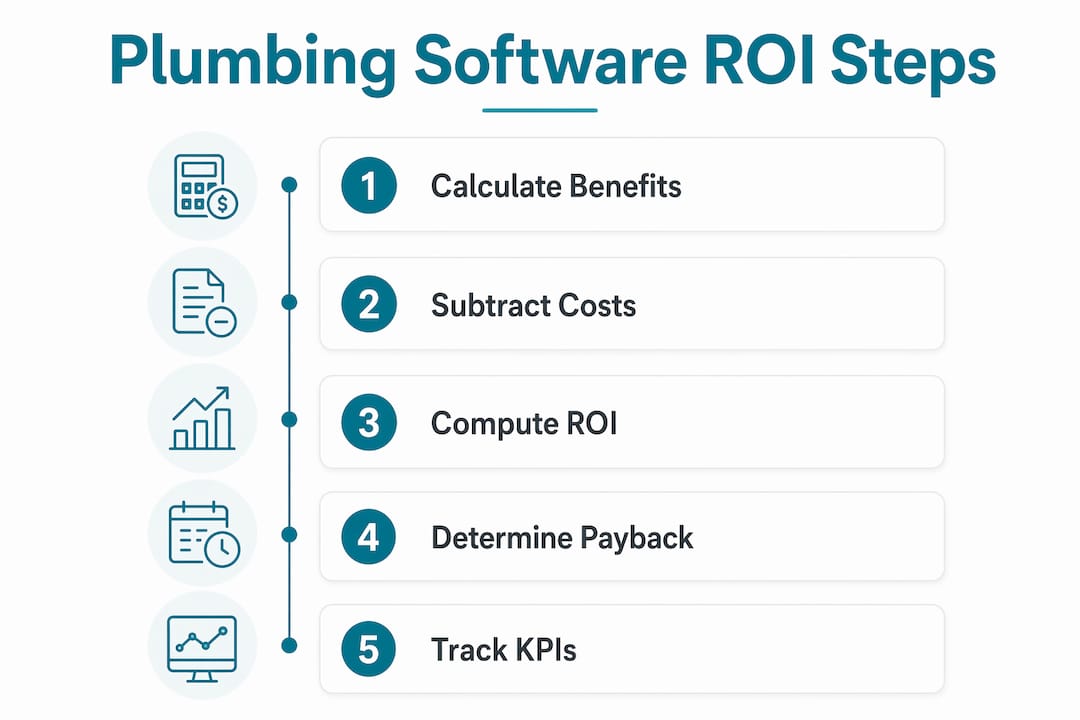
To make this formula work for your plumbing business, you need to convert operational improvements into dollar values. Here is how to model each component:
| Metric | How to calculate it |
|---|---|
| Labor savings per month | (Minutes saved per job ÷ 60) × burdened rate × monthly job count |
| Inventory recovery per month | Monthly parts spend × 0.23 (industry recovery rate) |
| Payment acceleration value | (Old payment days – New payment days) × average daily receivables |
| Sales enablement gain | Close rate improvement × average ticket size × monthly lead count |
| Software cost per month | Subscription fee + implementation time cost + training hours |
Once you have monthly net benefits and monthly software cost, calculate your payback period by dividing total software cost (including setup) by monthly net benefit. A platform costing $500 per month that generates $2,500 in monthly benefit has a payback period of less than one month on recurring costs.
Effective ROI calculation requires mapping software features to measurable KPIs like job volume, close rates, and invoice payment speed. Without that mapping, you are estimating rather than calculating.
Key metrics to track monthly:
- Gross margin per job by job type
- Net margin after overhead allocation
- Average invoice-to-payment days
- Parts billed versus parts purchased ratio
- Jobs completed per technician per day
For ServiceTitan pricing context relative to these benefit projections, verify your per-user cost before finalizing the denominator in your ROI formula.
What do industry benchmarks and real-world case studies show?
Real contractor outcomes give your ROI projections a credibility check. These are not projections. They are documented results.
"Vector Services went from $3.9M in revenue to a projected $9.3M between 2023 and 2026 after switching to ServiceTitan, with average revenue increasing 21% in the first two years."
The Vector Services result was driven by faster estimating, optimized routing, and on-site payment acceptance. Each of those improvements maps directly to the benefit categories in the formulas above. The field service software ROI in their case came from top-line revenue growth combined with a shorter cash cycle, not from cost cutting alone.
Chesapeake Electric provides a different angle. A 10% improvement in close rate through software-enabled coaching and process adherence produced an estimated $40,000 annual benefit per technician. For a plumbing shop with five technicians, that same close rate improvement would represent $200,000 in annual revenue gain. The software cost becomes almost irrelevant at that scale.
On the inventory side, 23% higher material cost recovery using digital tracking is a consistent benchmark across field service businesses. For a mid-sized plumbing operation spending $20,000 per month on materials, that is $4,600 per month in previously lost revenue now captured.
Profitability Partners benchmarks confirm that a shop at 160 jobs per month with $40,000 in monthly overhead sits well above breakeven, but every percentage point of margin improvement at that volume compounds quickly. A 2% net margin gain on $400,000 in monthly revenue is $8,000 per month in additional profit.
For plumbing software options that match your crew size and job volume, comparing platforms against these benchmarks gives you a realistic ROI target before you commit.
How to run a step-by-step ROI calculation for your plumbing business
Follow this process to move from raw data to a defensible ROI number:
- Measure your baseline. Pull 90 days of job records. Calculate average labor hours, parts cost, and gross margin per job type. Record your current invoice-to-payment average and monthly overhead total.
- Pilot inventory tracking on one truck for two weeks. Start inventory ROI analysis with a single truck before scaling. Count lost parts, double purchases, and unbilled materials. This gives you a real leak rate, not an industry estimate.
- Estimate labor time savings. Review the scheduling and dispatch features of your target software. Calculate how many minutes per job you expect to save on routing, paperwork, and data entry. Multiply by your burdened rate and monthly job count.
- Model gross and net margin improvements. Use the formulas from Section 4 to project monthly benefit totals. Subtract the full software cost including setup, training, and your time investment during rollout.
- Run three scenarios. Build a conservative case (50% of projected benefits realized), a base case (75%), and an optimistic case (100%). This range tells you the minimum ROI you can expect if adoption is slow and the upside if your team executes well.
| Scenario | Monthly benefit | Monthly software cost | Monthly net ROI |
|---|---|---|---|
| Conservative | $1,500 | $500 | $1,000 |
| Base case | $2,250 | $500 | $1,750 |
| Optimistic | $3,000 | $500 | $2,500 |
Pro Tip: Review your Austin plumbing software benchmarks or your local market data before setting benefit assumptions. Regional labor rates and parts costs affect every line in your ROI model.
Key takeaways
Plumbing software ROI is calculated by converting labor savings, inventory recovery, and faster payments into monthly dollar benefits, then subtracting total software cost to produce a net return figure.
| Point | Details |
|---|---|
| Start with net margin, not gross | Subtract all overhead costs from job revenue before measuring software impact. |
| Pilot before you scale | Run a two-week single-truck inventory test to establish real leak rates before full deployment. |
| Map features to KPIs | Link each software feature to a measurable metric like close rate, invoice days, or parts recovery. |
| Use real benchmarks | Vector Services' 21% revenue gain and Chesapeake Electric's $40,000 per-technician benefit set realistic ROI targets. |
| Model three scenarios | Build conservative, base, and optimistic projections to understand your minimum acceptable ROI. |
What I've learned about ROI calculations that most contractors skip
Most contractors I talk to focus on the gross margin number and stop there. That is the single most common mistake in any plumbing software profitability guide. Your gross margin looks healthy at 58%, but after $40,000 in monthly overhead, your net margin can be razor thin. Software that improves gross margin by 3% while adding $500 per month in subscription cost is still a net positive, but only if you do the full math.
The second mistake is skipping the pilot phase. Contractors buy a platform, roll it out across the entire fleet, and then wonder why adoption is poor and the ROI never materializes. A two-week single-truck pilot on inventory alone will tell you more about your actual leak rate than any vendor demo. That data becomes the foundation of a credible ROI model.
Technician buy-in is the variable that no formula captures. A platform with strong features but poor field adoption delivers a fraction of its projected ROI. Involve your lead technicians in the evaluation process. Let them test the mobile app. Their feedback shapes adoption, and adoption drives results.
The contractors who see the strongest software investment return are not necessarily the ones who chose the most feature-rich platform. They are the ones who measured their baseline, ran a structured pilot, and held their team accountable to the new process. The software is the tool. The discipline is the multiplier.
— Blake
Find the right plumbing software for your ROI goals
Ampleexpress evaluates over 30 field service software options ranked by crew size, pricing path, and rollout risk, so you can match a platform to the specific ROI drivers in your business. Whether your priority is inventory recovery, faster invoicing, or sales enablement, the Ampleexpress shortlist shows you which tools deliver on each metric and what they cost in your market. Share your crew size and top priorities, and you get a tailored recommendation that cuts vendor selection time and reduces the risk of a costly mismatch. Check Housecall Pro pricing or compare the full field service catalog to start building your ROI case today.
FAQ
What is the basic formula for plumbing software ROI?
ROI equals net monthly benefits minus software cost, divided by software cost, multiplied by 100. Net benefits include labor savings, inventory recovery, faster payment value, and sales enablement gains.
How long does it take to break even on plumbing software?
Payback period depends on your job volume and which benefits you capture first. Shops that prioritize on-site payment collection and inventory tracking typically see payback within one to three months.
Why does net margin matter more than gross margin for ROI?
Gross margin excludes overhead costs like truck payments, insurance, and software fees. Net margin subtracts all overhead, giving you the true profit figure that software improvements must beat to justify the investment.
How much can digital inventory tracking improve material cost recovery?
Contractors using digital tracking recover 23% more material costs on average than those using manual methods. On $15,000 in monthly parts spend, that is $3,450 in previously unbilled or lost materials recovered each month.
What KPIs should I track to measure plumbing software ROI accurately?
Track gross margin per job type, net margin after overhead, average invoice-to-payment days, parts billed versus parts purchased ratio, and jobs completed per technician per day. These five metrics cover every major software benefit category.
Recommended
- austin Plumbing software guide | Ample Express
- Best Plumbing Field Service Software (2026) - Compare Top Tools
- Servicetitan pricing guide for plumbing companies | Ample Express
- chicago Plumbing software guide | Ample Express