
Affordable Plumbing Dispatch Tools Examples for Small Teams
Discover affordable plumbing dispatch tools examples perfect for small teams. Get real-time tracking, mobile invoicing, and flat-rate pricing!
July 19, 2026
Article

Affordable plumbing dispatch tools are field service management apps built specifically for plumbing contractors, delivering real-time GPS tracking, mobile invoicing, and flat-rate pricing without per-user fees. The industry standard for small teams in 2026 puts solo plans as low as $19/month and small-team plans between $39 and $150 monthly. That pricing range matters because enterprise-grade platforms routinely charge $1,800 or more per month plus thousands in setup fees, making them the wrong fit for a crew of two to ten technicians. The right budget plumbing tools cover scheduling, dispatch, and invoicing in one subscription with no surprise add-ons. This guide covers the features that matter, real pricing examples, and how to match a tool to your crew size.
What essential features must affordable plumbing dispatch tools include?
The best affordable plumbing dispatch tools examples share a core set of features that separate plumber-first software from generic field service apps. Generic tools force manual workarounds within months because they lack plumbing-specific features like shutoff location tracking, recurring maintenance plans, and emergency triage. Verify these capabilities before you subscribe.
Real-time GPS tracking and emergency dispatch

Real-time GPS tracking lets your office identify the nearest certified plumber the moment an emergency call comes in. Effective dispatch tools triage emergency calls by instantly routing the closest qualified technician and sending automated ETA updates to the customer. That combination cuts response time and protects your reputation on urgent jobs.
Mobile invoicing and same-day payments
Mobile invoicing closes the gap between job completion and payment. Platforms with strong invoicing modules have reduced invoice aging from 34 days to 6 days for plumbing businesses. That is a cash flow improvement most small contractors feel immediately.
Flat-rate price books and QuickBooks sync
A built-in flat-rate price book prevents technicians from quoting inconsistent prices in the field. QuickBooks sync pushes completed invoices directly into your accounting software, eliminating double entry. Both features belong in the base subscription, not as paid add-ons.
Offline-capable mobile apps
Plumbers regularly work in basements, crawl spaces, and rural areas with poor cell coverage. An offline-capable mobile app lets technicians document work orders, capture photos, and generate invoices without a signal. The data syncs automatically when connectivity returns.
Automated after-hours lead capture
Missed calls after 5:00 PM cost real revenue. Automated after-hours answering captures lead details, confirms appointment windows, and sends confirmation texts without a live dispatcher. This feature alone can pay for a monthly subscription many times over.
Pro Tip: Before signing up, open the mobile app on your phone and simulate a job with no Wi-Fi. If the app freezes or loses data, walk away. Field usability is the single most important test for any plumbing dispatch tool.
Pricing models and examples of budget-friendly dispatch tools
Plumbing dispatch software pricing falls into three clear tiers, and understanding each tier helps you avoid overpaying.
- Solo and husband-wife team plans ($19–$39/month). These entry-level plans cover one or two users with scheduling, dispatch, and basic invoicing. They suit owner-operators who handle their own calls and want digital job tracking without a large monthly commitment. The tradeoff is limited technician seats and fewer automation features.
- Small-team flat-rate plans ($39–$150/month). This tier targets crews of 2–10 technicians and typically includes unlimited job creation, GPS tracking, mobile invoicing, and a flat-rate price book. The defining feature is a flat monthly fee regardless of how many technicians you add. That structure means hiring an apprentice does not trigger a higher bill.
- All-in-one subscriptions with no per-user fees. The strongest value in plumbing management tools comes from platforms that bundle GPS, invoicing, inventory, and automated communication into one price. These subscriptions give you full cost visibility from day one. Hidden costs for GPS tracking, AI answering, and payment processing are the most common source of bill shock, so all-in-one pricing is worth prioritizing.
- Enterprise platforms ($1,800+/month plus setup). Enterprise solutions are built for large fleets and carry steep learning curves. They are the wrong fit for small plumbing shops. The setup fees alone can exceed $5,000, and the feature depth creates complexity your team does not need.
- Per-user pricing models (avoid for growing teams). Some platforms charge $25–$75 per technician per month. That model works when you have one or two techs, but it becomes expensive fast. A team of six technicians on a $50-per-user plan pays $300 monthly before any add-ons. A flat-rate plan at $99/month for unlimited users is the better deal at that crew size.
The clearest signal of a well-priced tool is a published pricing page with no asterisks. If a vendor requires a sales call to reveal pricing, expect per-user fees and upsells.
Pro Tip: Use Ampleexpress's software cost calculator to model your total monthly spend across different crew sizes before committing to any platform.
How to evaluate dispatch tools beyond the sticker price
Price is the starting point, not the finish line. A $39/month plan that lacks offline capability or emergency triage costs you more in lost jobs than a $99/month plan that covers both.
Run a free trial with real job scenarios
Testing with a free trial before subscribing is the single most effective way to avoid a costly mistake. Create a test job, dispatch it to a technician's phone, generate an invoice, and sync it to QuickBooks. If any step requires a workaround, that friction will multiply across every job you run.
Verify what the base price actually includes
Build a checklist of the features your crew uses daily: GPS tracking, flat-rate price book, mobile invoicing, inventory management, and automated customer notifications. Then confirm each one is included in the advertised base price. Hidden add-on costs for GPS, AI answering, and payment processing inflate the real monthly cost well beyond the headline number.
Evaluate the pricing structure as your team grows
A tool that costs $49/month for two technicians might cost $250/month for eight if it uses per-user pricing. Map out your expected crew size 12 months from now and calculate the projected cost at that scale. Avoiding per-user pricing tiers protects your budget as you add apprentices or seasonal staff.
| Evaluation criterion | What to check |
|---|---|
| Base price transparency | Is full pricing published without a sales call? |
| Feature inclusion | Are GPS, invoicing, and inventory in the base plan? |
| Offline functionality | Does the mobile app work without cell service? |
| Scalability | Does the price stay flat as you add technicians? |
| Free trial availability | Can you test real job scenarios before subscribing? |
Pro Tip: Ask the vendor directly: "What is my total monthly cost for eight technicians including GPS and payment processing?" A vendor that cannot answer clearly is one to avoid.
Which tool type fits your operation size?
The right dispatch tool depends on your current crew size and where you expect to be in 18 months. Matching tool type to team size prevents both overspending and outgrowing your software too quickly.
- Solo operators and owner-operators. A solo plan at $19–$39/month covers everything a one-person shop needs: job scheduling, dispatch, mobile invoicing, and basic customer communication. Avoid paying for multi-technician features you will not use.
- Husband-wife teams and two-tech crews. Look for a flat-rate plan that includes two technician seats, GPS tracking, and a flat-rate price book. The priority is ease of use. Software complexity causes failure in the transition from paper to digital when apps are hard to use in the field.
- Small teams of 3–10 technicians. This crew size benefits most from all-in-one flat-fee platforms that include dispatch, invoicing, and inventory without per-user charges. Emergency triage dispatch becomes critical at this scale because you have multiple trucks to coordinate.
- Growing mid-size teams of 10–15 technicians. Unlimited-user flat-rate plans are the right structure here. Per-user fees at this crew size add up to hundreds of dollars monthly. Prioritize platforms with route optimization and recurring maintenance contract management.
- High-volume, multi-truck operations. Operations running 15 or more trucks need enterprise-level solutions with advanced reporting and fleet management. Expect significantly higher costs and longer implementation timelines. Budget for training and a dedicated rollout period.
Anticipate your growth before you sign a contract. Switching platforms mid-growth is expensive and disruptive. Choose a tool that fits your crew today and has a clear upgrade path for where you are headed.
Key Takeaways
The most cost-effective plumbing dispatch tools combine flat-rate pricing, offline mobile capability, and plumbing-specific features like emergency triage and shutoff tracking in one base subscription.
| Point | Details |
|---|---|
| Pricing tiers by crew size | Solo plans start at $19/month; small-team flat-rate plans run $39–$150/month. |
| Avoid per-user fees | Flat-rate subscriptions protect your budget as you add technicians or apprentices. |
| Verify feature inclusion | Confirm GPS, invoicing, and inventory are in the base price before subscribing. |
| Test before you commit | Run a free trial with real job scenarios to confirm field usability and offline capability. |
| Match tool to team size | Solo operators, small teams, and growing mid-size crews each need a different pricing structure. |
What I have learned from watching small plumbing shops pick the wrong software
The most common mistake I see small plumbing contractors make is choosing a platform based on a demo video rather than a field test. A polished interface on a laptop means nothing if the app stalls when a technician is in a basement with no signal.
The second mistake is underestimating how fast per-user fees compound. A contractor who starts with three techs and grows to eight pays more than double on a per-user plan. That money disappears from profit without adding a single new capability.
My honest recommendation: start with the smallest plan that covers your actual daily workflow, run it for 30 days, and measure whether it reduces your invoice aging and dispatch response time. If it does both, you have the right tool. If it does not, the free trial saved you from a year-long contract.
Flat-rate pricing is not just a budget preference. It is a planning tool. When your monthly software cost is fixed, you can calculate your true cost per job and price your services accordingly. That clarity is worth more than any feature a vendor demos in a sales call.
— Blake
How Ampleexpress helps plumbing contractors find the right fit
Choosing between dozens of plumbing dispatch platforms takes time most contractors do not have. Ampleexpress evaluates over 30 field service software options and ranks them by crew size, pricing structure, and rollout risk, so you get a shortlist built for your operation rather than a generic list.
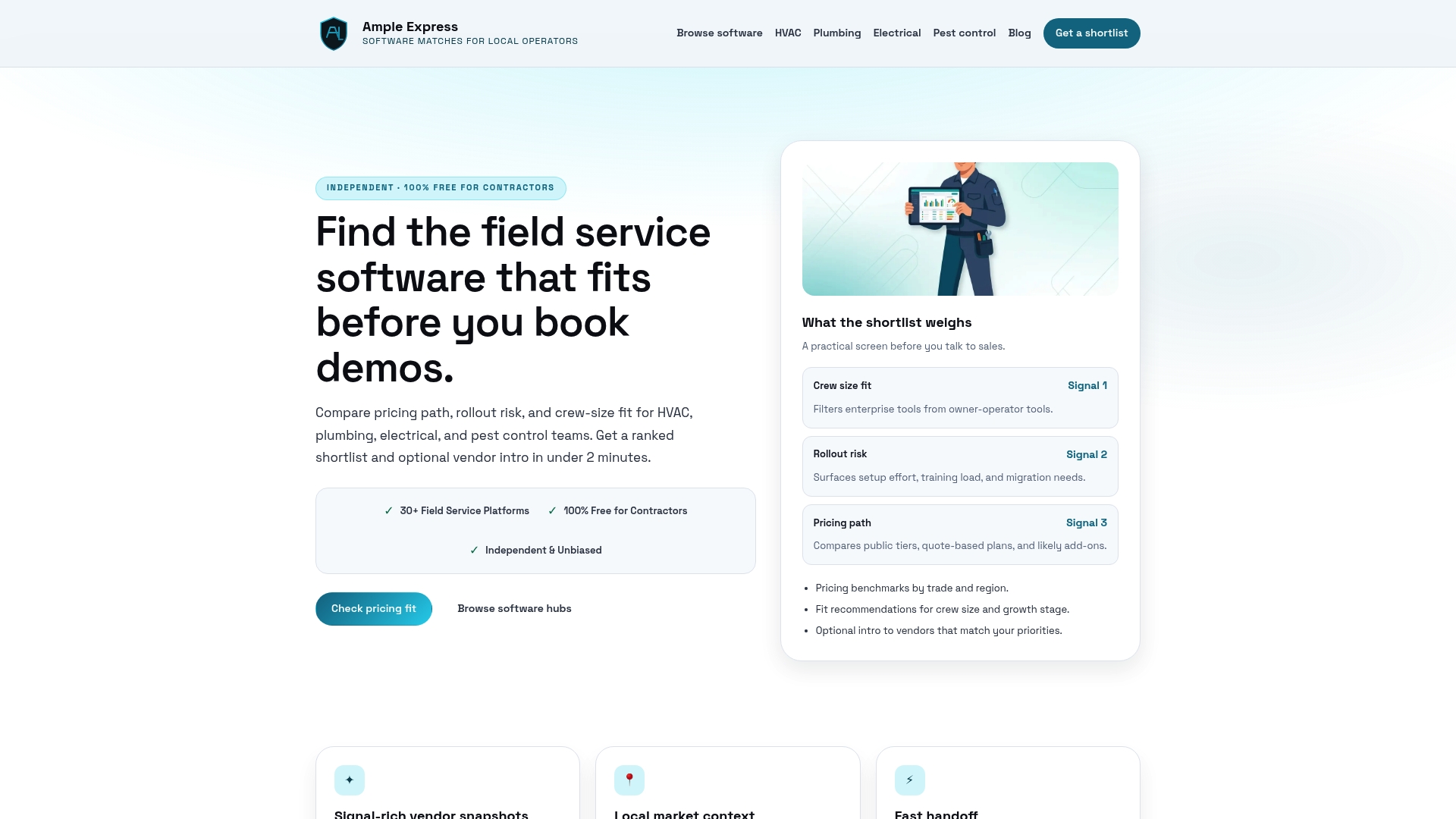
Ampleexpress provides regional pricing benchmarks and crew size trends that show you what similar plumbing businesses in your market are paying. You can also use the software cost calculator to model your exact monthly spend before talking to any vendor. Share your crew size and top priorities, and Ampleexpress returns a ranked shortlist with transparent pricing paths and fit recommendations tailored to plumbing contractors.
FAQ
What do affordable plumbing dispatch tools typically cost?
Solo-focused plans start at $19/month, while small-team plans for 2–10 technicians typically run $39–$150/month with flat-rate pricing. Enterprise solutions cost $1,800 or more per month and are not suited for small plumbing shops.
What features should a budget plumbing dispatch tool include?
The core features are real-time GPS tracking, mobile invoicing, a flat-rate price book, QuickBooks sync, and an offline-capable mobile app. Emergency triage dispatch and automated after-hours lead capture are also standard expectations for 2026 tools.
Why should small plumbing teams avoid per-user pricing?
Per-user fees escalate quickly when you add apprentices or seasonal staff. A flat-rate subscription keeps your monthly cost predictable regardless of how many technicians you dispatch.
How do I know if a dispatch tool is truly all-in-one?
Ask the vendor to confirm that GPS tracking, inventory management, and payment processing are included in the base price. Hidden add-on costs for these modules are the most common source of unexpected monthly charges.
When should a plumbing business upgrade to a more advanced platform?
Upgrade when your current tool cannot handle route optimization, recurring maintenance contracts, or multi-truck coordination without manual workarounds. Plan the switch before you hit that ceiling, not after, to avoid disruption during a busy season.