
Software Vendor Selection: A Decision-Maker's 2026 Guide
Discover what software vendor selection is and how to make informed decisions to avoid costly mismatches in your organization in 2026.
June 11, 2026
Article

Software vendor selection is the formal, data-driven process of evaluating and choosing a software vendor based on defined business needs, budget, compliance standards, and growth objectives. Done well, it reduces the risk of costly mismatches between your organization and the tools you depend on. Done poorly, it produces failed implementations, wasted budgets, and teams stuck with software that doesn't fit how they actually work. The process typically includes defining requirements, setting evaluation criteria, shortlisting candidates, running scenario-based demos, and scoring vendors with a weighted matrix. Tools like vendor scorecards, RFIs (Requests for Information), and RFPs (Requests for Proposal) are standard instruments in any structured selection process.
What is software vendor selection and why does it matter?
Software vendor selection is defined as a structured evaluation process that moves an organization from a broad market of potential vendors to a single, defensible choice aligned with operational and strategic needs. The industry term for the broader discipline is vendor assessment, and it covers everything from initial market scanning to final contract negotiation.
The stakes are real. Poor vendor and solution fit is one of the leading causes of ERP project failure, with Gartner research consistently flagging misalignment between business requirements and software capabilities as a primary driver of overruns and abandonment. That pattern repeats across field service software, CRM platforms, and workforce management tools. Selecting the wrong vendor doesn't just cost money upfront. It costs months of retraining, lost productivity, and the political capital required to restart the process.

For field service contractors, HVAC operators, and project managers running multi-crew operations, the importance of software vendor selection is especially direct. Your dispatch workflows, job history tracking, and parts standardization all depend on software that fits your crew size and operational model. A mismatch at the vendor selection stage creates friction at every level of daily operations.
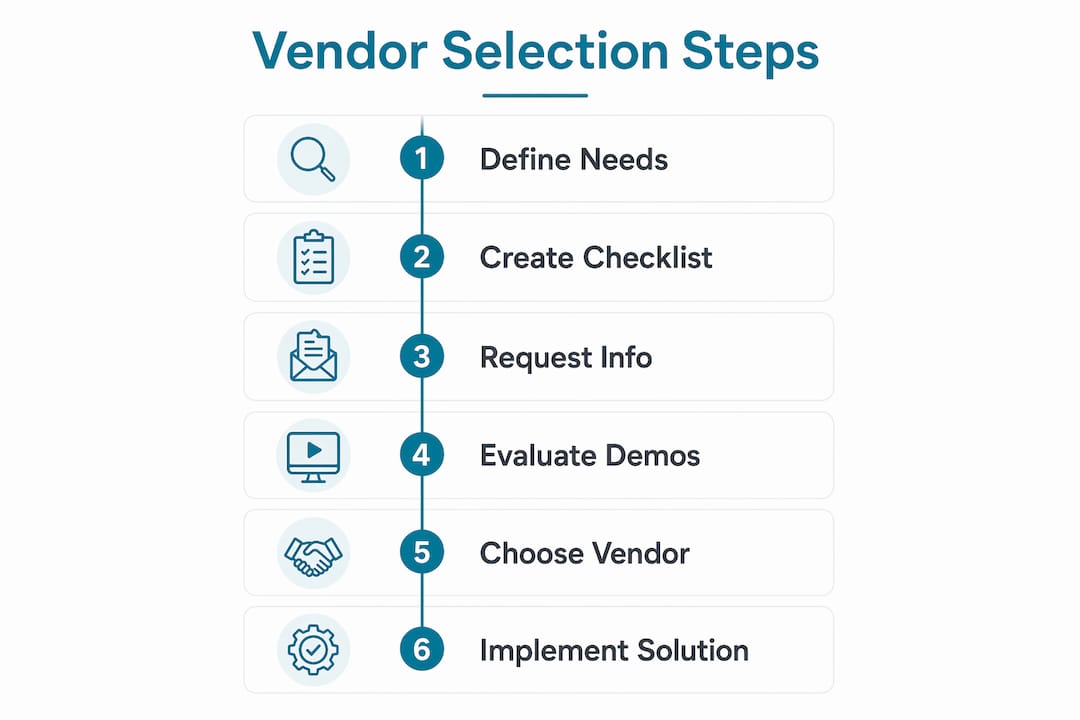
What are the key steps in the software vendor selection process?
A structured software selection process follows a defined sequence. Skipping steps or reordering them is the most common cause of evaluation drift and split-committee deadlock.
- Define business needs and goals. Document your functional requirements (what the software must do) and operational requirements (how it must perform in your environment). Be specific. "Better scheduling" is not a requirement. "Automated dispatch for crews of 8 to 15 technicians with GPS tracking" is.
- Set measurable evaluation criteria. Assign weight to each criterion based on business impact. Compliance certifications, integration with existing tools, and scalability typically rank as must-haves. Reporting dashboards and mobile UX are often nice-to-haves. Locking these weights before demos prevents cost from dominating the final decision.
- Build a longlist, then shortlist with an RFI. Use an RFI as a market assessment tool to generate enough information for a sensible shortlisting decision. The goal is to move from a broad market to a focused group of 4 to 6 vendors. An RFI is not an internal document. It goes to vendors and asks them to confirm capability against your requirements.
- Run qualification calls before full demos. A 30-minute qualification call focused on must-haves, pricing, and implementation details lets vendors self-select and narrows your shortlist efficiently. This step alone can eliminate two or three vendors before you invest time in full demonstrations.
- Conduct scenario-based demos. Provide vendors with a scenario document before the demo. Score them on how well they demonstrate your specific use cases, not on how polished their standard presentation looks. Use a consistent rubric across all vendors.
- Apply a weighted scorecard. Weighted scoring produces a defensible recommendation and prevents any single factor, especially cost, from dominating the outcome. Average scores across evaluators to reduce individual bias.
- Verify references and compliance. Contact at least two reference customers in your industry or crew size range. Confirm compliance certifications independently, not just from vendor-supplied documentation.
Pro Tip: Build your vendor selection checklist before you contact a single vendor. Ampleexpress publishes a contractor selection checklist that covers scoring criteria and evaluation steps specifically for field service operations.
How to avoid common pitfalls in vendor evaluation
Most vendor evaluations fail not because of bad vendors but because of process failures on the buyer's side. These are the patterns that derail decisions most often.
- Skipping stakeholder alignment on requirements. Early agreement on requirements before demos begin prevents split-committee outcomes and rework. If your operations manager and your IT lead disagree on what "integration" means, that conflict will surface mid-demo and stall the process.
- Running open-ended timelines. A structured evaluation should take approximately six weeks, not six months. Long timelines create evaluation fatigue, allow vendor relationships to influence scoring, and delay operational improvements. Compress the process with a defined schedule and fixed decision dates.
- Shortlisting too many vendors. Limit your shortlist to 3 to 6 vendors. Evaluating 10 vendors produces diminishing returns and exhausts your team. The goal of the RFI stage is to cut the list aggressively before demos begin.
- Letting vendors script the demo. Vendor-scripted presentations do not reflect real usage. Provide scenario documents in advance and require vendors to demonstrate your actual workflows using your data or close approximations.
- Locking scoring weights after demos. Weights set after seeing demos are influenced by what impressed the team, not by what the business actually needs. Lock criteria weights before the first demo runs.
- Allowing gut-feel decisions. Document every scoring decision. Transparency protects the process from political pressure and makes the final recommendation defensible to leadership and to vendors who didn't win.
Pro Tip: If your evaluation is running past six weeks, the most likely cause is an unresolved requirements disagreement, not a vendor problem. Pause, resolve the internal conflict, and restart demos with locked criteria.
Traditional vs. rapid evaluation frameworks: which fits your timeline?
The software vendor evaluation process has two dominant timing models, and choosing between them depends on your project complexity and organizational capacity.
| Framework | Timeline | Best for | Key trade-off |
|---|---|---|---|
| Traditional multi-phase | 3 to 6 months | Complex ERP or enterprise platforms | Thorough but slow; risk of evaluation fatigue |
| 30-day rapid evaluation | 4 to 5 weeks | Mid-market or field service software | Fast but requires pre-aligned requirements |
| Proof of concept (POC) add-on | 5 to 7 business days | High-risk technical integrations | Validates assumptions but can drift if unscoped |
The 30-day rapid framework compresses the traditional process by running RFI and qualification calls in parallel during week one, completing all demos in weeks two and three, and finalizing scoring and reference checks in week four. This model works when requirements are documented before the process starts.
Proofs of concept serve a specific purpose. A POC scoped to 5 to 7 business days tests the riskiest technical assumptions, such as API integration with your existing dispatch system, without expanding into full project planning. Unchecked POC work drifts into weeks of effort and delays the final decision. Scope it tightly or skip it.
Rapid RFI and RFP models can accelerate selection while maintaining evaluation quality. The key is standardized documentation. Every vendor receives the same questions, the same scenario scripts, and the same scoring rubric. Consistency is what makes speed possible without sacrificing defensibility.
For field service contractors evaluating scheduling, dispatch, or job costing software, the 30-day model is typically the right fit. The software category is well-defined, vendor capabilities are comparable, and the primary differentiators are pricing, crew size fit, and regional support. Ampleexpress provides software pricing benchmarks for service businesses that help calibrate your budget expectations before the RFI stage.
What criteria should you use to evaluate software vendors?
Criteria for software vendors fall into two categories: functional requirements (what the software does) and operational requirements (how it performs in your environment). Both matter, and conflating them is a common mistake.
Functional requirements include capabilities like automated dispatch, job history capture, invoicing, parts tracking, and customer communication tools. These are the features your crew uses daily. Score vendors on whether they meet each requirement fully, partially, or not at all.
Operational requirements cover performance, security, compliance certifications, uptime guarantees, and integration with your existing tools. A platform that dispatches well but can't connect to your accounting software creates a manual data transfer problem that costs hours every week.
A data-driven methodology uses standardized documentation and scenario-based demos to quantify vendor compliance, then averages and normalizes scores across evaluators to minimize individual bias. This approach makes the final recommendation comparable and repeatable across future selection cycles.
Vendor relationship and support culture deserve their own scoring dimension. Ask vendors how they handle implementation support, what their average onboarding timeline looks like for your crew size, and how they manage product updates that affect existing workflows. A vendor with strong software but poor support creates long-term operational risk.
When you normalize and average scores across your evaluation team, individual preferences and biases cancel out. The composite score reflects the team's collective judgment, not the loudest voice in the room. That composite score is also what you present to leadership when justifying the final decision.
Pro Tip: Write a one-page post-selection summary documenting which requirements are met, which trade-offs were accepted, and what success looks like at 90 days. This document guides onboarding and reduces contract disputes.
Key takeaways
A structured software vendor selection process, built on locked criteria, scenario-based demos, and normalized scoring, produces faster decisions and better vendor fit than any informal approach.
| Point | Details |
|---|---|
| Define requirements first | Document functional and operational needs before contacting any vendor to prevent mid-process conflicts. |
| Limit your shortlist | Keep the vendor shortlist to 3 to 6 options to avoid evaluation fatigue and maintain scoring quality. |
| Use scenario-based demos | Require vendors to demonstrate your actual workflows, not their standard sales presentation. |
| Lock scoring weights early | Set criteria weights before demos begin to prevent cost or personal preference from skewing results. |
| Document the final decision | A one-page post-selection summary aligns your team and reduces disputes during contract negotiation. |
What I've learned from watching vendor selections go wrong
The most expensive mistake I see organizations make is starting demos before they've finished arguing about requirements. It sounds obvious, but it happens constantly. Two stakeholders walk into a demo with different definitions of "integration," and suddenly the vendor is caught in the middle of an internal debate that has nothing to do with their product.
The second pattern is shortlist inflation. Teams feel obligated to evaluate eight or ten vendors to appear thorough. In practice, evaluating more than six vendors produces diminishing returns and exhausted evaluators who start scoring on autopilot by vendor four. Cut aggressively at the RFI stage. Three strong candidates evaluated rigorously beat ten candidates evaluated carelessly.
I'm also a firm believer in the post-selection summary. Most teams finalize a vendor and immediately move to contract negotiation without documenting why they chose what they chose. Six months into implementation, when a workflow doesn't match expectations, nobody can reconstruct the original trade-off decisions. That one-page document prevents a lot of friction.
Finally, if your organization is a field service contractor evaluating scheduling or dispatch software, your evaluation criteria need to reflect crew size and regional context, not generic enterprise benchmarks. A platform built for 200-person enterprises behaves differently at 12 technicians. Evaluate for your actual operating model.
— Blake
How Ampleexpress helps you select the right field service software
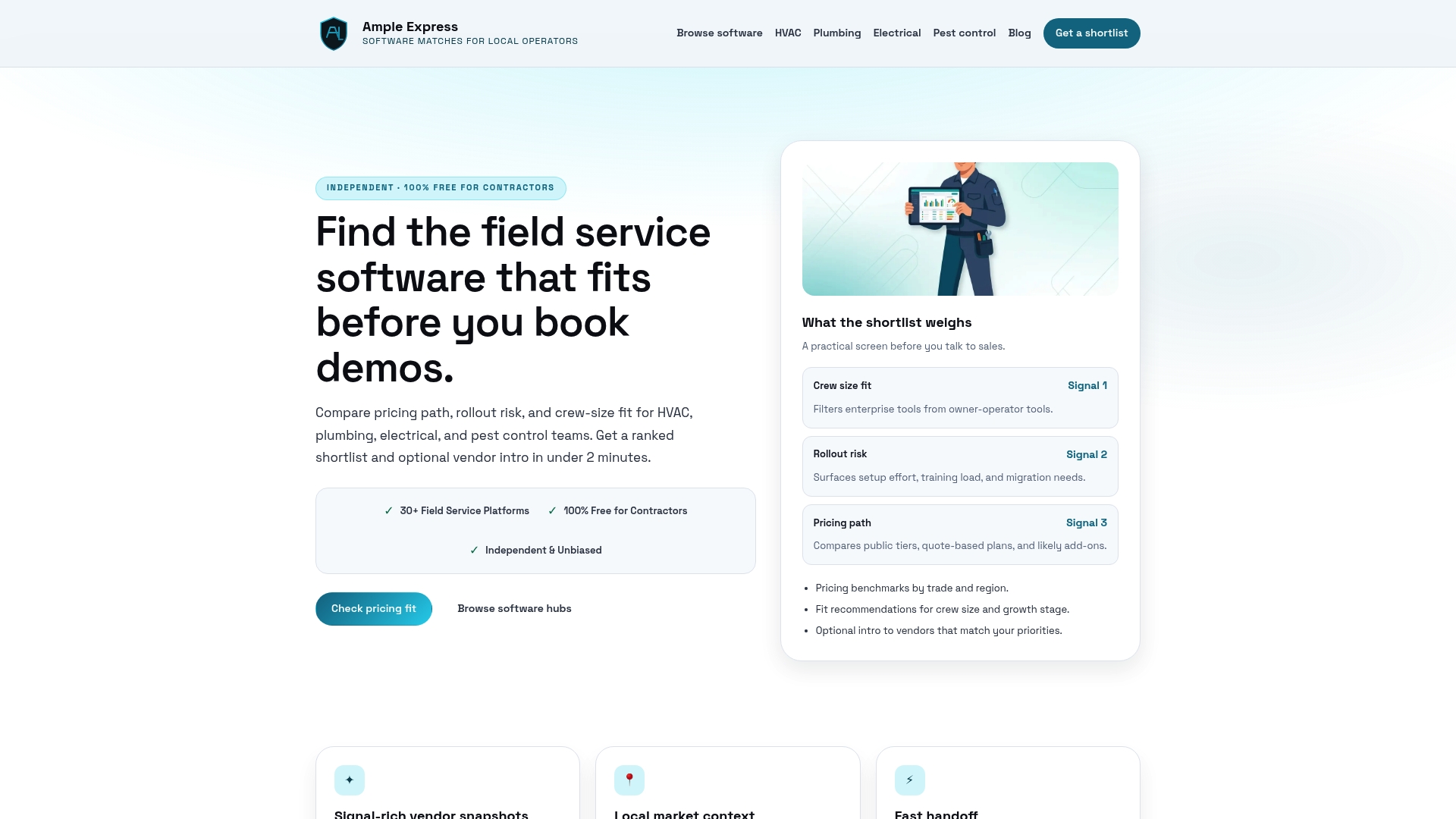
Ampleexpress is built specifically for field service contractors who need a faster, lower-risk path through the vendor selection process. The platform provides a ranked shortlist of over 30 field service software options across HVAC, plumbing, electrical, and pest control, with fit recommendations based on your crew size and operational priorities. Each option includes pricing path details, rollout risk ratings, and regional benchmarks so you evaluate vendors against criteria that actually match your business. Share your crew size and top priorities with Ampleexpress, and you get a shortlist that skips the noise and gets you to a defensible decision faster.
FAQ
What is software vendor selection?
Software vendor selection is the formal process of evaluating and choosing a software vendor based on defined business needs, budget, compliance standards, and growth goals. It typically includes steps like requirements definition, shortlisting, scenario-based demos, and weighted scoring.
How long should the software selection process take?
A structured evaluation should take approximately six weeks when requirements are pre-aligned and the shortlist is limited to 3 to 6 vendors. Complex enterprise implementations may use a longer timeline, while mid-market tools can follow a 30-day rapid framework.
What criteria matter most when evaluating software vendors?
The most critical criteria are functional fit (does it do what your team needs daily), operational requirements (security, compliance, integrations), and vendor support quality. Weight each criterion before demos begin to prevent cost from dominating the final score.
What is a vendor scorecard and why use one?
A vendor scorecard is a weighted matrix that scores each vendor against predefined criteria to produce a defensible, comparable recommendation. It prevents decisions driven by a single factor and gives leadership a transparent basis for the final choice.
What is a proof of concept in vendor selection?
A proof of concept (POC) is a scoped technical test used to validate the riskiest assumptions about a vendor's software, such as API integration or data migration. It should be limited to 5 to 7 business days to avoid drifting into full project planning.
Recommended
- Pest Control field service software
- Get a Pest Control software shortlist
- Contractor Software Selection Checklist for 2026 | Ample Express
- austin Electrical software guide | Ample Express
- Service Fusion pricing guide for hvac companies | Ample Express
- Service Fusion pricing guide for plumbing companies | Ample Express