
How to Negotiate Field Service Software Pricing in 2026
Learn how to negotiate field service software pricing effectively in 2026. Save 15-30% with proven strategies and expert tips!
June 7, 2026
Article

Negotiating field service software pricing is the single most effective way to reduce your software spend without sacrificing the features your crew depends on. Buyers who approach vendors like Salesforce Field Service, ServiceTitan, and Jobber with structured counter-offers consistently secure 15 to 30% off list price, while unprepared buyers pay full rate. The key levers are timing, multi-year commitments, and contract terms. This guide gives you the exact playbook to use each one.
What are the current field service software pricing models and benchmarks?
Field service software pricing follows a per-user, per-month model across nearly every major vendor, but the range is wide. Per-user costs span $39 to $650 depending on the platform and tier you select. That gap is not random. It reflects the difference between entry-level scheduling tools and full enterprise platforms with dispatch automation, contract management, and integrated inventory.
Here is how the three most widely deployed platforms compare as of 2026:
| Platform | Entry Tier | Mid Tier | Enterprise Tier |
|---|---|---|---|
| Salesforce Field Service | $55/user/month | ~$150/user/month | Up to $650/user/month |
| ServiceTitan | $250/user/month | ~$375/user/month | Up to $498/user/month |
| Jobber | $39/user/month | ~$149/user/month | Up to $599/user/month |
These are list prices. No serious vendor expects you to pay them without a conversation. The gap between list price and what you actually pay depends entirely on how you approach the negotiation. A 10-person HVAC team paying $250 per user on ServiceTitan is spending $2,500 per month. A 15% discount saves $375 monthly, or $4,500 annually. That math justifies every hour you put into preparation.
Pricing also shifts based on add-ons. Vendors routinely bundle features like GPS tracking, customer portal access, or advanced reporting into higher tiers, then price them separately at lower tiers. Before you negotiate, map exactly which features your team uses daily versus which ones are included by default. You can review pricing benchmarks by trade to understand what comparable crews are paying in your market.
When is the best time to negotiate field service software pricing?
Timing is the most underused lever in field service software cost negotiation. End-of-quarter windows in March, June, September, and December are when sales reps are most motivated to close deals. In the final week of each quarter, quota pressure peaks and reps have more authority to approve discounts that would otherwise require manager sign-off.

This is not speculation. Software vendors operate on quarterly sales cycles, and their compensation structures reward reps who hit targets by a specific date. A deal that closes on December 28 counts for Q4. The same deal on January 3 counts for Q1. That difference matters enormously to the rep sitting across from you.
Pro Tip: Start your renewal conversation at least six months before your contract expires. Buyers who engage early average around 28% better pricing than those who wait until the final 30 days before renewal, according to structured procurement data.
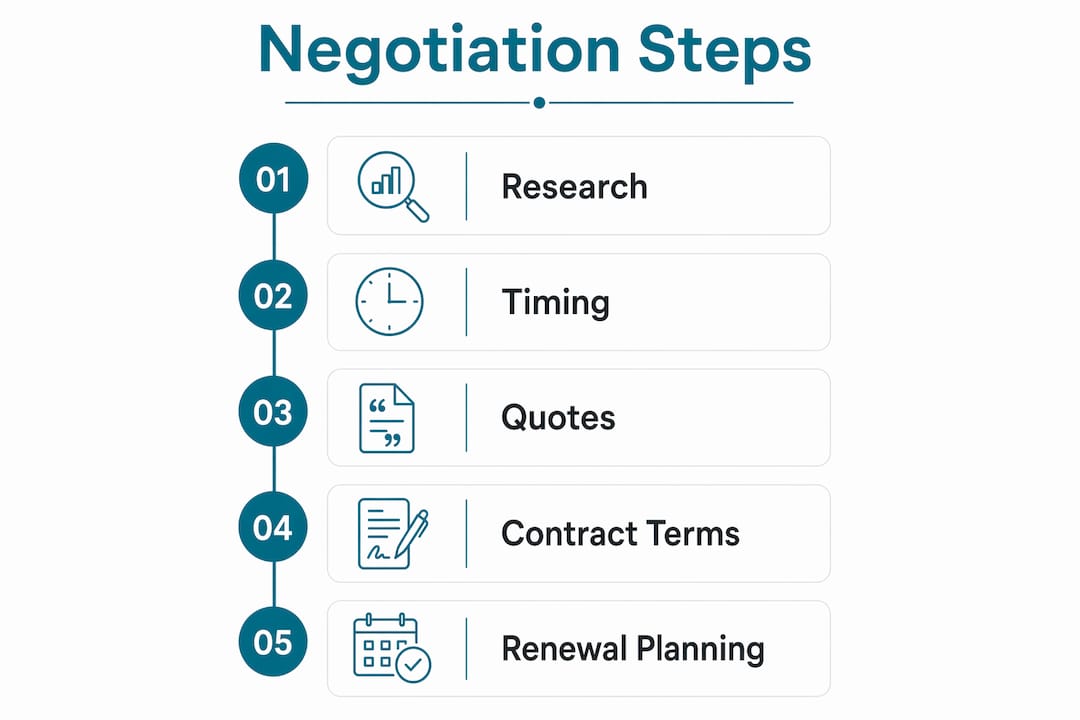
For new purchases, align your buying decision with the vendor's fiscal year end, not your own. Many software companies close their fiscal year in January or June rather than December. A quick search of the vendor's investor relations page or a direct question to your sales rep will confirm the date. Buying in the final two weeks of a vendor's fiscal year gives you maximum leverage.
What negotiation tactics maximize discounts and value?
The most effective field service pricing strategies combine direct discount requests with creative value asks. Here is a structured approach that works across vendors:
- Request a multi-year commitment in exchange for a discount. A two or three-year deal typically unlocks 10 to 25% off list price plus a price lock clause. The vendor gets revenue predictability. You get a lower rate and protection against annual increases.
- Ask for free months instead of percentage discounts. One to two free months in lieu of a direct discount is often easier for a sales rep to approve internally. The financial value is equivalent, but it clears a different budget line on the vendor's side.
- Bundle products and services. If you need dispatch software, scheduling, and a customer portal, negotiate them as a package. Vendors price bundles more aggressively than individual modules because it increases switching costs and total contract value.
- Use competitive quotes as leverage. Get written quotes from at least two alternative platforms before your negotiation call. You do not need to switch. You need the vendor to believe you will.
Beyond discounts, these value-adds are worth requesting in every negotiation:
- Premium support or a dedicated customer success manager at no extra cost
- Free onboarding or implementation assistance (often worth $2,000 to $10,000 depending on crew size)
- Extended trial periods for new modules before they are added to your contract
- Training credits for new technicians added during the contract term
Multi-year deals with price lock clauses generate more predictable savings than single-year discounts because they eliminate compounding annual increases. A three-year deal at 15% off beats a one-year deal at 20% off if the vendor raises rates 8% in year two.
How to prepare for negotiation and avoid common mistakes
Field service software pricing is asymmetric. Vendors negotiate daily; most buyers negotiate infrequently. That gap in experience is the primary reason buyers leave money on the table. Preparation closes it.
Before your first call with a vendor, complete these steps:
- Identify your BATNA. Your Best Alternative To a Negotiated Agreement is the platform you will buy if this deal falls through. Name it. Price it. Know your walk-away number before the conversation starts.
- Engage procurement for large deals. For contracts over $50,000 annually, buying groups average 18 to 22% savings through pre-negotiated terms. If your company has a procurement team, involve them early.
- Set a deadline. Tell the vendor you are making a decision by a specific date. Deadlines create urgency and give the rep a reason to escalate discount approvals internally.
- Counter every initial proposal. Buyers with defined negotiation processes achieve 20 to 28% better pricing than those who accept the first offer. The first proposal is a starting point, not a final number.
The most expensive mistake in software procurement is accepting the first proposal. Vendors build negotiation room into every quote. If you do not ask, you do not get it.
Review the contract itself before signing. Auto-renewal clauses, price escalation terms, and termination rights are where deals that look good on paper become costly over time. Know what you are agreeing to beyond the monthly rate.
How to leverage contract terms for long-term savings
The headline discount is the most visible number in any software deal, but non-price contract terms often save more money over the life of a contract than the upfront discount. A 15% discount paired with a 120-day auto-renewal window can cost more than a 10% discount with a 30-day notice window, simply because you lose the ability to exit or renegotiate on your timeline.
Here is a comparison of contract terms worth negotiating and their financial impact:
| Contract Term | Risk if Not Negotiated | What to Request |
|---|---|---|
| Price escalation clause | 5 to 10% annual increases compound quickly | Cap annual increases at 3 to 5% |
| Auto-renewal window | Locked in for another year without notice | Require 30-day notice window |
| Seat count flexibility | Paying for unused licenses | Right to reduce seats at renewal |
| Termination for convenience | Trapped if software underperforms | 30 to 60-day exit clause |
| Payment terms | Cash flow strain on net 30 | Negotiate Net 60 or Net 90 |
Tight annual uplift caps of 3 to 5% are more financially beneficial than relying on upfront discounts alone because price escalations compound over time. A vendor who gives you 20% off year one but raises rates 9% annually will cost more by year three than a vendor who gave you 12% off with a 3% annual cap.
Pro Tip: Always request the contract in editable format before the final review. Vendors often send PDFs to discourage redlines. An editable document signals that you intend to negotiate terms, not just price.
Payment terms are also negotiable. Net 60 or Net 90 payment schedules improve your cash flow without changing the contract price. For seasonal businesses like HVAC or pest control, aligning payment timing with your revenue cycle can reduce financial pressure significantly. You can explore how software needs differ by trade to understand which contract terms matter most for your specific operation.
Key takeaways
Successful field service software cost negotiation requires timing, preparation, and contract discipline, not just asking for a lower price.
| Point | Details |
|---|---|
| Use quarter-end timing | The final week of March, June, September, and December maximizes vendor discount authority. |
| Start six months early | Early engagement averages 28% better pricing than last-minute renewal negotiations. |
| Request multi-year deals | Two to three-year commitments unlock 10 to 25% discounts plus price lock protection. |
| Negotiate contract terms | Auto-renewal windows, escalation caps, and seat flexibility save more than headline discounts over time. |
| Always counter the first offer | Buyers with structured processes achieve 20 to 28% better outcomes than those who accept initial proposals. |
What I have learned from watching hundreds of field service software deals
The buyers who get the best deals are not the most aggressive negotiators. They are the most prepared ones. Every time I see a field service operator walk into a vendor call without a BATNA, without competitive quotes, and without a defined walk-away price, they pay more than they should. Not because the vendor is dishonest. Because the vendor has done this a thousand times and the buyer has done it twice.
The advice I give most often is this: treat the contract terms as seriously as the price. I have seen operators celebrate a 20% discount and then get locked into a 120-day auto-renewal with 9% annual escalations. By year two, the discount was gone. The operators who come out ahead are the ones who read every clause, request editable contracts, and push back on escalation caps even when the vendor acts like it is non-negotiable. It is always negotiable.
One more thing worth saying directly: do not negotiate alone if the deal is large. For contracts over $50,000 annually, bring in procurement support or use a buying group. The savings from professional negotiation almost always exceed the cost of getting help. Ampleexpress exists precisely for this reason. An independent shortlist with real pricing context gives you the leverage that comes from knowing exactly what comparable teams are paying.
— Blake
How Ampleexpress helps you negotiate with confidence
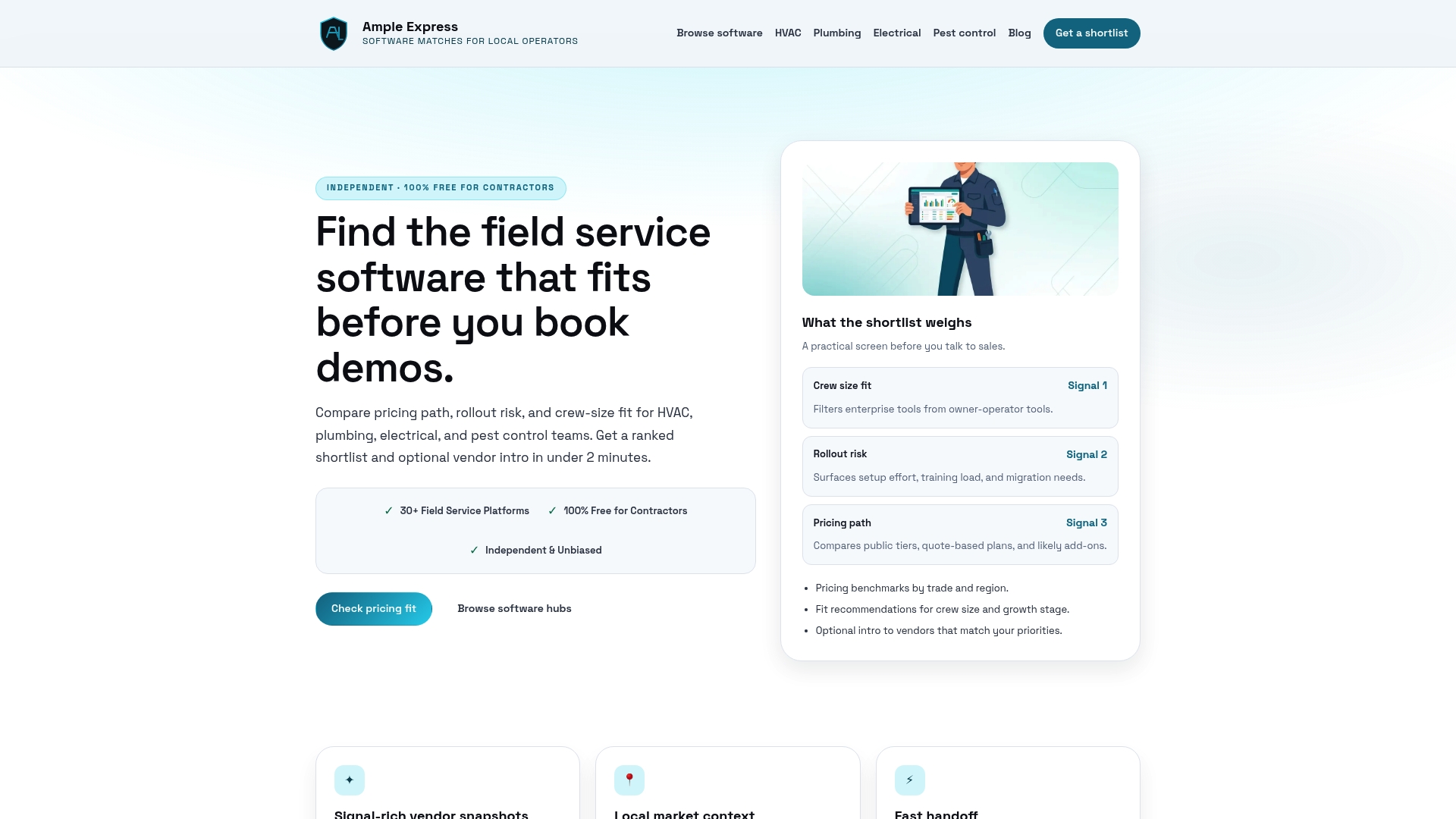
Ampleexpress gives field service managers an independent, ranked shortlist of over 30 software platforms with real pricing paths, rollout risk ratings, and fit recommendations by trade. Whether you run an HVAC crew, a plumbing operation, an electrical team, or a pest control company, you get the pricing context you need before you sit down with a vendor. Browse the full field service software comparison by trade to see current benchmarks, or get a tailored shortlist matched to your crew size and operational priorities at Ampleexpress. Walk into your next negotiation knowing what comparable teams actually pay.
FAQ
What discount can I realistically get on field service software?
Most buyers secure 15 to 30% off list price, with larger deployments and multi-year commitments reaching the higher end of that range. Structured negotiation with competitive quotes and defined deadlines consistently outperforms informal requests.
When should I start negotiating my software renewal?
Start at least six months before your renewal date. Early engagement gives you time to gather competitive quotes, identify your BATNA, and align your negotiation with the vendor's fiscal quarter end for maximum leverage.
Is it worth negotiating non-price contract terms?
Non-price terms like auto-renewal windows, annual escalation caps, and seat count flexibility often save more money over the contract life than the upfront discount. A 3 to 5% annual cap on price increases prevents compounding cost growth that erodes early savings.
How do I use competitive quotes in a negotiation?
Get written quotes from at least two alternative platforms before your negotiation call. Present them as active alternatives, not bluffs. Vendors respond to documented competition by increasing discount authority and adding value-added terms to retain the deal.
Should I involve procurement for smaller software deals?
For contracts under $50,000 annually, a defined personal negotiation process with a clear BATNA and counter-offer strategy is sufficient. For deals above $50,000, buying groups average 18 to 22% savings through pre-negotiated terms and are worth engaging.
Recommended
- Pest Control field service software
- Get a Pest Control software shortlist
- Software Pricing Benchmarks for Service Businesses (2026)
- Best Field Service Software Shortlist | Ample Express
- Why Service Business Software Needs Differ by Trade
- Top 5 Service Fusion Alternatives in 2026 | Ample Express