
Software Comparison Framework: A Decision-Maker's Guide
Discover what is a software comparison framework and learn how to make informed software purchasing decisions with our detailed seven-step guide.
June 17, 2026
Article

A software comparison framework is defined as a structured, repeatable methodology that evaluates multiple software tools against consistent business criteria to produce objective, defensible purchasing decisions. The industry term for this practice is a vendor evaluation framework or software assessment framework, and both names describe the same discipline. If you run an HVAC, plumbing, electrical, or pest control operation and you have ever picked software based on a demo that impressed you, you already know the cost of skipping this process. This guide explains what a software comparison framework contains, how to build one in seven steps, and where most decision-makers go wrong.
What is a software comparison framework?
A software comparison framework is a structured evaluation methodology that scores vendors across defined criteria on a consistent scale, typically 1–5, to replace gut decisions with data. The framework converts subjective impressions into a numeric record you can defend to a partner, a board, or yourself six months later when the contract renewal arrives.
The core evaluation dimensions in any credible framework include:
- Features: Must-have versus nice-to-have, mapped to your actual workflows
- Pricing transparency: Base subscription cost versus total cost of ownership, including training, implementation, and support tiers
- Integrations: Compatibility with your existing dispatch, accounting, or CRM tools
- Security: Data handling, access controls, and compliance requirements
- Support: Response time commitments, support tier access, and escalation paths
- Scalability: Performance at your projected crew size in 12–24 months
- Vendor reputation: Customer references, review volume on G2 or Capterra, and financial stability
- Exit strategy: Contract termination rights, data portability, and offboarding procedures
Effective frameworks save time and reduce risk by giving every vendor the same test. Without one, you are comparing a vendor's best demo against another vendor's pricing sheet, which is not a comparison at all.
Pro Tip: Avoid building your criteria list from vendor feature pages. Start with the specific operational problem you need to solve, then work backward to the features that address it.
What are the core components of a software evaluation framework?
The weighted scoring matrix is the most versatile baseline approach for any software assessment framework. You define criteria, assign a weight to each based on business priority, score each vendor, and multiply to get a total. This method works across software categories from field service management to invoicing to route optimization.

Defining and weighting your criteria
Not every criterion carries equal weight for your business. A five-person plumbing crew cares more about mobile dispatch reliability than API access. A 40-technician electrical contractor cares deeply about user permissions and reporting. Assign weights as percentages that total 100, then score each vendor 1–5 on each criterion. Multiply score by weight and sum the results.
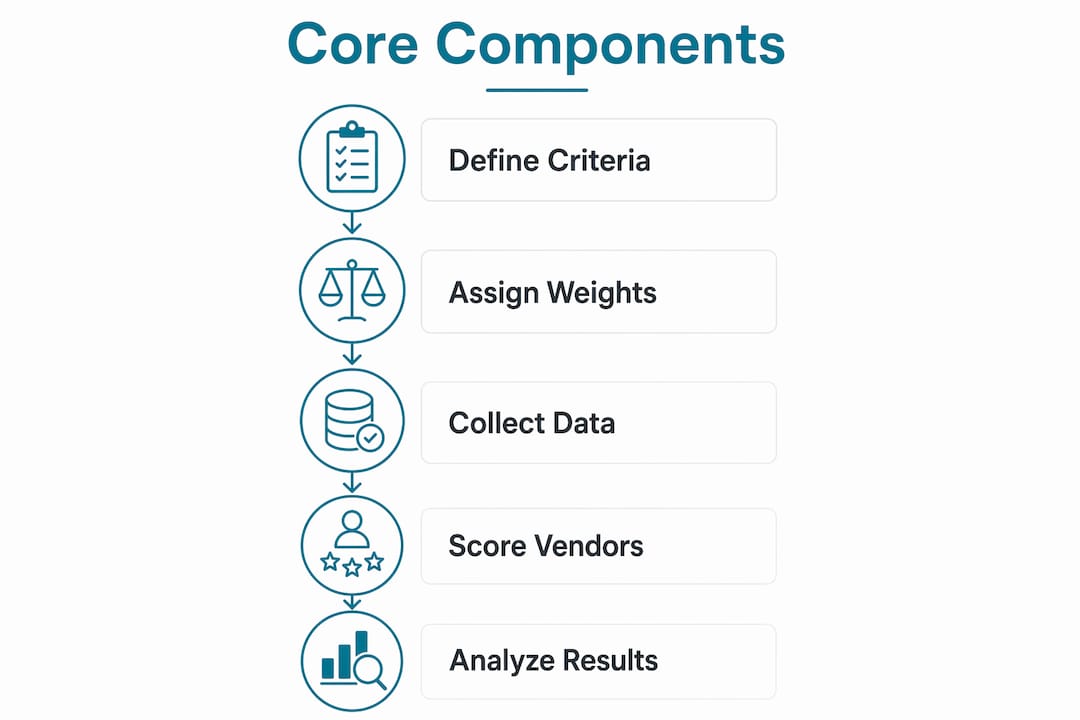
Weighted scoring methodologies translate vague vendor claims into business-relevant numbers, which prevents the misleading "green checkmark" comparisons that ignore whether a feature actually fits your workflow. A vendor can check every box on a feature list and still be the wrong tool for your crew size and dispatch volume.
Separating base price from true cost
True pricing includes hidden costs such as training fees, implementation charges, support tier upgrades, and per-user expansion thresholds. A platform listed at $79 per month can cost $400 per month once you add onboarding, a dedicated support tier, and additional user seats. Evaluate vendors on their full cost of ownership, not their homepage price.
How do you implement a software comparison framework step by step?
The seven-stage evaluation cycle below converts software selection into a repeatable discipline that takes roughly 30 minutes of focused work per vendor once your criteria are defined.
- Define the job. Write one sentence describing the operational problem the software must solve. "We need to reduce missed appointments caused by manual scheduling" is a job definition. "We want better software" is not.
- Shortlist 3–5 vendors. Use trusted platforms like G2, Capterra, or Ampleexpress to identify candidates that serve your trade and crew size. Avoid shortlisting more than five. Decision quality drops when you spread attention across too many options.
- Check pricing transparency. Request full pricing documentation before any demo. Eliminate vendors who cannot provide a clear breakdown of base cost, onboarding fees, and support tiers. Opaque pricing is a vendor behavior pattern, not a one-time oversight.
- Complete the scoring matrix. Score each shortlisted vendor across your weighted criteria. Use the same rubric for every vendor. Do not adjust scores after seeing a demo.
- Run a structured 14-day trial. Test the software using real jobs, real technicians, and real dispatch scenarios. Assign one team member to document friction points daily. A trial that uses dummy data tells you nothing useful.
- Ask standardized demo questions. Prepare the same 8–10 questions for every vendor demo. Ask about data export formats, support escalation timelines, and what happens to your data if you cancel. Vendors who deflect these questions are signaling risk.
- Verify exit terms and check references. Read the contract termination clause before signing. Call two references who have a similar crew size and trade. Ask them specifically about the offboarding experience, not just the onboarding.
Pro Tip: Treat steps 4 and 5 as non-negotiable. Skipping the trial or the scoring matrix in favor of a strong demo is the single most common path to a bad contract.
What are the biggest pitfalls in software comparison?
Three bias patterns consistently undermine software evaluations, and recognizing them is the first step to avoiding them.
- Demo bias: A polished demo creates a positive emotional response that inflates scores. Vendors train their sales teams to show you the best version of their product. Your scoring matrix must be completed before and after the demo, not during it.
- Popularity bias: Choosing the most recognized brand in a category is not the same as choosing the best fit. A platform with 50,000 users may be built for enterprise teams, not a 10-technician pest control operation.
- Sunk-cost fallacy: After investing three weeks in evaluating a vendor, decision-makers feel pressure to select someone, even if no option is a good fit. Including a "none suitable" option in your framework prevents this. If no vendor clears your minimum weighted score, restart the shortlist rather than force a bad decision.
Beyond bias, two structural gaps cause the most expensive mistakes.
First, exit strategy evaluation is consistently neglected. Most decision-makers scrutinize features and pricing but skip the contract termination clause. Vendor lock-in through proprietary data formats or 12-month auto-renewal terms can cost more than the software itself. Treat exit terms with the same rigor you apply to pricing.
Second, frameworks become outdated when business requirements change. A vendor comparison matrix should be updated when you add crew members, expand into a new trade, or change your dispatch model. Updating only when new software enters the market means your criteria may no longer reflect your actual operations.
How do software comparison approaches compare in 2026?
Different evaluation approaches suit different levels of decision complexity. The table below compares the most common methods used by service business decision-makers.
| Approach | Best For | Key Advantage | Main Limitation |
|---|---|---|---|
| Weighted scoring matrix | Most business decisions | Objective, repeatable, defensible | Requires upfront criteria definition |
| Vendor scorecard (Capterra template) | First-time evaluators | Structured and fast to deploy | Less customizable to specific workflows |
| Ad hoc feature checklist | Simple, low-stakes tools | Quick to complete | Highly susceptible to demo bias |
| SaaS evaluation calculator | Cost-focused comparisons | Surfaces true total cost of ownership | Does not capture qualitative fit |
| Custom spreadsheet matrix | Experienced teams | Fully tailored to business priorities | Requires maintenance discipline |
The SpecLens Comparable-Spec Index offers a useful quality check on top of any of these methods. It scores your comparison data across coverage, normalization, citation, confidence, and decision-readiness on a 20-point scale. A score below 16 signals that your data quality is too low to support a reliable decision, regardless of which framework you use.
Pro Tip: Choose the simplest framework your team will actually maintain. A weighted matrix that gets updated quarterly beats a sophisticated evaluation tool that gets abandoned after the first purchase.
You can also use the software vendor selection guide from Ampleexpress to cross-reference your shortlist against field service-specific criteria before finalizing your scoring weights.
Key takeaways
A software comparison framework converts vendor selection from a subjective process into a repeatable, scored discipline that protects your business from bad contracts and hidden costs.
| Point | Details |
|---|---|
| Start with the problem, not features | Define the operational job the software must solve before building your criteria list. |
| Weight your criteria | Assign percentage weights so that your highest-priority needs drive the final score. |
| Evaluate total cost of ownership | Include training, implementation, support tiers, and user expansion costs, not just the base price. |
| Enforce exit term review | Read contract termination and data portability clauses before signing, not after. |
| Keep the framework current | Update your criteria when your crew size or operations change, not only when new vendors appear. |
Why i think most software decisions are made backwards
After reviewing how field service contractors across HVAC, plumbing, and electrical trades approach software selection, the pattern is consistent. Most decision-makers start with a vendor demo, fall in love with a feature they saw once, and then build justification around that impression. The framework comes after the decision, if it comes at all.
The uncomfortable truth is that letting vendors dictate your decision criteria is the default mode for most small and mid-size service businesses. Vendors are very good at showing you what they want you to see. Your job is to define what you need to see before you take the first call.
The businesses I have seen make consistently good software decisions share one habit. They write down the operational problem first. Not the features they want. The problem. That single discipline forces every subsequent evaluation step to stay grounded in business outcomes rather than product impressions.
Keeping your framework as a living document is equally important. A comparison matrix built for a five-person crew is not the right tool for a 20-person operation. Update your criteria when your business changes. The framework is only as useful as its alignment with your current reality.
— Blake
How Ampleexpress helps you compare field service software
Ampleexpress applies the principles in this guide to match HVAC, plumbing, electrical, and pest control contractors with software that fits their crew size and operational model. The platform evaluates over 30 field service software options across pricing transparency, rollout risk, and workflow fit, so you get a ranked shortlist rather than a raw list of vendors to sort through yourself.
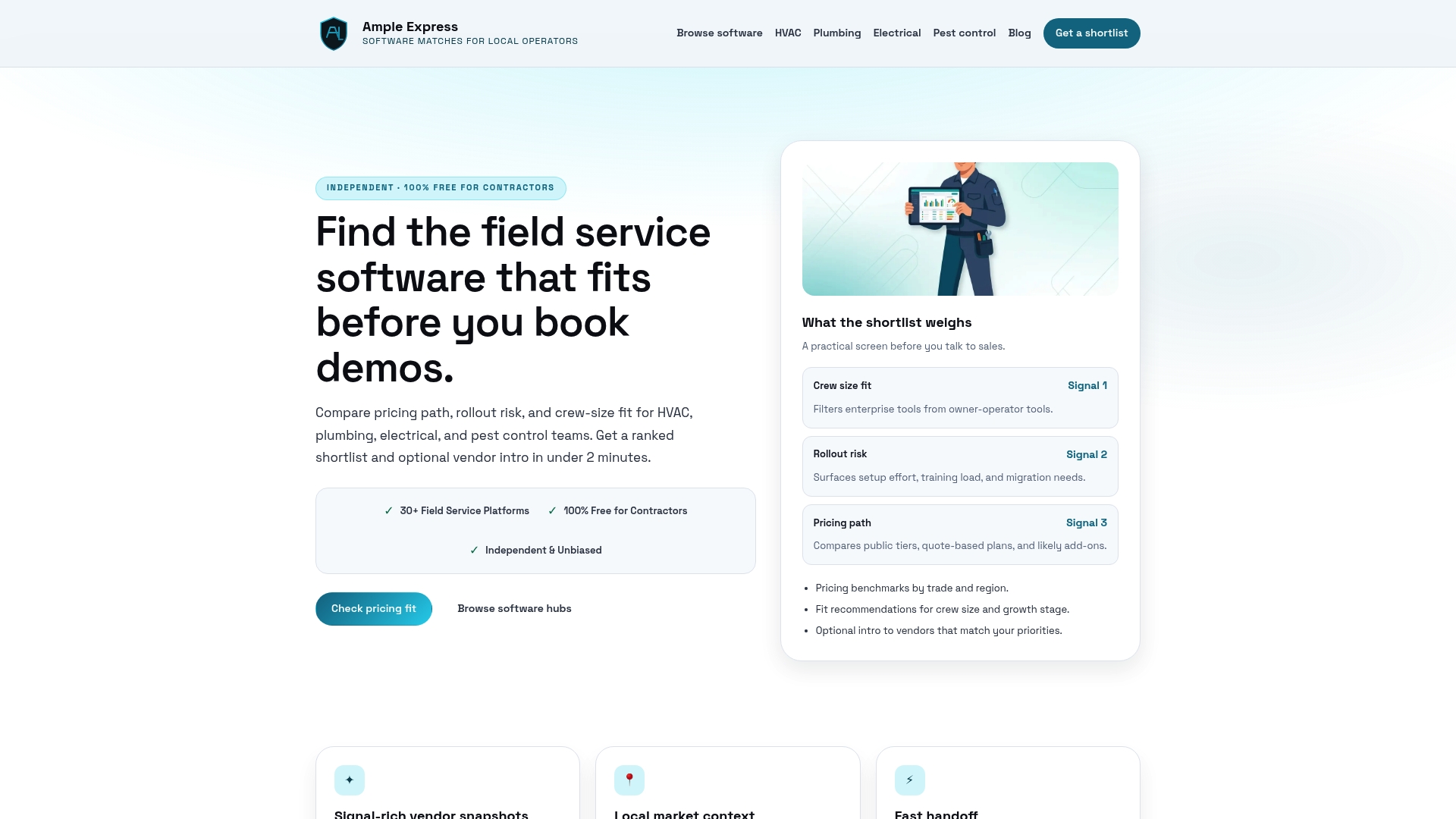
You can compare field service software side by side using Ampleexpress's structured tool, or use the software cost calculator to surface true total cost of ownership before you commit to a trial. If you want a trade-specific starting point, the field service software by trade page breaks down top options for HVAC, plumbing, electrical, and pest control teams with fit recommendations built in.
FAQ
What is a software comparison framework in simple terms?
A software comparison framework is a structured method for scoring multiple software tools against the same business criteria to make an objective purchasing decision. It replaces gut instinct with a repeatable, documented process.
How many vendors should i compare in a software evaluation?
Shortlist 3–5 vendors for any evaluation. Comparing more than five dilutes focus and rarely improves the final decision.
What criteria should a software evaluation framework include?
Core criteria include features, pricing transparency, integrations, security, support quality, scalability, vendor reputation, and exit terms. Weight each criterion based on your specific operational priorities.
Why is exit strategy important in software comparison?
Exit terms determine how easily you can leave a vendor, export your data, and avoid auto-renewal traps. Neglecting this step is one of the most common causes of costly vendor lock-in.
How often should i update my software comparison framework?
Update your framework whenever your business requirements change, such as crew size growth, new service lines, or dispatch model shifts. Do not wait for new software to enter the market to revisit your criteria.