
Software Fit Score Meaning: A Field Service Manager's Guide
Discover software fit score meaning to transform your software evaluations. Use this metric to ensure confident decisions as a field service manager.
July 4, 2026
Article

A software fit score is a quantitative metric that measures how closely a software solution matches your organization's specific operational requirements. Rather than relying on gut feel or a vendor's sales pitch, fit scoring converts your priorities into weighted numbers, then ranks each solution against those numbers. For field service managers evaluating dispatch tools, job scheduling platforms, or crew management software, this structure is the difference between a confident decision and a costly mistake. Understanding the software fit score meaning gives you a repeatable, defensible framework you can use every time you evaluate a new platform.
What is a software fit score, and why does it matter?
A software fit score is defined as a structured evaluation metric that maps software capabilities to your organization's documented requirements. The industry term for this process is "weighted scoring" or a "weighted scorecard," and fit score is the shorthand most decision-makers use in practice. Both terms describe the same method: assign weights to criteria, rate each vendor against those criteria, and calculate a final numeric score.
The core advantage is objectivity. Fit scoring converts vague feelings into measurable, comparable numbers, which makes decisions easier to justify to leadership and easier to repeat on the next evaluation cycle. For a field service manager choosing between platforms that all claim to handle dispatch, scheduling, and invoicing, a fit score cuts through the noise.

Fit scores also surface hidden priorities. Explicit criteria definition often reveals that teams are optimizing for features that do not add real operational value. Running a formal scoring process forces your team to agree on what actually matters before any vendor walks in the door.
What criteria and weights make up a fit score?
Weighting frameworks typically allocate 30–40% to functional fit, 15–25% to technical and security fit, 15–20% to total cost of ownership, and 10–15% each to vendor viability and implementation risk. These five categories cover the full range of risk a field service manager faces when adopting new software.
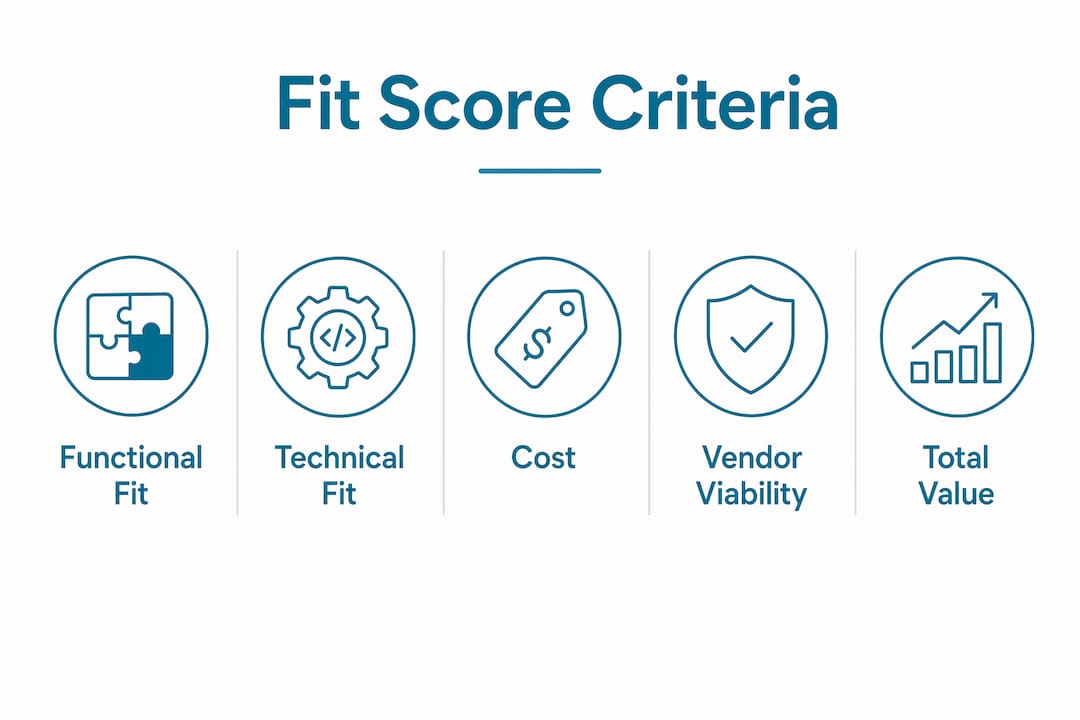
Here is a sample weighted scoring framework:
| Criteria category | Typical weight | What it measures |
|---|---|---|
| Functional fit | 30–40% | Does the software handle your core workflows? |
| Technical and security fit | 15–25% | Does it integrate with your existing systems securely? |
| Total cost of ownership | 15–20% | What is the full cost over a 3-year period? |
| Vendor viability | 10–15% | Is the vendor financially stable and actively developing? |
| Implementation risk | 10–15% | How complex is the rollout for your crew size? |
Within each category, requirements fall into three tiers:
- Must-have: Non-negotiable features. A plumbing contractor needs mobile job capture in the field. No score here means automatic disqualification.
- Should-have: Important but not deal-breaking. GPS tracking is valuable but not the reason you buy software.
- Nice-to-have: Features that add value if present but do not affect your core operations.
Balanced weighted scoring prevents cost from overshadowing functional, cultural, and technical factors that matter for long-term success. A platform that looks cheap on paper but scores poorly on functional fit will cost far more in rework and retraining within 18 months.
Pro Tip: Weight your Must-have criteria at least twice as heavily as Should-have criteria. This prevents a vendor with flashy Nice-to-have features from outscoring a platform that actually fits your daily operations.
How is a software fit score calculated?
Fit scores are calculated by rating each vendor on a 1–5 scale per requirement, then multiplying each raw score by its assigned weight to produce a weighted score. The sum of all weighted scores is the vendor's final fit score. The process follows a clear sequence.
- Define your requirements explicitly. List every workflow your crew depends on: dispatch, job history, parts ordering, invoicing, and customer communication.
- Categorize each requirement. Label each as Must-have, Should-have, or Nice-to-have. Assign a weight to each category.
- Build your scoring rubric. Define what a 1, 3, and 5 look like for each criterion. A 5 on mobile job capture means offline functionality with photo attachments. A 1 means no mobile access at all.
- Assign evaluators by domain. Finance scores cost criteria, IT scores technical and security fit, and operations scores functional fit. Diverse evaluators reduce individual bias.
- Score after all demos are complete. Scoring after demos allows objective comparison without influence from presentation order or a vendor's charisma.
- Calculate weighted totals. Multiply each raw score by its weight. Sum the results. Compare final scores across vendors.
Common pitfalls to avoid:
- Letting one stakeholder score all criteria, which introduces a single point of bias
- Scoring during a live demo, which inflates scores for the last vendor you saw
- Ignoring Must-have failures because a vendor scored well elsewhere
Pro Tip: Build your scoring sheet before you contact any vendor. Locking in criteria and weights before demos prevents vendors from shaping your evaluation criteria during their presentations.
What nuances improve the accuracy of fit scoring?
A single score of 1/5 in a critical dimension is more dangerous than a uniformly average score across all dimensions. Critical failures in security or integration can outweigh high scores everywhere else. A field service platform that scores 4/5 on functional fit but 1/5 on API integration will break your billing workflow the moment you try to connect it to QuickBooks or your parts supplier.
Subjective criteria belong in your scorecard too. Vendor responsiveness, quality of onboarding documentation, and the clarity of the support team's answers during the sales process are all scorable. They are harder to quantify, but they predict your implementation experience accurately.
For high-stakes decisions, supplement your fit score with a sandboxed Proof of Concept test. PoC testing lasting 14 to 30 days evaluates real data integration, API behavior, and security compliance before you commit. For a 10-person HVAC crew, a 30-day sandbox on your actual job data will reveal scheduling conflicts, sync failures, and mobile performance issues that no demo will show you.
Fit score and vendor engagement are not the same metric. High engagement from a vendor does not guarantee operational fit if the technical architecture or product roadmap does not align with your needs. A vendor who responds within the hour but whose platform cannot handle multi-trade job assignments is still a poor fit.
Pro Tip: Flag any vendor who scores 1/5 on a Must-have criterion as a conditional disqualification. Before removing them, confirm the gap is real and not a configuration issue. Some platforms hide critical features behind add-on modules.
How do field service managers apply fit scores in practice?
Fit scoring works best as part of a structured selection process, not as a standalone exercise. Here is a practical framework for field service managers.
- Gather requirements from your crew. Interview dispatchers, technicians, and office staff. Ask what breaks down in your current workflow. Capture specific pain points, not feature wish lists.
- Build your weighted scorecard. Use the five-category framework above. Adjust weights to reflect your operation. A 3-person electrical crew weights cost higher than a 20-person plumbing operation with complex dispatch needs.
- Shortlist vendors before scoring. Evaluate 4–6 platforms. More than that creates scoring fatigue and reduces accuracy. Ampleexpress provides a ranked shortlist of field service software across HVAC, plumbing, electrical, and pest control categories, which cuts your initial research time significantly.
- Run demos and collect raw scores. Have each evaluator score independently. Do not share scores until all demos are complete.
- Calculate weighted totals and compare. The top two or three scores become your finalists for deeper evaluation or PoC testing.
- Pair fit scores with cost data. A high fit score on a platform that exceeds your budget is not a win. Use a software cost calculator to model total cost of ownership alongside your fit scores.
- Use scores to guide negotiation. If your top-scoring vendor has a gap in one Should-have area, use that gap as a negotiation point for a lower price or a roadmap commitment.
Key benefits of this approach:
- Reduces selection risk by surfacing gaps before you sign a contract
- Creates a documented audit trail you can present to ownership or leadership
- Builds stakeholder consensus because everyone's priorities are represented in the weights
- Makes future software reviews faster because your scorecard becomes a reusable template
Ampleexpress also offers a side-by-side software comparison tool that maps features across more than 30 field service platforms, which you can use to pre-screen vendors before building your formal scorecard.
Key Takeaways
A software fit score is the most reliable method for selecting field service software because it converts operational priorities into objective, weighted numbers that every stakeholder can evaluate and defend.
| Point | Details |
|---|---|
| Fit score definition | A weighted numeric metric that maps software capabilities to your documented operational requirements. |
| Standard weighting | Functional fit takes 30–40% of the score; cost, technical fit, and risk share the remaining weight. |
| Scoring process | Rate vendors 1–5 per criterion after all demos, multiply by weights, and sum for a final score. |
| Critical gap rule | A score of 1/5 on a Must-have criterion signals higher risk than a uniformly average score across all criteria. |
| Fit vs. engagement | High vendor responsiveness does not equal high fit; score alignment separately from sales experience. |
Why fit scoring changed how I evaluate software
Most field service managers I talk to have made at least one software purchase they regret. The pattern is almost always the same: the demo was impressive, the salesperson was responsive, and the price felt right. Nobody scored the platform against actual operational requirements before signing.
The uncomfortable truth is that vendor engagement is a terrible proxy for software fit. A vendor who calls you back within 20 minutes and has a polished demo may still deliver a platform that cannot handle your dispatch workflow or sync with your accounting system. Fit scoring separates enthusiasm from actual solution suitability, and that separation is where good decisions happen.
I also think most teams underestimate how much organizational alignment matters in a fit score. Technical criteria are easy to score. Cultural fit, meaning how well the vendor's support model matches your team's pace and communication style, is harder to quantify but just as predictive of success. Build it into your scorecard as a subjective criterion with a modest weight.
One more thing: your fit criteria should change as your business grows. A scorecard built for a 5-person crew will not serve a 20-person operation. Revisit your weights and Must-have list every time your headcount or service area changes significantly. The software fit recommendation framework from Ampleexpress is a useful reference point for recalibrating criteria as your operation scales.
— Blake
How Ampleexpress helps you put fit scoring into practice
Applying a fit score framework takes time, and the research phase alone can slow your decision by weeks. Ampleexpress removes that friction by providing an independent, pre-ranked shortlist of over 30 field service software options across HVAC, plumbing, electrical, and pest control categories.
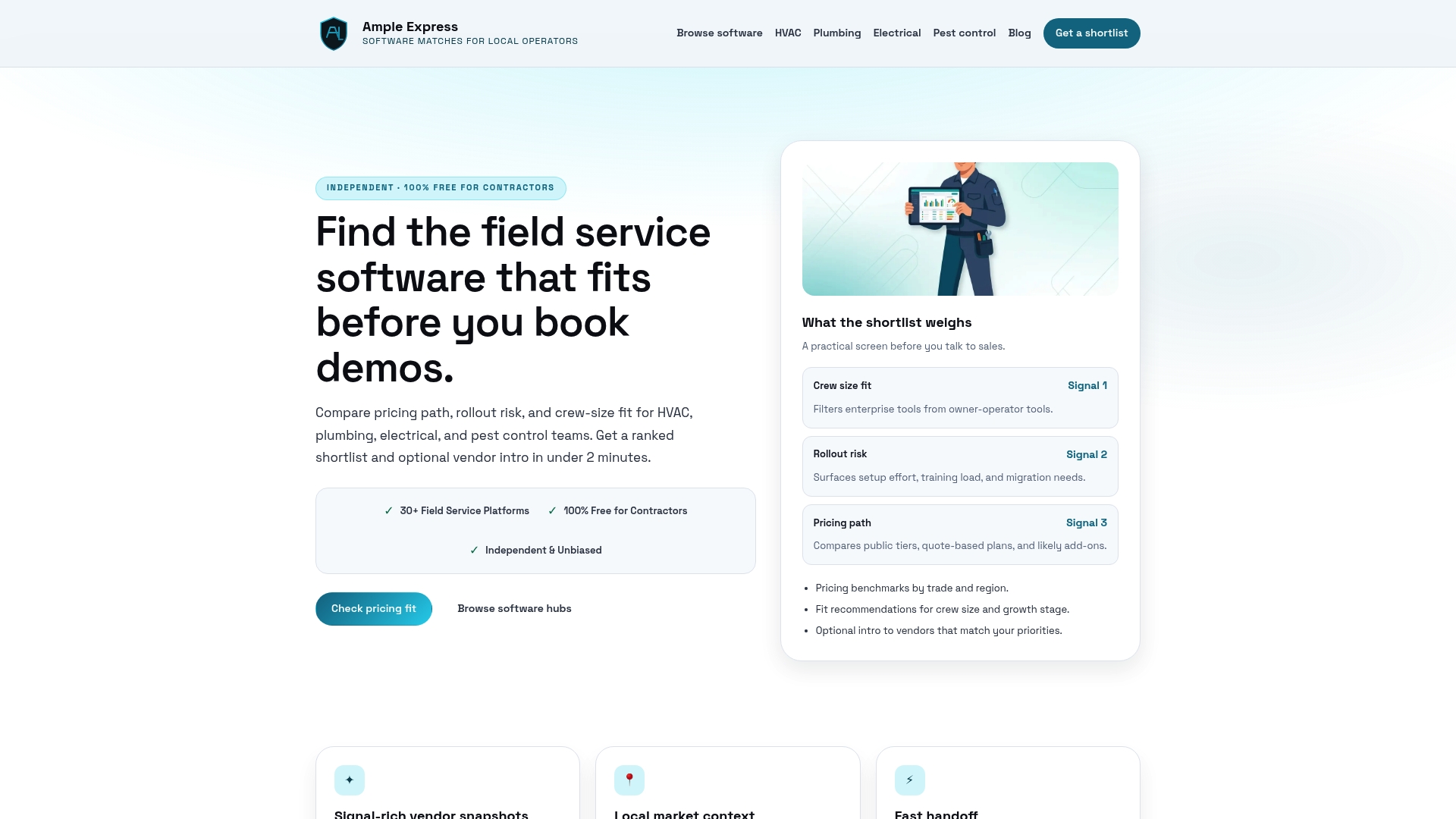
Each listing on Ampleexpress includes fit recommendations, pricing paths, and rollout risk ratings, which map directly to the criteria categories in a weighted scorecard. You can use the field service software directory to pre-screen vendors before your formal evaluation, then run your fit score process on a tighter shortlist. The platform also provides regional pricing benchmarks and crew size trends, so your cost weighting reflects real market data rather than vendor estimates.
FAQ
What is the software fit score meaning in simple terms?
A software fit score is a number that shows how well a software product matches your organization's documented requirements. It is calculated by rating vendors on weighted criteria and summing the results.
How many criteria should a fit scorecard include?
Most effective scorecards include 10–20 criteria across five categories: functional fit, technical fit, cost, vendor viability, and implementation risk. Fewer criteria miss critical gaps; more criteria create scoring fatigue.
Can a vendor with a lower fit score still be the right choice?
Yes, if the higher-scoring vendor has a critical gap in a Must-have area or exceeds your budget by a significant margin. Fit scores guide decisions but do not replace judgment on deal-breaker factors.
What is the difference between a fit score and a vendor engagement score?
A fit score measures how well a platform aligns with your operational requirements. Vendor engagement measures interest level and responsiveness, which does not predict whether the software will perform in your environment.
How often should field service managers update their fit scorecard?
Update your scorecard whenever your crew size, service area, or core workflows change materially. A scorecard built for your current operation will produce inaccurate results if your business has grown or diversified since you last used it.
Recommended
- Pest Control field service software
- Get a Pest Control software shortlist
- Software Fit Recommendation for Field Service Managers
- State of Field Service Software 2026 | Ample Express
- Software Comparison Framework: A Decision-Maker's Guide
- Field Service Software Pricing Transparency Index 2026 | Ample Express