
Software Pricing Path Explained for Service Business Owners
Discover the software pricing path explained for service business owners. Master pricing strategies to optimize value and boost growth.
June 22, 2026
Article

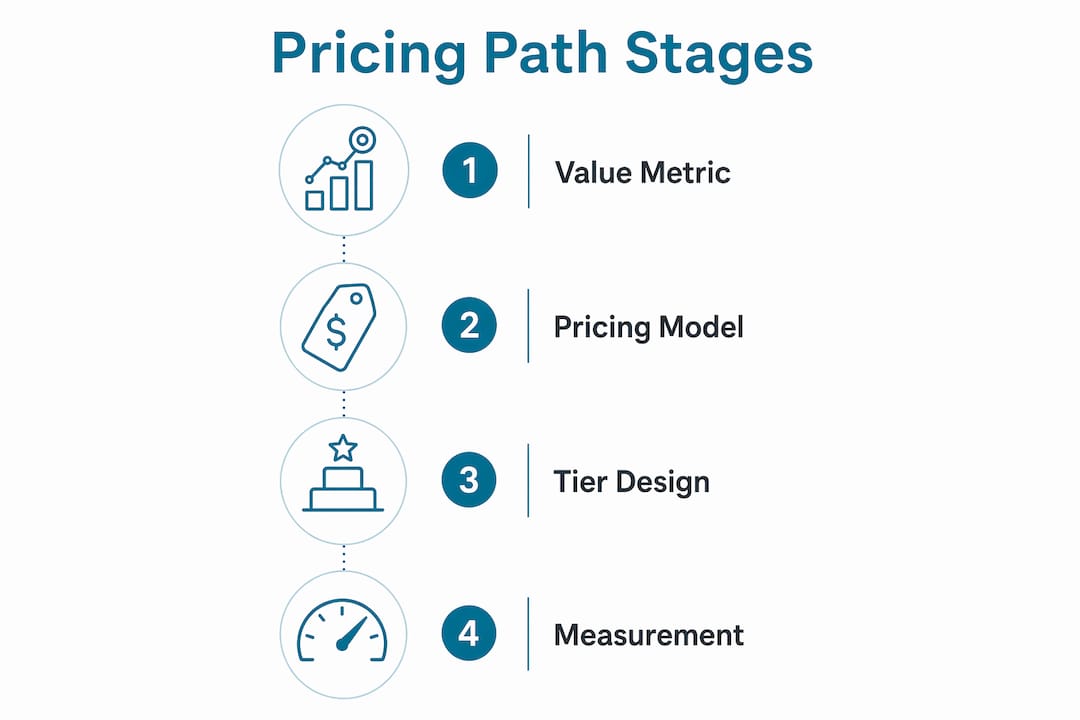
A software pricing path is the step-by-step sequence a company uses to set, structure, and refine its prices to match customer value and business goals. For service business owners evaluating field service software, understanding this sequence is the difference between a purchase that fits your operation and one that quietly drains your budget. The software pricing path explained in this guide covers four core stages: value metric selection, pricing model choice, tier structure design, and measurement infrastructure. Frameworks from Stripe, OpenView, and softwarepricing.com all confirm that companies refining this process grow 30% faster than those that skip it.
What are the four key stages of the software pricing path?
The software pricing path follows a fixed sequence. Skipping a stage creates gaps that show up later as poor conversion rates, unexpected price hikes, or tiers that do not match how your crew actually works.
Stage 1: Value metric selection
A value metric is the unit a vendor uses to measure and charge for your usage. Common examples include active users, jobs dispatched, locations managed, or API calls made. The right value metric grows with your business. A plumbing company with 4 technicians and one with 20 technicians should pay proportionally different amounts. If a vendor charges a flat rate regardless of usage, you are either overpaying early or underpaying later.
Stage 2: Pricing model choice
The pricing model defines the structure of how you pay. Subscription, usage-based, hybrid, per-seat, and value-based are the five most common models in field service software. Each model carries different implications for your cash flow and budget predictability. The right pricing model depends heavily on whether you prefer self-service sign-up or a sales-led purchase process.

Stage 3: Tier structure design
Tiers bundle features and usage limits into 2–4 plans aimed at distinct customer segments. Optimal tier plans range between 2 and 4 options to avoid buyer paralysis. A good tier is described in one sentence: "For teams dispatching up to 10 jobs per day." Tiers built around internal feature lists rather than real customer needs create confusion and slow purchasing decisions.
Stage 4: Measurement infrastructure
Measurement infrastructure is the system a vendor uses to track whether its pricing is working. This includes monitoring sign-up conversion, trial-to-paid rates, retention, and net revenue retention. Pricing is an ongoing discipline that requires integrated data from deal outcomes, discount tracking, and churn metrics. As a buyer, you benefit when vendors invest in this discipline because it signals they will adjust pricing based on real market feedback rather than guesswork.
Pro Tip: Ask any software vendor you are evaluating how often they review their pricing. A vendor that reviews pricing quarterly is more likely to keep tiers aligned with actual customer value than one that has not changed prices in three years.
How do common software pricing models compare?
Choosing the wrong model costs more than just money. It creates friction at renewal time, surprise charges mid-year, and budget conversations you did not plan for. The table below compares the five models you will encounter most often when buying field service software.
| Model | How you pay | Best for | Watch out for |
|---|---|---|---|
| Subscription (flat rate) | Fixed monthly or annual fee | Predictable budgets, small crews | Overpaying if usage is low |
| Per-seat | Fee per user per month | Growing teams with clear headcount | Costs spike fast as you hire |
| Usage-based | Pay per job, dispatch, or API call | Variable workloads | Unpredictable monthly bills |
| Hybrid | Base fee plus usage charges | Mid-size operations with growth plans | Complexity in billing reconciliation |
| Value-based | Priced on outcomes delivered | Enterprise or outcome-driven contracts | Hard to verify vendor ROI claims |
61% of SaaS companies now use usage-based or hybrid pricing models. That shift means more field service platforms are moving away from simple flat-rate subscriptions toward models that scale with your activity.
Hybrid pricing is now the dominant architecture in B2B software. It combines a stable base fee with variable consumption pricing. For an HVAC company running 50 jobs per week in summer and 15 in winter, hybrid pricing can be a fair match. The trade-off is billing complexity. You need to verify exactly which activities trigger variable charges before you sign.
Buyers also interpret price as a signal of product quality. Low entry prices around $6 per month signal commodity tools, while higher prices indicate professional-grade platforms. If a dispatch and scheduling platform costs less than a streaming subscription, treat that as a red flag, not a bargain.
- Subscription: Best for teams that want budget certainty and do not need to scale rapidly.
- Per-seat: Works well when every technician needs a full license. Check the per-user pricing benefits before committing.
- Usage-based: Suits seasonal businesses but requires careful monitoring of monthly spend.
- Hybrid: Offers balance but demands clear contract language on what triggers variable fees.
- Value-based: Appropriate only when the vendor can demonstrate measurable outcomes tied to your revenue.
What pitfalls should buyers watch for in software pricing?
Software pricing paths contain several traps that catch buyers off guard. Knowing them in advance saves you from expensive contract mistakes.
- Tiers built on features, not value. Tier plans aligned to real customer value reduce buyer confusion and improve conversion. If a vendor's tiers are labeled "Starter, Pro, Enterprise" but the differences are buried in a feature comparison table, ask them to explain each tier in one sentence. If they cannot, the tiers are not well designed.
- Underpricing as a warning sign. Founders commonly underprice software. Doubling initial intuitive prices is advised because it is better to lose some prospects than to permanently miss revenue. When a platform is priced suspiciously low, the vendor may be planning a price increase after you are locked in, or the product may lack the depth you need.
- The 10x ROI rule. Software pricing should anchor at a level where customers receive at least ten times the value in outcomes compared to subscription costs. Apply this rule when evaluating any platform. If a $200 per month field service tool cannot save you $2,000 per month in labor, scheduling errors, or missed jobs, the price is not justified.
- Hybrid model complexity. Hybrid pricing requires clear communication from the vendor about billing triggers. Request a sample invoice before you sign. Verify which actions generate variable charges and set a monthly spend cap if the vendor allows it.
- Grandfathering during price changes. Grandfathering existing customers for 12–18 months during pricing model transitions helps maintain revenue stability. Ask any vendor you are considering whether they have a grandfathering policy. A vendor that protects existing customers during price changes is less likely to surprise you mid-contract.
Pro Tip: Before signing a multi-year contract, ask the vendor for their price change history over the past three years. A pattern of annual increases above 10% is a signal to negotiate a price lock clause into your agreement.
How does measurement keep software pricing on track?
Pricing is not a one-time decision. Continuous monitoring of pricing impact through detailed analytics on discounts, conversion rates, and churn is necessary to keep pricing aligned with real customer value. For you as a buyer, this matters because vendors that measure pricing rigorously are more likely to offer fair adjustments and transparent upgrade paths.
The key metrics a well-run software vendor tracks include:
- Sign-up conversion rate: The percentage of visitors who start a trial or purchase.
- Trial-to-paid rate: How many trial users convert to paying customers.
- Customer retention rate: The percentage of customers who renew each period.
- Net revenue retention (NRR): Total revenue from existing customers after accounting for upgrades, downgrades, and cancellations.
High NRR above 100% means existing customers are spending more over time. That signals a vendor whose pricing tiers create natural upgrade paths rather than dead ends. When evaluating field service software, ask vendors for their NRR or retention benchmarks. Vendors confident in their numbers will share them. You can also cross-reference against the Ampleexpress pricing index to see how a vendor's pricing compares to regional benchmarks.
A 4–6 week cohort substitution test is the standard method vendors use to evaluate price changes. They track 30-day retention and sign-up rates against a control group. As a buyer, you can request whether a vendor has run pricing tests before rolling out a new model. Vendors who test before changing prices are less likely to make abrupt shifts that disrupt your budget.
What steps should you take when evaluating software pricing paths?
Evaluating a software pricing path requires a structured approach. These steps apply whether you are buying your first field service platform or switching from a tool that no longer fits your crew size.
- Identify your value drivers. List the three operational outcomes that matter most: faster dispatch, fewer missed appointments, better invoicing. The right software pricing path charges you for the metric closest to those outcomes.
- Decide your purchasing model. Self-service models favor transparent tiers you can evaluate online. Sales-led models require negotiation and flexibility. Know which approach fits your decision-making style before you start demos.
- Verify tier clarity. Each tier should describe a real customer segment in plain language. Use the Ampleexpress software comparison tool to review tier structures side by side across more than 30 field service platforms.
- Request pricing test data. Ask vendors whether they have tested their current pricing model. A vendor that has validated pricing through cohort testing is more confident in its structure and less likely to change it abruptly.
- Check upgrade triggers. Understand exactly what causes you to move from one tier to the next. If the trigger is a number of users or jobs, calculate when your operation will hit that threshold. Factor the next tier's cost into your total budget from day one.
- Use a cost calculator. Estimate your total annual spend under each model before committing. The Ampleexpress cost calculator lets you model different pricing paths against your actual crew size and job volume.
Key takeaways
Understanding the software pricing path gives you a clear framework to evaluate any field service software purchase, from value metric to measurement infrastructure.
| Point | Details |
|---|---|
| Four-stage sequence | Every pricing path covers value metric, model, tier structure, and measurement in order. |
| Hybrid models dominate | 61% of SaaS companies use usage-based or hybrid pricing, so expect variable billing components. |
| Tiers must reflect value | Tiers built on features rather than customer segments create confusion and slow your decision. |
| Apply the 10x ROI rule | Verify that each platform delivers at least ten times its cost in measurable operational outcomes. |
| Measurement signals vendor quality | Vendors that track retention, conversion, and churn data make more reliable pricing partners. |
What I have learned about pricing paths the hard way
Blake's perspective
After reviewing dozens of field service software contracts with HVAC, plumbing, and electrical operators, the single most consistent mistake I see is treating pricing as a fixed input rather than a negotiable variable. Operators sign a contract, accept the tier they were shown in the demo, and never ask whether a different model would fit their workflow better. That passivity costs real money.
The underpricing trap is real, but it cuts both ways. Vendors who price too low often compensate with aggressive upsell tactics at renewal. I have seen operators locked into a "Starter" plan that technically covered their needs, only to find that the feature they needed most was gated behind a tier costing three times more. Clear tier definitions protect you from that situation.
Hybrid pricing is genuinely useful for seasonal service businesses, but only when the contract spells out every variable charge in plain language. I always recommend requesting a sample invoice before signing any hybrid contract. If the vendor cannot produce one, that is a signal the billing structure is not yet mature.
My strongest advice: invest time in the measurement conversation before you buy. Ask the vendor how they track whether their pricing is working. A vendor that monitors deal outcomes and churn data is building pricing around real customer behavior. That vendor is a safer long-term partner than one relying on annual surveys and gut instinct.
— Blake
Field service software with pricing you can actually evaluate
Ampleexpress ranks over 30 field service software options by pricing path, rollout risk, and fit for your crew size. Whether you run an HVAC team, a plumbing operation, an electrical company, or a pest control crew, the platform gives you a shortlist built around your actual job volume and headcount.
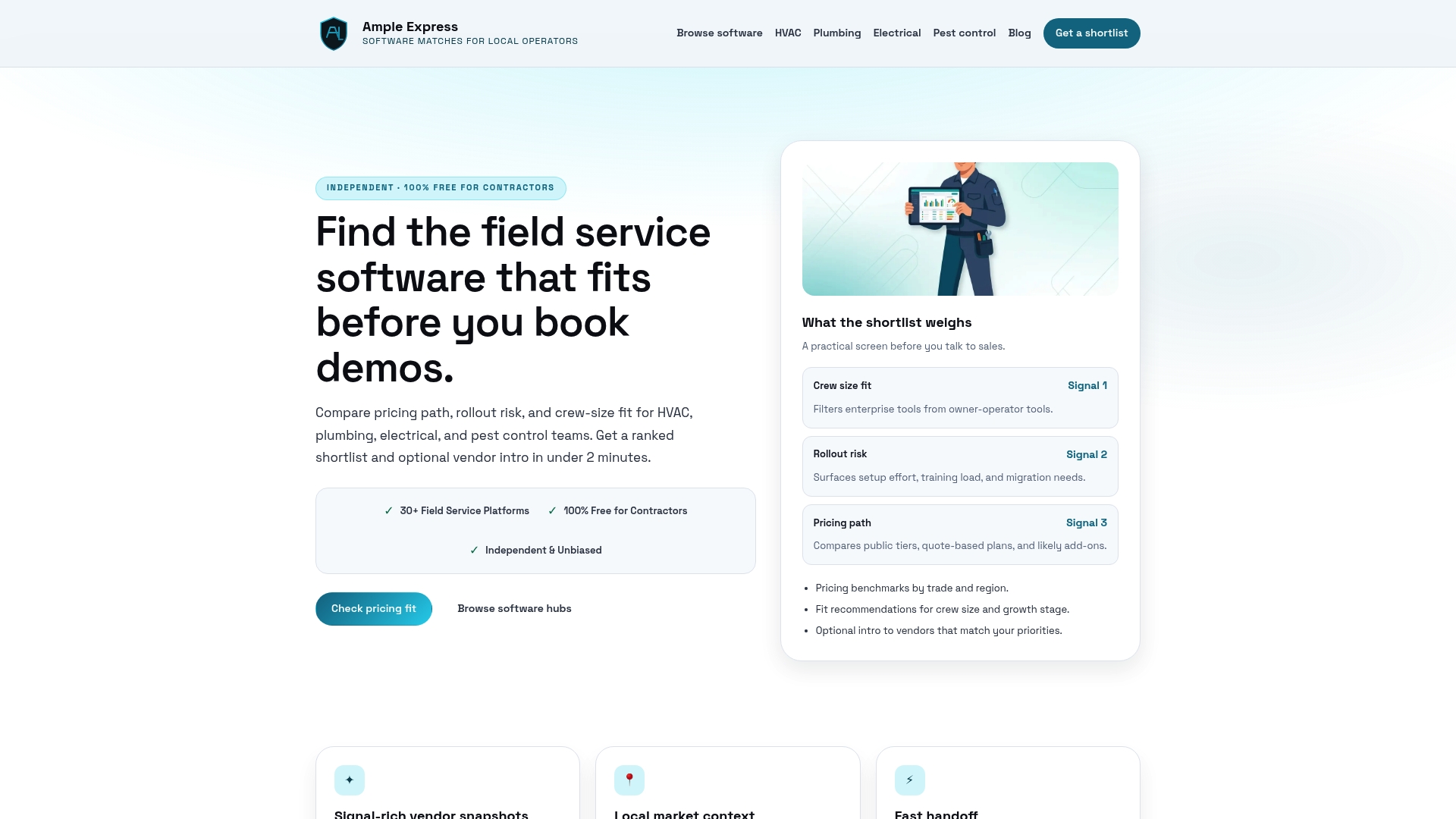
You can browse field service software by trade to compare pricing tiers, model types, and regional benchmarks side by side. Every listing includes a transparent cost breakdown so you know exactly what you are paying for before you book a demo. Use the software cost calculator to model your annual spend under different pricing paths and find the option that fits your budget without surprises at renewal.
FAQ
What is a software pricing path?
A software pricing path is the structured sequence a vendor uses to set prices, covering value metric selection, pricing model choice, tier structure design, and measurement infrastructure. Companies that follow this sequence grow faster and maintain better revenue predictability.
Which software pricing model is best for small service crews?
Subscription or per-seat models work best for small crews because they offer predictable monthly costs. Hybrid models add flexibility for growth but require careful review of variable billing triggers.
How many pricing tiers should a field service software have?
Two to four tiers is the standard range. More than four tiers creates buyer paralysis; fewer than two limits your ability to find a plan that matches your actual crew size and job volume.
What does grandfathering mean in software pricing?
Grandfathering means a vendor keeps existing customers on their current pricing for a set period, typically 12–18 months, when the vendor changes its pricing model. It protects your budget during transitions.
How do I know if a software price is fair?
Apply the 10x ROI rule: the platform should deliver at least ten times its cost in measurable outcomes like time saved, jobs completed, or billing errors reduced. If it cannot, the price is not justified for your operation.
Recommended
- Pest Control field service software
- Get a Pest Control software shortlist
- Software Pricing Benchmarks for Service Businesses (2026)
- Field Service Software Cost Calculator (2026) | Ample Express
- Field Service Platform Pricing Models: 2026 Guide
- Service Fusion pricing guide for electrical companies | Ample Express