
Per-User Plumbing Software Pricing: 9 Key Benefits
Discover the benefits of per-user plumbing software pricing, including cost savings and flexibility. Learn why this model suits your business needs!
June 6, 2026
Article

Per-user plumbing software pricing is defined as a subscription model where your monthly fee scales directly with the number of active users on your account. This model, sometimes called "seat-based pricing" in the broader SaaS industry, is offered by platforms like Jobber, ServiceTitan, and QuoteIQ. For plumbing contractors evaluating software costs in 2026, the benefits of per-user plumbing software pricing are real and measurable. You pay for what your crew actually uses, your budget stays predictable, and your access controls stay tight. But this model also carries trade-offs worth understanding before you sign a contract.
1. Benefits of per-user plumbing software pricing: the core case
The clearest advantage of per-user pricing is direct cost alignment. Your software bill reflects your actual team size, not a flat fee that may cover 20 users when you only need 4. For a solo operator or a two-tech shop, entry-level per-user rates start at $13 to $39 per month, making this one of the most affordable ways to access professional dispatch, estimating, and invoicing tools.
- Scalable costs: You add a seat when you hire, and remove it when a tech leaves. No wasted spend on unused licenses.
- Budget predictability: A fixed per-user rate makes monthly forecasting straightforward. You know exactly what each new hire adds to your software overhead.
- Access control: Each user gets a unique login with role-specific permissions. Your office admin sees invoices; your field tech sees job assignments. That separation protects sensitive pricing data and customer records.
- Accountability: Individual logins create clear audit trails. You can track who created an estimate, who dispatched a job, and who collected payment.
Pro Tip: Before committing to any per-user plan, list every person who needs software access. Include office staff, apprentices, and part-time techs. That full headcount is your real monthly cost baseline.
2. How per-user pricing compares to flat-rate and tiered models

Flat-rate pricing charges a fixed monthly fee regardless of how many users you add. Tiered pricing bundles a set number of users into each plan level, with price jumps at defined thresholds. Per-user pricing charges a consistent rate per seat with no user cap.
The cost math shifts significantly as your team grows. Enterprise per-tech rates reach $245 to $398 or more per month, while flat-rate plans cap costs at $300 to $700 per month for unlimited users. That means a 5-tech shop paying $300 per tech per month spends $1,500 monthly on per-user fees versus a flat-rate plan at $500 for the same team.
| Team size | Per-user cost (est. $250/user) | Flat-rate cost (est.) | Lower cost option |
|---|---|---|---|
| 3 technicians | $750/month | $400/month | Flat-rate |
| 5 technicians | $1,250/month | $500/month | Flat-rate |
| 7 technicians | $1,750/month | $600/month | Flat-rate |
| 2 technicians | $500/month | $400/month | Flat-rate (marginal) |
The table above uses mid-range estimates for illustration. Your actual numbers depend on the specific platform and plan tier. Flat-rate models can offer 35 to 50 percent lower total cost of ownership over 24 months for growing businesses. That is a significant gap if you plan to add even two or three techs in the next year.
Pro Tip: Run a 24-month cost projection before choosing a model. Multiply your expected headcount at month 24 by the per-user rate, then compare that figure to the flat-rate alternative. The answer often surprises contractors who focus only on the current monthly price.
3. Cost scalability for small and growing plumbing shops
Per-user pricing works best when your team is small and stable. A solo plumber or a two-tech operation gets full access to professional software at a fraction of what a flat-rate plan costs. This is where the model genuinely delivers value as a cost-effective plumbing solution.
The scalability benefit also works in reverse. If you lose a technician or reduce hours during a slow season, you can drop a seat and immediately reduce your bill. Flat-rate plans do not offer that flexibility. For contractors who run lean crews through winter months and scale up in spring, per-user pricing provides a natural cost buffer.
The key constraint is growth velocity. Per-user pricing offers affordability at small scale but introduces a hidden growth penalty as teams exceed four technicians. Plan your software budget around your 12-month hiring forecast, not just your current headcount.
4. User-specific access control and security
Per-user pricing enforces individual logins by design. Each technician, dispatcher, and office manager has a unique account with permissions matched to their role. This structure protects your business in ways that shared-access plans cannot.
Estimating, invoicing, and payment capabilities linked to individual users improve accountability and expedite cash flow. When a payment dispute arises, you can trace exactly which user created the invoice, applied the discount, or marked the job complete. That audit trail is worth real money in a disagreement with a customer or a subcontractor.
Security also matters for customer data. Plumbing software stores addresses, payment methods, and service histories. Role-based access limits who can export or modify that data, reducing your exposure to internal data misuse.
5. Operational advantages tied to per-user software adoption
Per-user pricing encourages deliberate, role-based software adoption. You onboard your dispatcher first, then add field techs as they get trained, rather than paying for all seats upfront and hoping everyone logs in. This phased approach reduces the chaos that often kills software rollouts in small shops.
- Incremental onboarding: Add users as each role is trained and ready. Avoid paying for seats that sit idle during a long implementation.
- Performance tracking: Individual logins let you measure job completion rates, estimate conversion, and invoice turnaround by technician. That data informs coaching and compensation decisions.
- Workflow integration: Dispatch, estimating, and invoicing tied to specific users creates a clear chain of responsibility from quote to payment.
- Administrative time savings: Per-user or flat-rate plumbing software models help recover 10 to 20 administrative hours weekly and reduce overhead by 20 to 30 percent. That time goes back into scheduling, customer follow-up, and job management.
Platforms like Jobber and ServiceTitan also connect user-level data to reporting dashboards, so you can see which technicians generate the most revenue or close the most upsells. Using Good/Better/Best estimating features in plumbing software can increase average ticket size by 18 to 32 percent. That lift is only measurable when you track estimates by individual user.
6. Potential drawbacks of per-user plumbing software pricing
Per-user pricing has real risks that contractors often discover after signing. Understanding them upfront protects your budget and your operations.
- Growth penalty: Every new hire adds a fixed cost to your software bill. For shops growing from 3 to 8 techs, that escalation can make per-user pricing more expensive than a flat-rate alternative within 12 months.
- Credential sharing: Sharing login credentials due to added per-user costs compromises security and audit trails. This is one of the most common and damaging workarounds contractors use to cut costs.
- Add-on fees: Many per-user plans charge separately for GPS tracking, customer portals, advanced reporting, or API integrations. The base per-user rate rarely reflects your true monthly spend.
- Onboarding costs: Some platforms charge implementation fees that are not included in the per-user rate. These can range from a few hundred to several thousand dollars depending on the platform.
- Limited inclusive access: Per-user pricing sometimes limits inclusive access, discouraging contractors from adding apprentices or office staff who would benefit the workflow but add to the bill.
Pro Tip: Request an itemized quote that includes the per-user rate, all add-on fees, onboarding costs, and any annual price increase clauses. Compare that full number to flat-rate alternatives before deciding.
7. How to decide if per-user pricing fits your plumbing business
The right pricing model depends on your current crew size, your growth plans, and the features you actually need. Work through these steps before committing:
- Count every user. Include field techs, dispatchers, office managers, and any part-time staff who need software access. This is your minimum seat count.
- Project 24-month headcount. If you plan to add three techs in the next two years, calculate the per-user cost at that future size and compare it to flat-rate options.
- List required features. Identify whether you need dispatch, estimating, invoicing, payment processing, or GPS tracking. Verify which features are included in the base per-user rate versus charged as add-ons.
- Calculate true total cost. Plumbing software pricing should be assessed on total ownership cost including add-ons, implementation, and future growth needs. Add onboarding fees, add-on costs, and projected seat increases to your monthly base rate.
- Request a free trial or demo. Test the platform with your actual workflows before paying. Most platforms including Jobber and Housecall Pro offer trial periods.
- Compare at least two pricing models. Run the same feature set through a per-user plan and a flat-rate plan side by side. The hidden fees comparison between models is often where the real cost difference lives.
Pro Tip: Ask the vendor for a 24-month TCO breakdown that multiplies your expected headcount by the per-user rate and adds onboarding and extras. Vendors who refuse to provide this number are worth approaching with caution.
8. When flat-rate or tiered pricing is the better call
Flat-rate and tiered pricing models often appeal to businesses planning rapid team growth, avoiding per-user escalation. If your shop runs 5 or more techs today, or plans to reach that size within a year, flat-rate pricing almost always delivers a lower total cost.
Flat-rate plans also remove the access barrier that per-user pricing creates. When every seat costs money, managers hesitate to give apprentices or part-time staff logins. That hesitation limits transparency and creates workflow gaps. Many plumbing shops with 1 to 10 techs find flat-rate or unlimited-user tiers more conducive to growth by removing those user access barriers.
Integrated platforms that bundle scheduling, estimating, invoicing, and payment in a single flat-rate plan also reduce the risk of tool bloat. Paying three separate per-user fees for disconnected apps costs more and creates more data entry than a single unified platform.
9. Using Ampleexpress to find the right pricing model for your crew
Ampleexpress provides a ranked shortlist of over 30 field service software options for plumbing contractors, with pricing model comparisons built in. Instead of researching each platform individually, you enter your crew size and operational priorities and receive a shortlist filtered by pricing structure, feature set, and rollout risk. That process saves the hours most contractors spend reading vendor marketing pages that rarely disclose true costs upfront.
Key takeaways
Per-user plumbing software pricing delivers the most value for small, stable crews and loses its cost advantage quickly as teams grow past four technicians.
| Point | Details |
|---|---|
| Per-user pricing suits small crews | Entry-level rates of $13 to $39 per month make it affordable for 1 to 3 tech operations. |
| Growth penalty is real | Costs can exceed flat-rate alternatives once your team reaches 4 or more users. |
| Audit trails require individual logins | Credential sharing undermines security and performance tracking, a common per-user risk. |
| Calculate true TCO before deciding | Add onboarding fees, add-ons, and 24-month headcount projections to your cost comparison. |
| Operational savings are model-neutral | Time savings of 10 to 20 hours weekly depend on feature adoption, not pricing structure alone. |
What I've learned watching plumbing shops pick the wrong pricing model
I've seen contractors get burned by per-user pricing more often than any other software decision. Not because the model is bad, but because they evaluate it at their current size instead of their 12-month size. A 2-tech shop that signs a $39 per-user plan looks smart on day one. Eighteen months later, with 6 techs on the roster, that same shop is paying $234 per month for a platform that a flat-rate competitor would cover for $150.
The other pattern I see consistently: contractors who share logins to avoid paying for extra seats. It feels like a smart workaround until a billing dispute surfaces and there is no audit trail, or until a former employee's credentials are still active months after they left. Individual logins are not just a pricing feature. They are a basic operational control.
My honest recommendation is to treat software pricing the same way you treat a subcontractor bid. Get the full scope, not just the headline number. Ask for the 24-month cost projection, the add-on fee schedule, and the onboarding cost in writing. The plumbing software ROI calculation that actually matters is not monthly rate versus monthly rate. It is total spend versus total time recovered and revenue generated.
Per-user pricing is a legitimate and often smart choice for small shops. Just go in with the full picture.
— Blake
Find the right plumbing software pricing model for your crew
Choosing between per-user and flat-rate pricing is easier when you can compare real options side by side with your crew size already factored in.
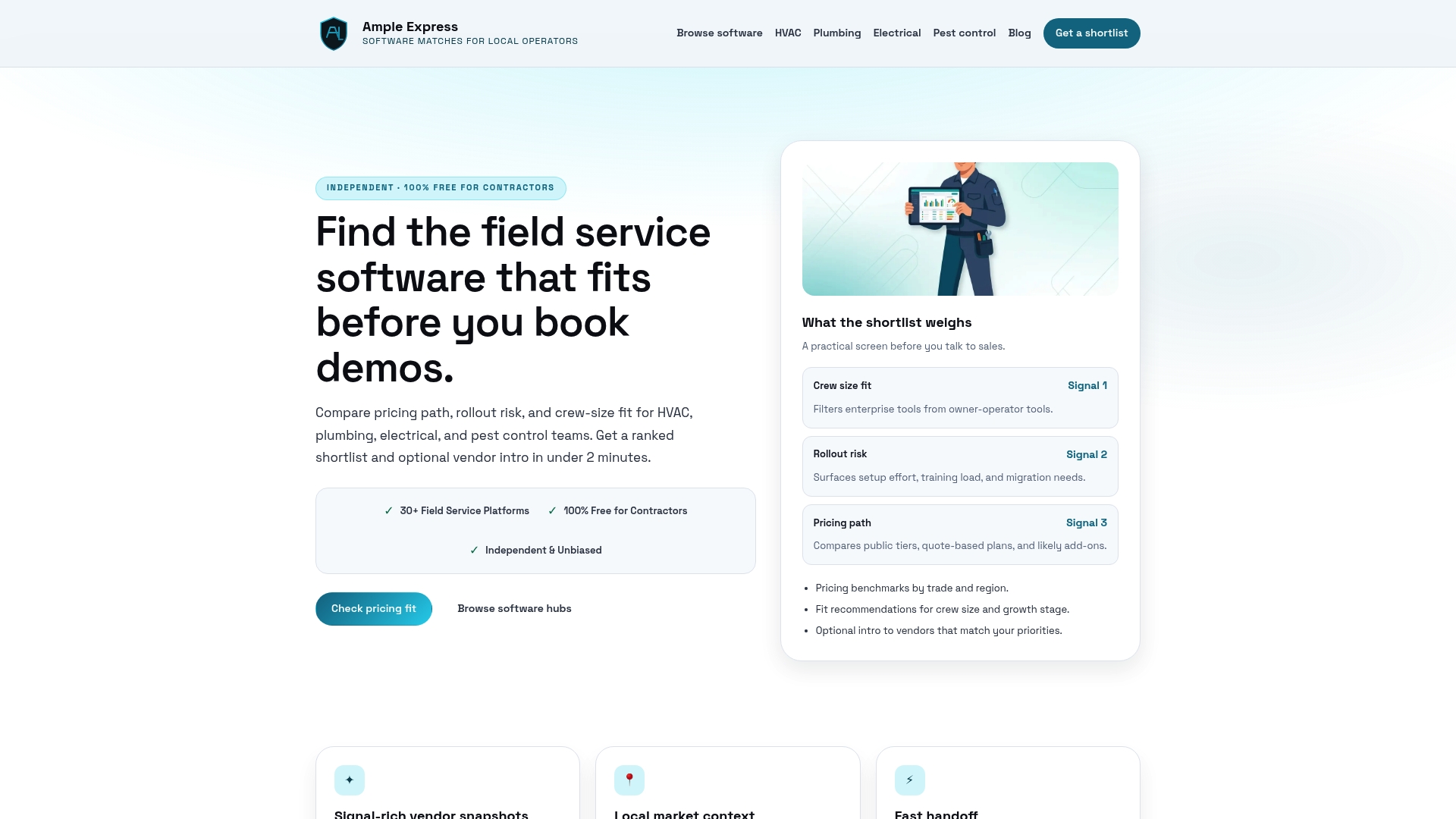
Ampleexpress ranks field service software by trade and crew size, so you see which platforms offer per-user plans, which offer flat-rate, and which pricing path fits your current operation and your 12-month growth plan. The shortlist includes over 30 tools with pricing transparency, rollout risk ratings, and fit recommendations built in. Share your crew size and priorities to get a tailored recommendation in minutes, without sitting through a vendor sales call first.
FAQ
What is per-user pricing in plumbing software?
Per-user pricing, also called seat-based pricing, charges a fixed monthly fee for each active user on your account. Platforms like Jobber and ServiceTitan use this model, with rates ranging from $13 to $398 or more per user depending on the plan tier.
When does per-user pricing cost more than flat-rate?
Per-user pricing typically exceeds flat-rate costs once your team reaches 4 or more technicians. Flat-rate plans capped at $300 to $700 per month for unlimited users become more cost-effective for growing shops beyond that threshold.
Does per-user pricing improve security for plumbing businesses?
Yes. Individual logins create role-based access controls and audit trails that shared-access plans cannot provide. The risk is that contractors sometimes share credentials to avoid per-user fees, which eliminates those security benefits.
What should I include in a total cost calculation for per-user software?
Your true total cost includes the per-user rate multiplied by your expected headcount, plus onboarding fees, add-on charges for features like GPS or reporting, and any annual price increase clauses written into the contract.
Can per-user pricing limit who gets software access on my team?
Yes. Because each additional user adds to your monthly bill, contractors often skip giving logins to apprentices, part-time staff, or office support roles. That limits workflow transparency and can create gaps in job tracking and invoicing accountability.
Recommended
- Get a Plumbing software shortlist
- Plumbing Software Hidden Fees: How to Avoid Them | Ample Express
- Why Software Bundling Saves Plumbing Teams Time and Money
- Plumbing Software ROI Calculation Guide for Contractors
- austin Plumbing software guide | Ample Express