
Contractor Operations Software Best Practices: 2026 Guide
Discover contractor operations software best practices to boost project margins, reduce errors, and enhance team accountability. Start optimizing today!
June 27, 2026
Article

Contractor operations software best practices are structured implementation and usage strategies that directly improve project margins, reduce admin errors, and build team accountability across field service businesses. The industry standard for successful deployment combines phased rollouts, workflow mapping, and operational controls. Contractors who apply these methods consistently see measurable gains in cost visibility and crew performance. This guide covers the top practices for HVAC, plumbing, electrical, and pest control contractors who want to get real results from their software investment.
1. Why phased implementation is the foundation of contractor software best practices
Phased implementation is the single most effective way to reduce software rollout risk. ERP failures drop by up to 70% when contractors deploy field tools first on pilot projects before expanding company-wide. That number reflects a hard reality: skipping the pilot phase means discovering critical problems after your entire team is already dependent on the new system.

A phased rollout follows a 6–12 week milestone structure. You start with one crew or one job type, resolve issues at that scale, then expand to the next group.
Key steps in a phased rollout:
- Week 1–2: Map your current workflows and identify the biggest friction points
- Week 3–6: Deploy the software with a pilot crew on active jobs
- Week 7–10: Collect feedback, fix configuration issues, and validate data
- Week 11–12: Prepare the full team for rollout with documented processes
Pro Tip: Identify internal champions in dispatch, field ops, and billing before launch. Champions drive adoption far more effectively than executive mandates alone.
Running old and new systems in parallel for at least one month lets you validate financial reporting and catch data discrepancies before you fully cut over. This parallel period is not optional. It is the safety net that protects your billing accuracy during the transition.
2. How workflow mapping improves project margins
Workflow mapping is the process of documenting every step from job requisition to final payment, then identifying where time and money are lost. Contractors using structured workflow mapping and real-time cost visibility see roughly 10% improvement in project margins. That gain comes from catching variance between estimated and actual costs before it compounds across multiple jobs.
Effective workflow mapping covers these areas:
- Requisition to purchase order: Track who approves material orders and how long each step takes
- Estimate to invoice: Verify that field labor hours match what gets billed
- Job costing variance: Compare budgeted versus actual costs at each project phase
- Dispatch to completion: Measure time from job assignment to sign-off
Real-time cost visibility is what turns a workflow map into a financial control tool. Without it, you are reviewing problems after the job closes rather than correcting them mid-project.
Pro Tip: When evaluating software, test it with your own project data rather than relying on vendor demos. Upload actual takeoffs, job photos, and labor records to see how the tool handles your real workload.
3. Operational controls that prevent workflow fragmentation
Treating software as an IT installation is the most common and costly mistake contractors make. Successful software deployment is an operating model redesign. That means establishing standardized approval workflows, budget inheritance rules, and billing controls before you configure a single screen.
The table below shows the core operational controls every contractor software setup should include.
| Control type | What it does | Why it matters |
|---|---|---|
| Budget inheritance | Pulls approved estimates into job cost budgets automatically | Prevents manual re-entry errors |
| Approval matrix | Routes purchase orders and change orders to the right approver | Stops unauthorized spending |
| Billing rules | Ties invoice generation to job completion milestones | Reduces billing disputes |
| Role-based access | Limits data visibility by crew role | Protects financial data |
Excessive customization is a warning sign. Custom code for standard workflows signals either poor software fit or over-specified requirements. If a vendor wants to build custom logic for a process every contractor uses, the software is not the right fit. Prioritize native integration with your accounting and payroll systems over all-in-one platforms that force you to abandon tools that already work.
4. Daily and weekly team rhythms that build accountability
Discipline in meeting cadence is a direct driver of profit margin. Short, structured weekly rhythms such as 15-minute Monday huddles and 10-minute Friday debriefs reduce errors and create a culture of transparency across field and office teams. The key word is short. Long meetings lose focus. Short meetings with a fixed agenda force clarity.
A practical weekly rhythm for a field service team looks like this:
- Monday huddle (15 minutes): Review the week's job schedule, flag resource conflicts, confirm crew assignments
- Wednesday check-in (10 minutes): Surface any active job issues, material delays, or billing holds
- Friday debrief (10 minutes): Capture completed jobs, note any callbacks or rework, confirm invoices sent
Role-specific scorecards reinforce this rhythm. Each team member tracks 3–5 measurable numbers tied to their role. A dispatcher tracks jobs scheduled versus completed. A field tech tracks callbacks per month. An office manager tracks days to invoice.
"Radical accountability starts with measuring the right numbers, not more numbers."
The software makes this possible by surfacing those numbers automatically. Without a system that captures job data in real time, scorecards become manual and unreliable.
5. Cost management: matching software features to your actual crew size
Software costs rise fast when you add users and modules without a plan. Contractor management software can exceed $800 per month for a 15-person team once per-user fees and add-ons stack up. That figure surprises most small contractors who start with a base subscription and expand incrementally without tracking total cost.
The table below maps feature categories to typical crew sizes.
| Feature category | Solo or 1–4 crew | 5–15 crew | 15+ crew |
|---|---|---|---|
| Scheduling and dispatch | Core need | Core need | Core need |
| Job costing and estimates | Core need | Core need | Core need |
| HR and compliance | Low priority | Medium priority | High priority |
| Project management | Low priority | Medium priority | High priority |
| Reporting and analytics | Low priority | Medium priority | High priority |
Focused tools that address your biggest pain point deliver more value than monolithic suites for most small and mid-size contractors. If your primary problem is field-to-office disconnect, a strong dispatch and job tracking tool solves that faster than a full enterprise platform. Add modules only when you have outgrown the current setup.
Pro Tip: Use a software cost calculator to model your true monthly spend before committing to any subscription. Include per-user fees, add-ons, and integration costs in the estimate.
You can also review the software selection checklist Ampleexpress publishes to verify you are evaluating the right feature tiers for your crew size.
6. Integration over all-in-one: why connected systems outperform monolithic platforms
Integration with accounting and payroll systems delivers more value than a single platform that tries to do everything. Native integrations reduce risk compared to third-party connectors, which are prone to sync failures and data loss. When your field service software connects directly to your accounting system, job costs flow into your books without manual re-entry.
Manual re-entry is where errors multiply. A tech closes a job in the field. Someone in the office re-enters the labor hours into the accounting system. A number gets transposed. The invoice is wrong. The client disputes it. That chain of events is preventable with a direct integration.
Evaluate any software by asking three integration questions:
- Does it connect natively to your accounting platform, or does it require a third-party connector?
- Does payroll sync automatically from field hours, or does someone export and import a file?
- Does the integration update in real time, or does it batch-sync overnight?
If the answers involve manual steps or third-party middleware, factor that risk into your decision. The cloud-based contractor software guide from Ampleexpress covers how integrated platforms prevent the workflow fragmentation that piecemeal tools create.
7. Continuous review: keeping your software setup aligned with growth
Software configuration that works for a 5-person crew often breaks down at 15 people. Scheduling logic, approval thresholds, and reporting structures all need review as your business grows. Build a quarterly software review into your operations calendar. Treat it the same way you treat a quarterly financial review.
A quarterly software review covers four areas:
- Workflow accuracy: Are the processes in the system still matching how your team actually works?
- User adoption: Are all team members using the system consistently, or are workarounds appearing?
- Cost audit: Are you paying for modules or seats you no longer use?
- Integration health: Are all connected systems syncing correctly with no manual corrections needed?
Leadership buy-in determines whether these reviews lead to action. If the owner or operations manager does not treat software discipline as a priority, the team will not either. The operational benefits of contractor software compound over time only when the setup keeps pace with the business.
Key takeaways
Applying contractor operations software best practices requires phased rollouts, mapped workflows, and disciplined team rhythms working together as a system, not as isolated steps.
| Point | Details |
|---|---|
| Phase your rollout | Use a 6–12 week pilot before full deployment to catch issues early. |
| Map workflows first | Document every step from requisition to payment before configuring software. |
| Set operational controls | Establish approval matrices and billing rules before going live. |
| Run short weekly rhythms | 15-minute huddles and role scorecards drive measurable accountability. |
| Match tools to crew size | Avoid paying for enterprise features your team size does not need. |
What I have learned about software adoption in the field
The contractors who get the most from their software are not the ones who bought the most features. They are the ones who did the hard work of mapping their processes before they ever logged into a new system.
I have seen crews adopt software quickly when they had an internal champion who understood both the field and the office. I have also seen expensive platforms sit unused because leadership assumed the software would fix a culture problem. It does not. Software surfaces problems. Your team has to solve them.
The resistance to new software is almost always about fear of accountability. When job costs are visible in real time, there is nowhere to hide a bad estimate or a billing delay. That visibility is uncomfortable at first. It becomes your biggest competitive advantage once the team adjusts.
My honest recommendation: start smaller than you think you need to. A focused tool that your crew uses every day beats a full platform that gets ignored. Build the habit first, then add capability. The incremental wins compound faster than any feature list.
— Blake
Ampleexpress helps contractors find the right fit
Choosing the wrong software costs more than the subscription fee. It costs you time, crew trust, and the months spent undoing a bad rollout.
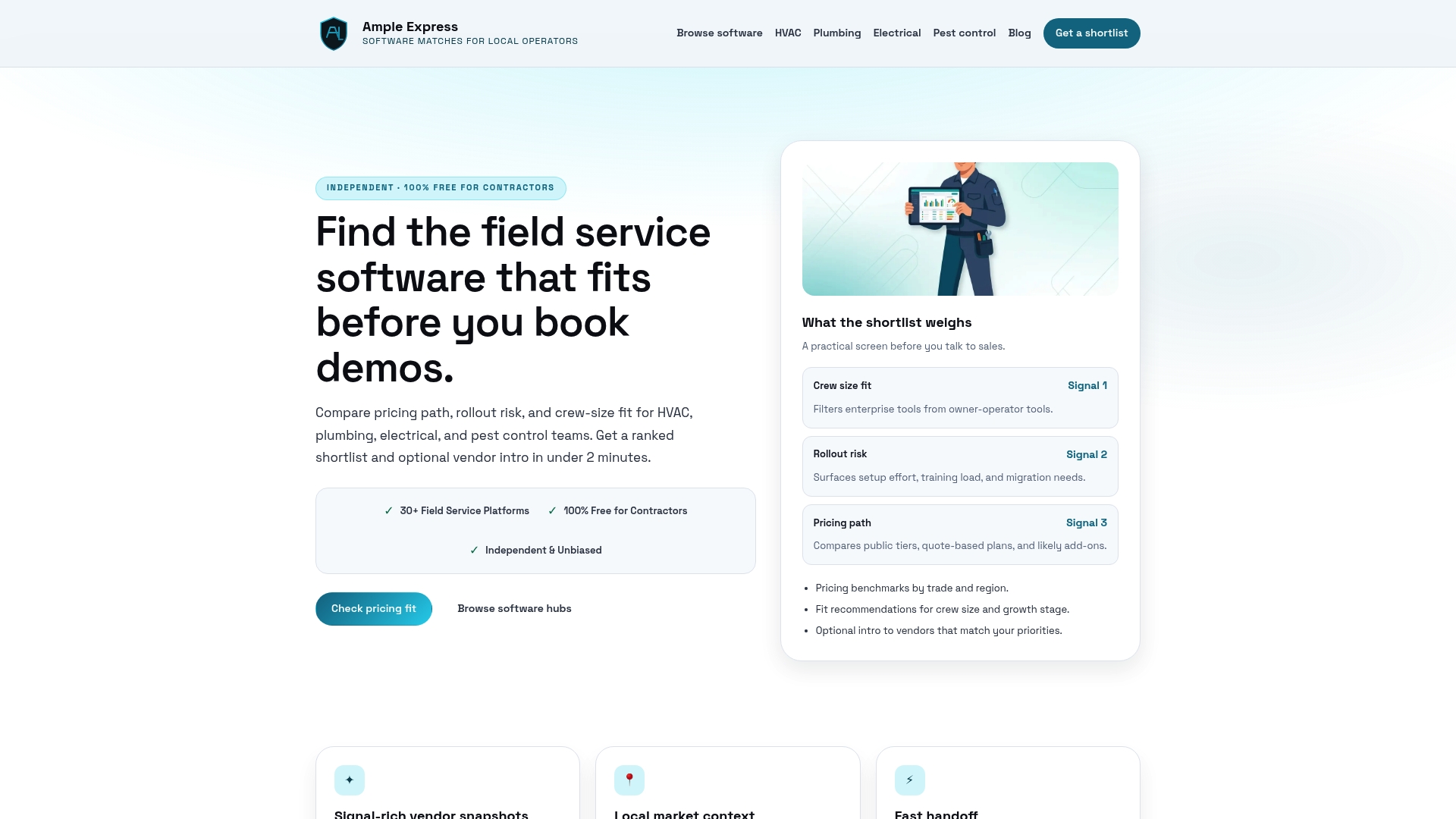
Ampleexpress evaluates over 30 field service software options by trade, covering HVAC, plumbing, electrical, and pest control teams. The platform ranks each option by crew size fit, rollout risk, and pricing path so you are not guessing. You get a shortlist built around your actual operation, not a generic top-ten list. If you want to know what your software stack will actually cost before you commit, the cost calculator tool gives you a clear number in minutes.
FAQ
What are contractor operations software best practices?
Contractor operations software best practices are structured approaches to software implementation and daily usage that improve project margins, reduce errors, and build team accountability. They include phased rollouts, workflow mapping, and disciplined meeting rhythms.
How long should a phased software rollout take?
A phased rollout typically runs 6–12 weeks, starting with a pilot crew before expanding to the full team. Running old and new systems in parallel for at least one month validates data accuracy before full cutover.
How much does contractor management software cost for a small team?
Costs vary widely by platform and crew size. Software subscriptions can exceed $800 per month for a 15-person team once per-user fees and add-ons are included. Focusing on tools that address your core pain points keeps costs in check.
Why is workflow mapping important before software setup?
Workflow mapping identifies bottlenecks and cost leaks before you configure the software. Contractors who map workflows first see roughly 10% improvement in project margins by catching variance between estimated and actual costs early.
Should contractors choose integrated tools or all-in-one platforms?
Integrated tools that connect natively to your accounting and payroll systems reduce manual re-entry errors and sync failures. All-in-one platforms can be useful at scale, but native integrations deliver more reliable data flow for most small and mid-size contractors.
Recommended
- Pest Control field service software
- Get a Pest Control software shortlist
- Contractor Software Selection Checklist for 2026 | Ample Express
- Why Contractors Need Software Solutions in 2026
- What Is Cloud-Based Contractor Software? 2026 Guide
- Best Electrical software for electrical companies with service contracts