
Software Scalability Factors in Field Service: 2026 Guide
Discover crucial software scalability factors in field service management for 2026. Learn how to improve efficiency and support growth.
July 5, 2026
Article

Software scalability in field service management is defined as a platform's ability to handle growing technician counts, job complexity, and data volume without degrading dispatch speed or service quality. The core software scalability factors field service managers must evaluate include scheduling architecture, API integration depth, cloud infrastructure, and user adoption rates. Feature utilization averages only 30–40% across field service platforms, which means most operations hit a performance ceiling long before they hit a headcount ceiling. Choosing software that addresses these factors from the start determines whether your operation grows cleanly or breaks under its own weight.
1. What are the key software scalability factors in field service?
Field service software scalability is determined by a cluster of interdependent factors, not a single feature. Weakness in any one area creates a bottleneck that limits the entire operation.
The primary factors affecting scalability in software for field service include:
- Scheduling architecture. Static or manual scheduling models hit a hard ceiling at around 50 technicians due to exponential decision complexity. Beyond that point, the number of possible job-technician combinations grows faster than any planner can evaluate.
- API integration depth. Connecting your field service management (FSM) platform to ERP, inventory, and CRM systems eliminates data silos. Without real-time data flow, dispatchers make decisions on stale information.
- Cloud infrastructure. On-premise systems require costly hardware upgrades to scale. Cloud-based platforms adjust capacity dynamically and support distributed teams across regions.
- User adoption rates. Low adoption produces incomplete job data. Incomplete data breaks automated workflows and forces manual intervention at exactly the wrong time.
- Performance visibility. Managers who monitor every job individually cannot scale. Exception-based reporting surfaces only the jobs that need attention, freeing capacity for growth.
- Mobile-first design. Field technicians who struggle with complex apps enter less data. Less data means fewer automated triggers and slower billing cycles.
Each factor compounds the others. Strong scheduling logic with poor mobile adoption still produces bad outcomes. Treat these factors as a system, not a checklist.
2. How scheduling complexity limits field service software scalability

Scheduling is the single biggest scalability bottleneck in field service operations. The reason is mathematical, not managerial.
Combinatorial scheduling problems require evaluating millions of scenarios in real time to find an optimal dispatch. Skills, SLAs, parts availability, travel time, and technician certifications all interact simultaneously. A human planner can hold roughly seven variables in working memory at once. A 60-technician operation with 200 daily jobs involves thousands of interacting constraints.
Manual and static calendar-based scheduling models collapse under this load. They produce suboptimal routes, missed SLAs, and frustrated technicians waiting on parts that were never checked against inventory. The result is not just inefficiency. It is a hard ceiling on how many technicians your operation can support without adding more planners.
Pro Tip: Treat your schedule as a living document, not a morning plan. Operations that re-optimize continuously throughout the day recover faster from cancellations, traffic delays, and emergency calls than those that lock in routes at 7:00 AM.
AI-driven scheduling algorithms address this by evaluating constraint combinations continuously. Continuous re-optimization and AI-driven dispatch reduce travel time, improve first-time fix rates, and keep SLA compliance intact as crew size grows. The practical implication: if your software cannot re-optimize mid-day, your scheduling model will not survive growth past 50 technicians.
3. Why integration maturity determines how far your software can scale
Integration depth is the infrastructure layer that either connects your operation or fragments it. A field service platform that cannot talk to your ERP, inventory system, or CRM forces staff to manually transfer data between systems. That manual transfer is slow, error-prone, and impossible to automate.
Global field service operations require 80 or more API connections to maintain consistent data flow across regions. That number reflects the real complexity of connecting FSM platforms with procurement, billing, HR, parts ordering, and customer communication tools. For most mid-market contractors, the number is smaller, but the principle holds: every disconnected system is a manual process waiting to fail.
The table below shows how integration maturity maps to operational scale:
| Integration level | Typical crew size | Key connections | Scalability risk |
|---|---|---|---|
| Basic (1–5 integrations) | 1–15 technicians | Invoicing, basic scheduling | High at growth stage |
| Intermediate (6–20 integrations) | 15–50 technicians | ERP, inventory, CRM | Moderate with planning |
| Advanced (20+ integrations) | 50–200+ technicians | Full API mesh, real-time sync | Low with proper governance |
Cloud-based optimization engines connected via secure APIs allow real-time scheduling adjustments without replacing your existing FSM platform. That matters because most operations cannot afford a full system replacement mid-growth. Understanding API best practices for FSM before you buy prevents expensive rework later.
4. How user adoption shapes field service management scalability
Software that technicians avoid is software that does not scale. Adoption is not a training problem. It is a design problem.
Feature overload causes adoption failure more often than feature gaps. When technicians face 15 menu options to close a job, they skip steps. Skipped steps mean missing job notes, unrecorded parts usage, and unsigned work orders. Those gaps break the automated billing and reporting workflows that make scaling possible.
The factors that drive adoption in field service apps include:
- Mobile-first interface. Apps designed for a desktop first and a phone second frustrate field users. Technicians need one-tap job updates, photo capture, and signature collection without navigating complex menus.
- Focused feature sets. Prioritize the five to eight features that directly address your operation's pain points. Every additional feature beyond that threshold reduces adoption rates.
- Short onboarding cycles. Training that takes more than two days signals a UX problem, not a complexity problem. Simpler software gets used consistently.
- Real-time data accuracy. When technicians trust that their inputs affect their schedules and pay, compliance improves. Connect data entry to outcomes they care about.
Pro Tip: Before evaluating any new platform, map the three tasks your technicians perform most often. If those three tasks require more than four taps each, adoption will suffer regardless of how many features the platform offers.
Technician adoption barriers arise primarily from complexity, not from software capability gaps. Simplifying UX and focusing training on core workflows produces better data quality than adding more features ever will.
5. What best practices improve software scalability in field service?
Scaling field service operations without breaking them requires a deliberate shift in how managers use their software. The most common failure mode is trying to scale manual processes rather than replacing them with automated ones.
Shift to manage-by-exception reporting
Exception-based reporting surfaces anomalies proactively before they become revenue losses. Instead of reviewing every job status, you set thresholds. The system alerts you when a job exceeds its time window, a technician misses a check-in, or a part is unavailable at dispatch. That shift from monitoring everything to acting on deviations is what makes managing 100 technicians feel like managing 20.
Enforce rules-based dispatch
Automated dispatch rules remove the human bottleneck from routine scheduling decisions. Rules can enforce skills matching, SLA priority tiers, and geographic clustering without a dispatcher manually reviewing each job. Adding more dispatchers beyond a certain crew size increases coordination overhead without solving the underlying complexity problem.
Invest in continuous re-optimization
Static morning schedules break by 9:00 AM. Traffic delays, no-shows, and emergency calls disrupt the plan within the first hour. Software that re-optimizes continuously absorbs those disruptions and reassigns work without manual intervention. This is the single highest-leverage investment for operations growing past 30 technicians.
Operational scalability is limited by decision complexity far more than by volume. The organizations that scale cleanly are those that automate the decisions, not just the paperwork. Shifting focus from adding headcount to improving scheduling logic and exception management is what separates operations that grow profitably from those that grow chaotically.
Review your field service software fit against these criteria before committing to a platform. The right architecture at 20 technicians prevents a painful migration at 60.
Key Takeaways
Scalability in field service software fails at the scheduling layer first, then at integration, then at adoption. Fixing all three together is the only path to sustainable growth.
| Point | Details |
|---|---|
| Scheduling hits a ceiling at 50 technicians | Manual models cannot handle combinatorial complexity; AI-driven re-optimization is required beyond this threshold. |
| Integration depth determines data quality | Operations with advanced API connections maintain real-time data flow and avoid manual transfer errors at scale. |
| Feature overload kills adoption | Average feature utilization sits at 30–40%; prioritizing core workflows drives better data and faster billing cycles. |
| Exception reporting replaces micromanagement | Automated alerts surface only deviations, freeing managers to focus on growth rather than monitoring every job. |
| Cloud architecture enables multi-region growth | Cloud platforms adjust capacity dynamically and support distributed teams without hardware investment. |
Scaling is about managing complexity, not just adding headcount
The most common mistake I see field service managers make is treating growth as a volume problem. They hire more dispatchers, add more planners, and buy more seats. The operation gets bigger and slower at the same time.
The real constraint is decision complexity. A 60-technician operation does not have three times the complexity of a 20-technician operation. It has exponentially more. Every additional technician, skill type, SLA tier, and service zone multiplies the number of scheduling combinations the system must evaluate. Manual processes cannot keep up. More staff cannot keep up. Only better logic keeps up.
What I have found consistently is that the operations that scale well treat their schedule as a dynamic asset. They re-optimize throughout the day. They set exception thresholds before problems occur. They connect their FSM to inventory and ERP so dispatchers never work from stale data. The 2026 field service software landscape shows that the gap between operations using dynamic scheduling and those still using static calendars is widening fast.
The other thing worth saying directly: adoption matters more than features. I have watched operations buy enterprise platforms with 200 features and use 12 of them. The technicians hated the app, skipped data entry steps, and the automated workflows never fired correctly. A simpler platform used consistently outperforms a powerful one used poorly every single time.
— Blake
Ampleexpress helps you find software built to grow with your operation
Selecting software that handles your current crew size is straightforward. Selecting software that handles your crew at two or three times the size requires a different evaluation entirely.
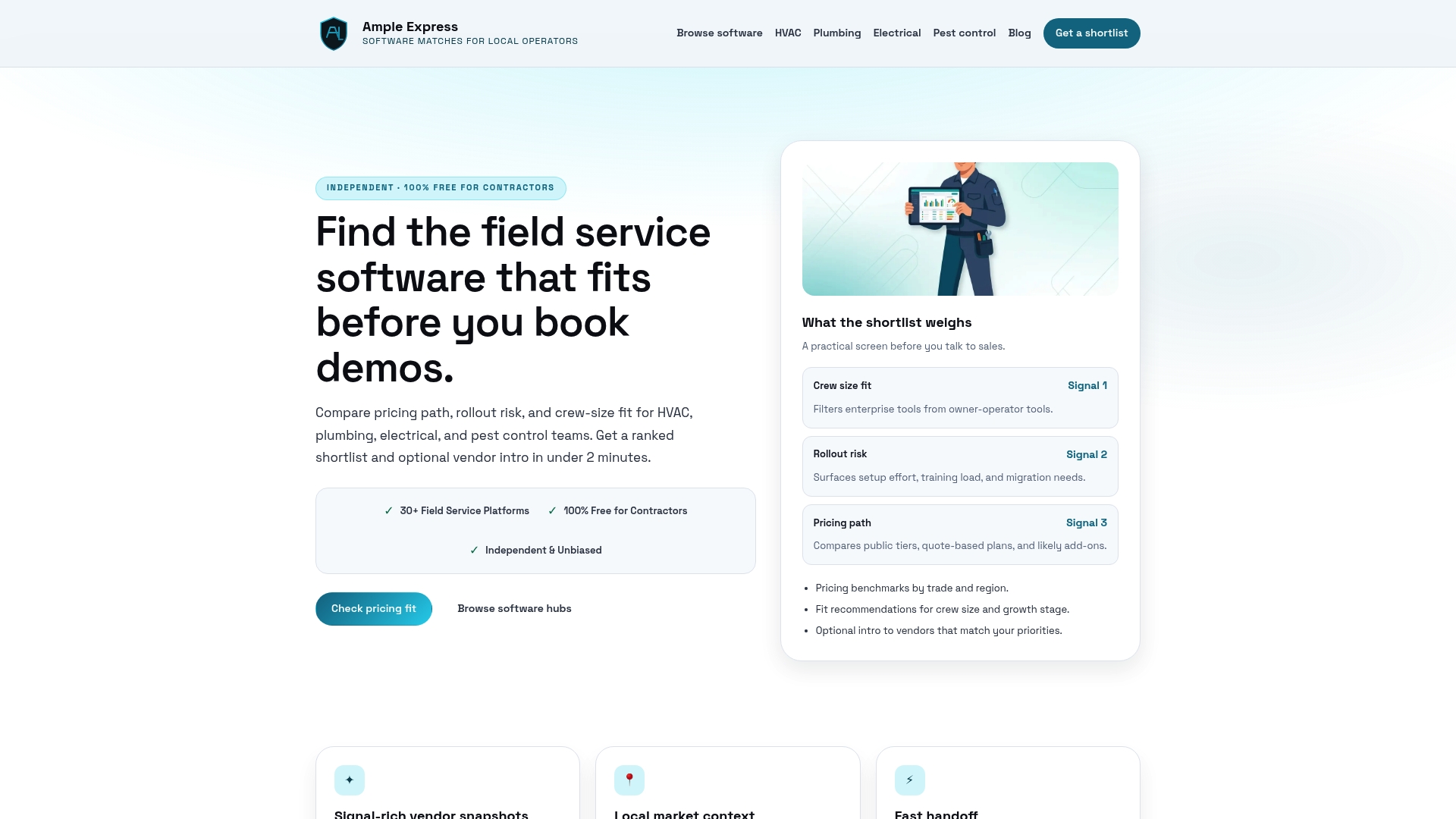
Ampleexpress evaluates over 30 field service software options by trade, ranking each one on integration depth, scheduling architecture, mobile UX, and rollout risk. Whether you run an HVAC team, a plumbing crew, an electrical operation, or a pest control business, Ampleexpress provides a ranked shortlist matched to your crew size and growth trajectory. You get regional pricing benchmarks, fit recommendations, and a clear view of which platforms will support your operation at scale. Share your crew size and priorities to get a tailored shortlist in minutes.
FAQ
What is the scalability ceiling for manual scheduling in field service?
Manual and static scheduling models hit a hard ceiling at approximately 50 technicians. Beyond that point, the combinatorial complexity of matching skills, SLAs, and travel time exceeds what any human planner can evaluate in real time.
How many API integrations does a large field service operation need?
Large-scale or global field service operations typically require 80 or more API connections to maintain consistent data flow across FSM, ERP, inventory, and CRM systems. Mid-market operations need fewer, but the principle of real-time integration applies at every size.
Why is feature utilization so low in field service software?
Feature utilization averages 30–40% because most platforms are designed with breadth rather than workflow focus. Technicians skip complex steps, which reduces data quality and breaks automated processes downstream.
What is manage-by-exception reporting in field service?
Manage-by-exception reporting is a system configuration where automated alerts flag only jobs or metrics that fall outside defined thresholds. It replaces manual job-by-job monitoring and allows managers to oversee larger crews without increasing oversight headcount.
How does cloud architecture support field service software scalability?
Cloud-based platforms adjust compute capacity dynamically and support thousands of concurrent users across multiple regions without hardware upgrades. They also enable real-time API connections to external systems, which is the foundation of integration maturity at scale.