
Payment Processing in Plumbing Software: 2026 Guide
Discover the role of payment processing in plumbing software. Improve cash flow and streamline operations with integrated payment solutions.
July 11, 2026
Article

Payment processing in plumbing software is defined as the built-in capability that lets technicians collect, authorize, and record customer payments directly within their job management platform. The role of payment processing in plumbing software extends far beyond accepting a credit card at the door. It connects financial transactions to scheduling, dispatch, invoicing, and accounting in one continuous workflow. Plumbing businesses that ignore this integration face a real cost: traditional operations lose $85,000 annually to delayed payments and administrative overhead. The industry standard for payment security, PCI DSS 4.0, became effective in march 2025 and now governs how any compliant platform handles cardholder data.
How does payment processing in plumbing software improve cash flow?
Integrated payment processing transforms how money moves through a plumbing business. Instead of mailing invoices and waiting weeks, technicians collect payment the moment a job closes. Plumbing companies using integrated mobile payment systems achieve a 94% same-day payment rate and 78% improved cash flow, while eliminating 40+ monthly hours of payment admin. That is not a marginal gain. It is the difference between funding payroll from receivables versus a line of credit.
The mechanics work like this:
- A technician completes a repair and opens the job in the mobile app.
- The software auto-generates an invoice tied to that job record.
- The customer pays by credit card, ACH, or digital wallet on-site.
- Funds deposit within 24 hours, and the invoice status flips to "Paid" in real time.
- The transaction syncs to your accounting platform without manual entry.
This loop cuts Days Sales Outstanding (DSO) from weeks to minutes. Automated follow-ups, digital receipts, and multi-method payment support handle the collection tasks that previously required a dedicated office staffer.
Pro Tip: Set your software to auto-sync payment records to QuickBooks or your accounting platform the moment a transaction clears. Manual re-entry labor can exceed your monthly software subscription cost, and errors compound at tax time.

What do payment processing fees cost plumbing businesses?
Fees are the most overlooked line item in plumbing software budgets. Card-processing fees for home service businesses typically range from 2.5% to 3.5% per transaction. For a shop processing six-figure card volumes annually, those fees can exceed the cost of the software subscription itself. That context changes how you should evaluate any platform's payment integration.
Two pricing models dominate the market:
- Flat-rate pricing. The processor charges one fixed percentage on every transaction regardless of card type. Simple to predict, but often more expensive for high-volume businesses.
- Interchange-plus pricing. The processor passes through the actual interchange cost set by card networks, then adds a fixed markup. Interchange-plus pricing can offer significant savings when matched to your actual transaction volume and card mix.
Most plumbing software bundles flat-rate processing because it is easy to sell. That convenience costs you money if your monthly card volume is high. Model your fees against real transaction data before you commit to a platform. Pull three months of payment records, apply both pricing models, and compare the annual totals.
Many plumbing businesses overlook this fee modeling step and pay more than necessary for years. A 0.5% difference in processing rate on $500,000 in annual card volume is $2,500 per year, every year.
Pro Tip: Always carry a backup mobile card reader on every truck. Card-not-present transactions, such as manually keyed-in card numbers when a reader fails, typically incur an additional 0.3% to 0.5% fee per transaction.
What features should plumbing software payment solutions include?
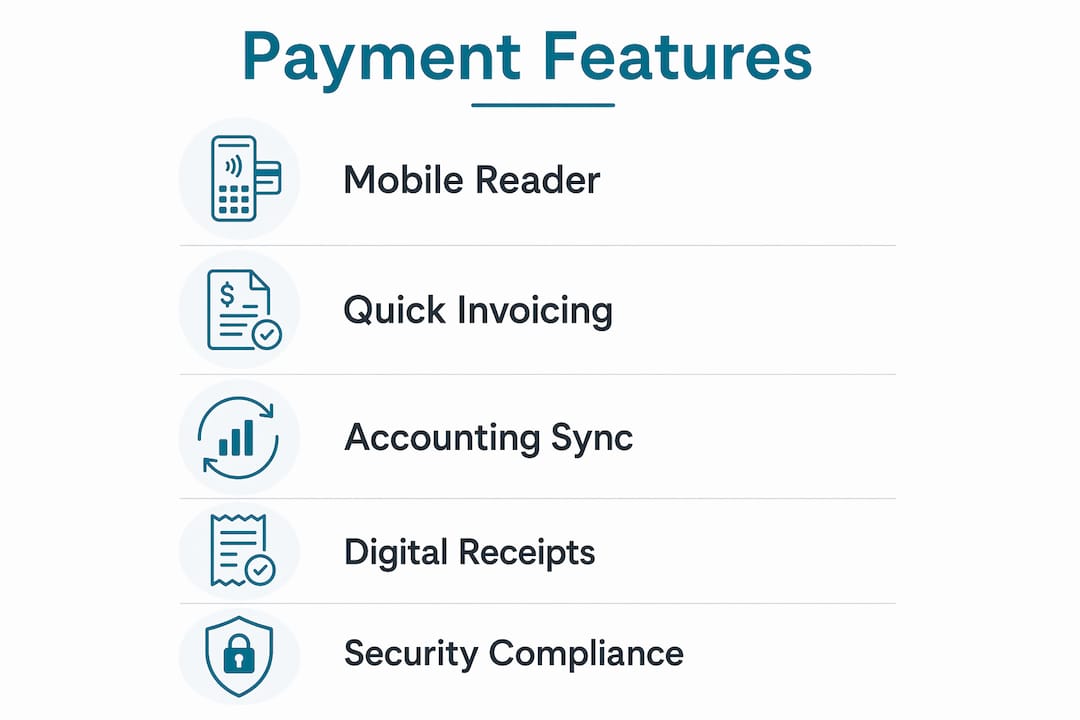
The right payment integration does more than accept cards. It connects every financial touchpoint in your operation. When evaluating plumbing software payment solutions, prioritize platforms that deliver the following:
- Multi-method payment acceptance. Credit cards, ACH bank transfers, and digital wallets like Apple Pay and Google Pay. Customers expect options, and ACH transfers carry lower fees than card transactions.
- Mobile payment capability. Technicians need to collect payment at the job site, not back at the office. Mobile card readers paired with a field app close the collection gap immediately.
- Automated invoice generation. The invoice should generate from the completed job record, not from a separate manual process. This eliminates transcription errors and speeds billing.
- Accounting integration. Direct sync with platforms like QuickBooks eliminates costly admin labor and errors caused by manual data re-entry.
- Automated follow-up for declined payments. The software should retry failed transactions and notify customers without requiring staff intervention.
- PCI DSS 4.0 compliance. Integrated encrypted payment gateways protect cardholder data and keep your business compliant with current security standards.
The table below shows how these features map to specific operational outcomes:
| Feature | Operational benefit |
|---|---|
| Mobile card reader + field app | Collects payment at job close, same day |
| ACH payment support | Reduces per-transaction fees vs. card |
| Auto-invoice from job record | Eliminates billing errors and delays |
| QuickBooks sync | Removes manual reconciliation labor |
| Declined payment retry | Recovers revenue without staff effort |
| PCI DSS 4.0 gateway | Protects customer data, reduces breach risk |
Payment infrastructure is a layered system involving card networks, acquiring banks, processors, and gateways. Each layer adds a fee. Platforms that consolidate these layers into one end-to-end system give you more control over costs and data.
Best practices for implementing payment processing in your plumbing business
Getting the software right is only half the job. How you configure and run it determines whether you capture the full financial benefit.
- Model total cost before selecting a platform. Calculate processing fees at your actual card volume, not a hypothetical average. Add software subscription costs, hardware costs, and estimated labor savings. The cheapest subscription often carries the most expensive processing rate.
- Verify accounting sync depth. Confirm that payment records, not just invoice totals, sync to your accounting platform. Shallow integrations push summary data and still require manual reconciliation at month end.
- Train every technician on the payment workflow. A technician who skips the in-app payment step because it feels unfamiliar costs you same-day collection on every job they run. Build a short training session into your onboarding process.
- Maintain backup card readers on every truck. Hardware failure at the job site forces manual card entry, which raises your per-transaction fee and creates a poor customer experience.
- Monitor authorization rates and payment churn monthly. Companies that control payment infrastructure outperform those using fully outsourced models. Tracking authorization rates tells you whether your processor is declining legitimate cards, which costs you revenue.
Pro Tip: Review your plumbing software hidden fees annually. Processors and software vendors adjust fee structures, and a rate that was competitive at signup may no longer be after 12 months.
True integration requires more than software connectivity. Poor workflow alignment causes manual data entry and reconciliation errors that cancel out the benefits of payment automation entirely. Define your payment workflow end-to-end before you configure the software, not after.
Key Takeaways
Integrated payment processing is the single highest-impact financial feature a plumbing business can add to its software stack, directly cutting DSO, reducing admin labor, and protecting revenue through compliance and fee control.
| Point | Details |
|---|---|
| Same-day payment rate | Integrated mobile payments drive a 94% same-day collection rate, eliminating weeks of receivables lag. |
| Fee modeling is non-negotiable | Model interchange-plus vs. flat-rate pricing against your actual card volume before committing to a platform. |
| PCI DSS 4.0 compliance | Any payment gateway you use must meet PCI DSS 4.0 standards, effective march 2025, to protect cardholder data. |
| Accounting sync depth matters | Confirm payment records sync directly to your accounting platform to eliminate manual reconciliation. |
| Backup hardware reduces fees | A secondary card reader prevents card-not-present surcharges of 0.3% to 0.5% per transaction when primary devices fail. |
Payment processing is a revenue decision, not a software checkbox
I have reviewed dozens of plumbing software evaluations where the payment processing section gets two minutes of attention and the scheduling module gets two hours. That priority is backwards. Scheduling affects how you deploy labor. Payment processing affects whether you get paid for that labor, and how quickly.
The businesses I see running the tightest operations treat payment infrastructure the same way they treat their truck fleet. They track it, maintain it, and negotiate it. They know their authorization rate. They know their blended processing cost. They have modeled what a 0.3% fee reduction would mean annually. That level of attention is not obsessive. It is what separates a profitable shop from one that is always chasing receivables.
The pitfall I see most often is owners who accept the bundled payment processing rate embedded in their software without question. That rate was set to be profitable for the software vendor, not for you. Interchange-plus pricing, negotiated hardware rates, and a clear accounting sync are not advanced topics. They are table stakes for any shop processing more than $200,000 in annual card volume.
Evaluate your payment setup the same way you evaluate a parts supplier. Ask for the rate sheet. Run the numbers. Switch if the math says to switch. Your software should work for your margin, not against it.
— Blake
How Ampleexpress helps plumbing businesses find the right payment integration
Ampleexpress evaluates over 30 field service software options for plumbing contractors, ranking each by payment processing depth, accounting sync quality, fee transparency, and crew size fit. The platform gives you a ranked shortlist built around your actual transaction volume and operational needs, not a generic feature checklist.
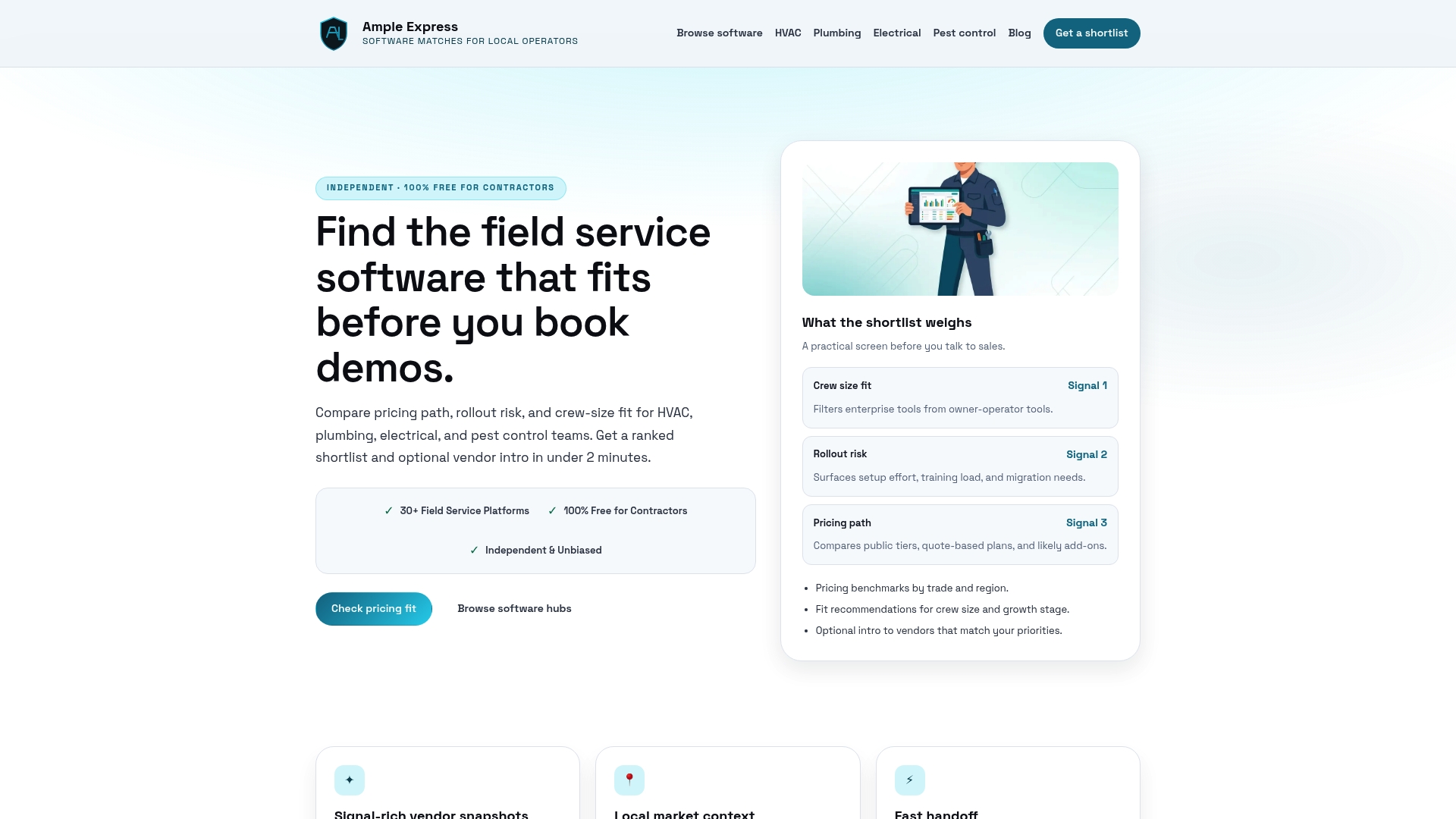
If you are comparing platforms and want to know which ones offer interchange-plus pricing, true QuickBooks sync, and PCI DSS 4.0 compliant gateways, Ampleexpress surfaces that detail without requiring you to read every vendor's fine print. Share your crew size and monthly card volume, and the platform returns a shortlist matched to your numbers. Visit the plumbing software comparison page to see ranked options with pricing paths and rollout risk scores included.
FAQ
What is the role of payment processing in plumbing software?
Payment processing in plumbing software connects on-site payment collection to invoicing, job records, and accounting in one automated workflow. It eliminates manual billing steps and reduces the time between job completion and cash in the bank.
How does payment processing work in a field service app?
A technician completes a job, the app generates an invoice, and the customer pays by card, ACH, or digital wallet on-site. Funds deposit within 24 hours, and the invoice status updates automatically in the accounting system.
What are typical payment processing fees for plumbing businesses?
Card-processing fees typically range from 2.5% to 3.5% per transaction for home service businesses. High-volume shops can reduce costs significantly by switching from flat-rate to interchange-plus pricing models.
Why does PCI DSS compliance matter for plumbing software payments?
PCI DSS 4.0, effective march 2025, sets the security standard for handling cardholder data. Plumbing software with a compliant encrypted gateway protects your customers and reduces your liability in the event of a data breach.
How can plumbing businesses reduce payment processing costs?
Model your actual card volume against both flat-rate and interchange-plus pricing before selecting a platform. Carry backup card readers on every truck to avoid card-not-present surcharges of 0.3% to 0.5% per transaction.