
Local Software Vendor Availability: What It Means for Your Business
Discover what local software vendor availability means for your business. Fast support, regional teams, and industry expertise can boost efficiency!
July 22, 2026
Article

Local software vendor availability refers to how accessible a software provider is to your business, whether through a nearby physical office, a regional support team, or a local partner network. It is not just about geography. It covers how quickly a vendor can respond to your needs, how well they understand your industry, and whether they can show up when something goes wrong.
Here is what local availability actually looks like in practice:
- Physical proximity: The vendor has an office or team within your region or state.
- Regional support teams: Dedicated staff who operate in your time zone and understand your market.
- Local partner networks: Authorized resellers or service partners who can provide onsite help.
- Industry familiarity: Vendors who have worked with businesses like yours in your area.
- Operational responsiveness: Faster turnaround on support tickets, training, and updates.
For field service businesses, HVAC crews, plumbers, and electricians, this kind of access can be the difference between a software problem resolved in hours versus days.
***
Why local vendor availability gives your business a real edge
Local vendor proximity delivers faster support, deeper industry understanding, and more resources on hand when you need them. That combination is hard to replicate with a vendor headquartered across the country or overseas.
- Industry knowledge: Boutique local vendors understand the specific operational gaps of small businesses far better than large platforms built for enterprise clients.
- No time zone or language friction: A 100% US-based team can serve Midwest and regional businesses without the delays that come from offshore support queues.
- Face-to-face access: Onsite visits, in-person training, and direct relationship-building are realistic with a local provider.
- Long-term partnership: Local vendors are invested in your success because your reputation feeds theirs. That accountability tends to produce better software fit and faster adoption.
- Cultural alignment: A vendor who operates in your region understands local regulations, workforce norms, and customer expectations.
Pro Tip: Do not evaluate a vendor's availability based on their zip code alone. Ask how many clients they actively support in your region, what their average response time is, and whether they offer a named account contact rather than a generic help desk.
***
How to find and evaluate local software vendors
Finding the right local provider takes more than a Google search. Use business directories, industry associations like the Air Conditioning Contractors of America (ACCA) or the Plumbing-Heating-Cooling Contractors Association (PHCC), and peer referral networks to build a shortlist. Then verify each vendor's actual service reach before you commit.
- Confirm market presence: Ask for a list of active clients in your region. A vendor with local references is a vendor with local accountability.
- Assess support responsiveness: Request their average ticket resolution time and find out whether support is handled in-house or outsourced.
- Review contract terms: Look for fixed-price contracts and long-term maintenance agreements. Avoid arrangements where you cannot access your own data or source code if the relationship ends.
- Check for exit strategies: Savvy businesses require clear terms around data portability and code ownership before signing anything.
- Evaluate ongoing care: A vendor who offers a structured maintenance and update plan is far less likely to build and abandon your software after launch.
Pro Tip: Before signing, ask the vendor directly: "What happens to our software and data if your company closes or is acquired?" A vendor who cannot answer that question clearly is a vendor worth reconsidering.
Ampleexpress publishes a vendor selection guide that walks through these evaluation criteria in detail, including how to weight local availability against feature fit and pricing.
***
Clarifying common terms around software vendors
What is a software vendor?
A software vendor is any company or individual that creates and sells software products. This includes independent software vendors (ISVs), which are organizations that build solutions independent of specific hardware platforms, as well as custom development shops that build software tailored to a single client's needs. Vendors sell through perpetual licenses, subscription agreements, or one-time build fees.
What makes a vendor "local"?
A local vendor operates within your geographic region, typically your state or metro area, and provides support without significant time zone or travel barriers. The distinction from a remote or global vendor is not just distance. It is about whether the vendor can realistically show up, respond quickly, and understand your regional market context.
How does vendor availability differ from software uptime?
These two concepts are often confused. Vendor availability describes how accessible your software provider is for support, updates, and collaboration. Software uptime, or system availability, refers to whether the application itself is running. Critical applications require high-availability middleware to guarantee near-continuous uptime regardless of which vendor built the software. A local vendor does not automatically mean higher uptime.
How do I find my software vendor?
Check your software's documentation, license agreement, or admin portal for the vendor's contact information. For field service software, your vendor is typically listed in the billing section or the original purchase confirmation.
***
What vendor availability really means beyond proximity
Geography is a starting point, not the full picture. Vendor availability is best evaluated through the lens of ongoing care and continuous collaboration, not just where the vendor's office is located.
- Care subscriptions matter: A vendor who offers structured post-launch support, bug fixes, and updates prevents the "build-and-abandon" pattern that leaves businesses stuck on outdated software.
- Hyper-local development models: Some local vendors offer a one-time build fee with full software ownership, which eliminates subscription price hikes and gives you complete control over your tools.
- Uptime is a separate problem: Even the most accessible local vendor cannot guarantee your software stays online without proper infrastructure design. High availability requires middleware built for 99.999% uptime, which is an engineering decision, not a vendor location decision.
- Enterprise tools often miss the mark: Local business software is one of the most underserved categories in software. Generic enterprise platforms get watered down for small operators rather than rebuilt for their actual workflows.
- Exit strategy is part of availability: If you cannot access your code or data when a vendor relationship ends, that vendor was never truly available to you.
***
Challenges of relying solely on local software vendors
Local vendors offer real advantages, but depending on them exclusively comes with trade-offs worth understanding before you commit.

The talent pool in any single region is limited. A local vendor may not have specialists in every area your software requires, whether that is mobile development, API integrations, or compliance-specific features. Smaller shops also carry concentration risk. If a key developer leaves or the business closes, your support structure disappears with them.
Pricing can also be higher for custom local builds compared to established SaaS platforms. Purpose-built local tools tend to price modestly for simpler vertical solutions, but custom development projects typically involve upfront costs that off-the-shelf software does not. You also have fewer options to compare. A regional market may have only one or two vendors who specialize in your trade, which limits your negotiating position.
***
Local vs. remote or global software vendor availability
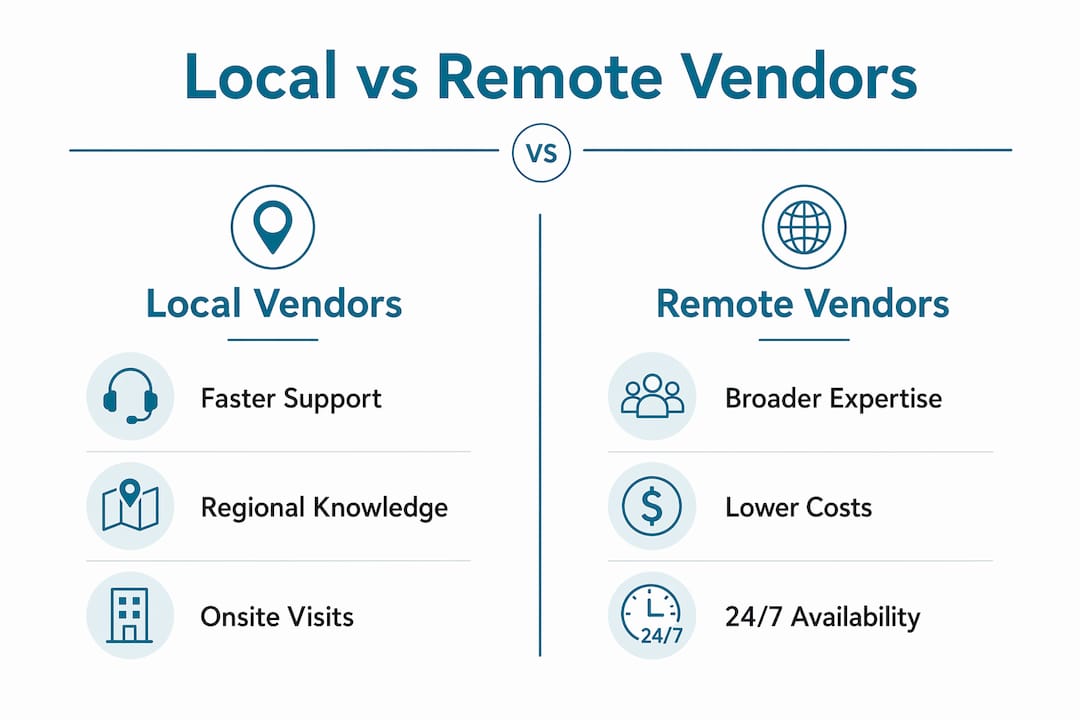
The core trade-off comes down to responsiveness versus breadth. Local vendors offer faster onsite support, regional industry knowledge, and direct relationships. Remote or global vendors typically offer more features, larger development teams, and lower per-seat pricing at scale.
For a three-person plumbing crew, a local vendor who understands dispatch workflows and regional permit requirements will often outperform a large platform that was built for mid-market companies and scaled down. For a 50-technician HVAC operation with complex inventory and multi-location scheduling, a nationally available platform with dedicated enterprise support may be the stronger fit. The right choice depends on trade, crew size, and how much customization your operation actually needs.
Remote vendors also carry time zone risk and language barriers that local providers avoid. That said, many national platforms now offer regional support teams, which blurs the line between local and remote availability. Verify whether "regional support" means a dedicated local contact or simply a support queue routed by area code.
***
Industries that benefit most from local software vendor availability
Field service trades gain the most from local vendor relationships. HVAC, plumbing, electrical, and pest control businesses operate in highly localized markets with region-specific licensing requirements, seasonal demand patterns, and customer bases built on referrals. A vendor who understands those dynamics builds better software for them.

Small manufacturers and industrial service companies in regions like the Midwest also benefit significantly. Local vendors who specialize in these sectors can address operational gaps that generic platforms miss entirely. Healthcare-adjacent service businesses, such as home health aides and medical equipment repair, face compliance requirements that vary by state, making a locally knowledgeable vendor a practical asset. Restaurants, salons, and other neighborhood service businesses round out the list. With millions of small businesses operating across the United States, many still using outdated tools or spreadsheets, the demand for purpose-built local software continues to grow.
For local apps and small-town businesses, the advantages of working with nearby vendors extend beyond software features to community investment and long-term reliability.
***
Ready to find the right software for your crew?
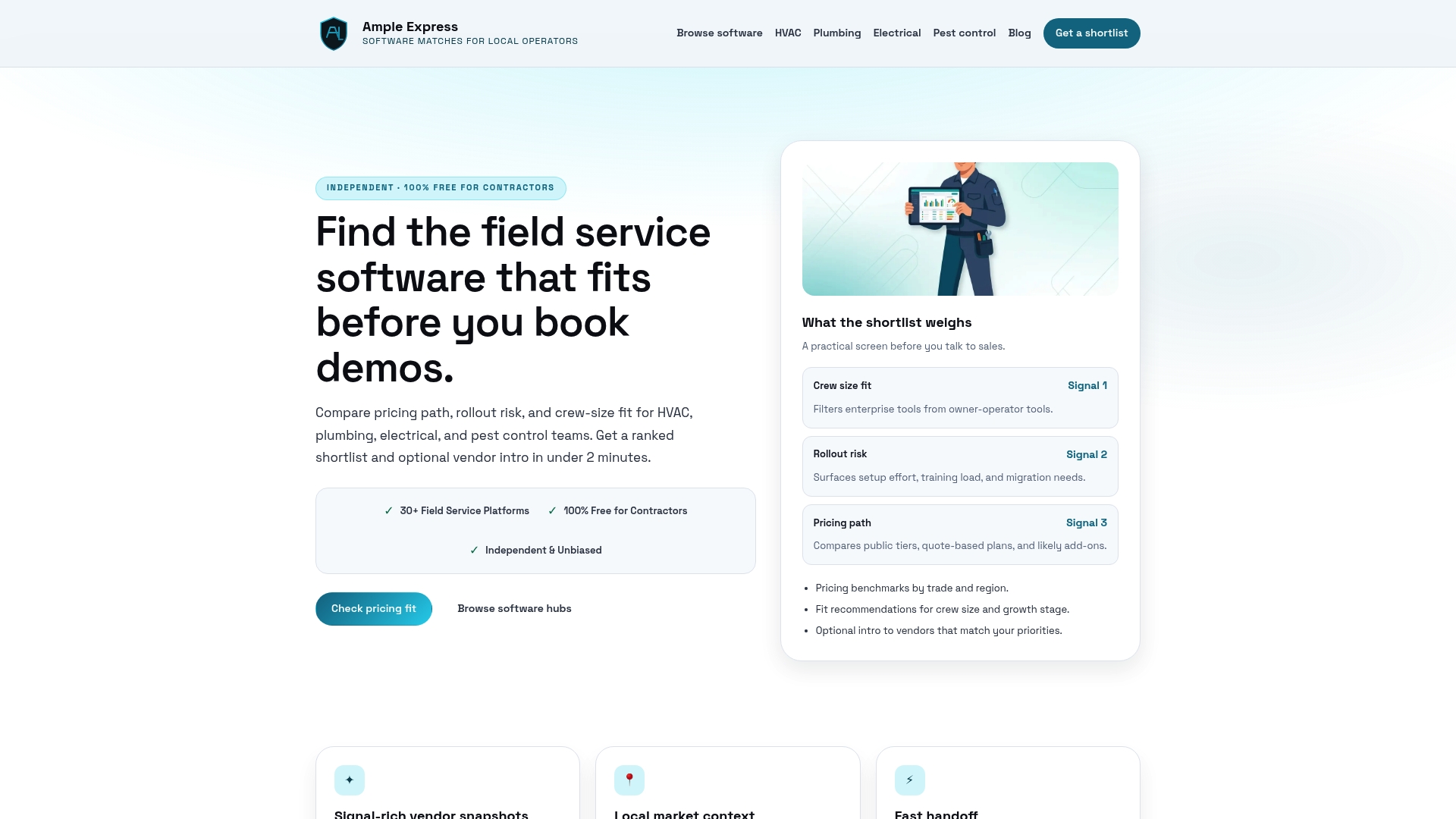
Ampleexpress helps field service contractors cut through the noise and find software that actually fits their operation. The platform ranks over 30 field service software options by crew size, pricing path, and rollout risk, with local market context built in. Share your trade and crew size to get a ranked shortlist in minutes.
Explore field service software by trade and see which options fit your region, budget, and team size.
***
Key Takeaways
Local software vendor availability covers both physical proximity and the ongoing support, care, and collaboration a vendor provides after your software goes live.
| Point | Details |
|---|---|
| Availability means more than location | Vendor accessibility includes support responsiveness, care plans, and exit strategy terms. |
| Local vendors know your market | Boutique regional providers understand operational gaps that generic enterprise platforms miss. |
| Uptime is a separate concern | System availability requires high-availability middleware for 99.999% uptime, independent of vendor location. |
| Evaluate contracts carefully | Fixed-price agreements and source code ownership protect you if the vendor relationship ends. |
| Field service trades benefit most | HVAC, plumbing, electrical, and pest control businesses gain the most from locally aligned software vendors. |
Recommended
- Pest Control field service software
- Get a Pest Control software shortlist
- Multi-Vendor Software Comparison: A 2026 Guide for Managers
- Software Vendor Selection: A Decision-Maker's 2026 Guide
- Why Software Customization Matters for Contractors
- Compare Field Service Software Side by Side (2026) | Ample Express