
Why Software Customization Matters for Contractors
Discover why software customization matters for contractors. Tailor technology to reduce admin time by 30-40% and boost accuracy today!
July 10, 2026
Article

Software customization for contractors is the process of tailoring technology to fit the specific workflows, crew sizes, and billing structures of contracting businesses. Generic platforms are built for broad markets. They are not built for your dispatch board, your change order process, or your subcontractor billing cycle. Custom software reduces administrative time by 30–40% and improves estimate accuracy by 15–20% by drawing on historical job data. Those numbers explain why software customization matters for contractors more than any feature checklist ever could. If your current platform forces you to work around it rather than with it, that friction costs you money every single day.
Why software customization matters for contractors' daily operations
Tailored software removes the friction that generic platforms build into your day. When a tool mirrors your actual workflow, your crew stops wasting time on workarounds and starts closing jobs faster.
The operational gains are specific and measurable:
- Administrative time. A 30–40% reduction in admin hours frees your office staff to handle more jobs without adding headcount.
- Estimate accuracy. Custom tools pull from your own job history to price work. That historical data integration improves estimate accuracy by 15–20%, which directly protects your margins.
- Subcontractor management. A platform built for your trade can track subcontractor certifications, payments, and job assignments in one place, not across three separate apps.
- Job costing. Custom job costing modules capture labor, materials, and overhead the way your business actually categorizes them, not the way a software vendor assumes you do.
- Change order workflows. Contractors lose revenue when change orders are informal. A customized change order process creates a paper trail, speeds client approval, and reduces disputes.
- Feature bloat elimination. Generic SaaS platforms often cost $500 or more per month and bundle features you will never use. Custom software charges you only for what your operation actually needs.
Pro Tip: Before evaluating any software, list the five workflows that consume the most time in your office each week. Any platform you consider, custom or off-the-shelf, should address at least four of them directly.
The benefits for contractors go beyond convenience. When your software fits your operation, your team uses it consistently. Consistent use means better data, and better data means smarter decisions on every bid you submit.

Why do generic off-the-shelf solutions often fail contractors?
Generic platforms fail contractors for a structural reason. They are designed to serve the widest possible market, which means they compromise on the specifics that make contracting work distinct.
Here are the four most common failure points:
- Integration gaps. The average construction business uses 6.2 different technology tools. When those tools do not communicate, your team re-enters data manually, and errors multiply across every job.
- Operational ceilings. Most contractors hit the limits of a generic platform within 12–24 months of growth. The software stops scaling with your business, and switching mid-growth is expensive and disruptive.
- Forced process changes. Generic tools require you to adapt your workflows to match the software's logic. That is backwards. Your processes exist because they work for your trade, your crew size, and your clients.
- Field-specific gaps. Contractors face real inefficiencies when software lacks offline capability for field environments. A platform that requires a strong internet connection fails the moment your crew is in a basement or a rural job site.
The cost of these failures is not just financial. When your team loses confidence in a tool, they stop using it. You end up with a platform you are paying for and a spreadsheet your crew actually trusts. That split creates the exact data fragmentation that kills accurate job costing.
For contractors managing multiple trades and complex projects, the gap between what generic software offers and what the job actually requires grows even wider.
How does customization drive scalability and competitive advantage?
Custom software gives contractors what off-the-shelf platforms cannot: the ability to grow volume without growing overhead at the same rate. This is called operational leverage, and it is the clearest competitive advantage tailored software provides.
Custom software supports volume growth without proportional staffing increases. That means you can take on more projects, manage more subcontractors, and serve more clients without hiring a new coordinator for every ten jobs you add.
The scalability benefits show up in four specific areas:
- Data handling. As your job history grows, spreadsheets become a liability rather than an asset. Custom databases handle volume and automate reporting that spreadsheets cannot.
- User adoption. Software adoption improves when tools align with how teams already work. A platform your crew recognizes gets used. A platform that feels foreign gets ignored.
- Superintendent capacity. When project data is centralized and accessible, one superintendent can manage more active jobs. That directly increases your revenue per manager.
- Client transparency. Custom client portals let owners track job progress in real time. That visibility reduces check-in calls and builds the kind of trust that generates repeat business.
"Software should adopt your team's existing workflows to ensure higher usage and effectiveness. When the tool fits the team, adoption follows naturally and the data you collect becomes reliable enough to act on."
The contractor operations best practices that separate high-growth firms from stagnant ones almost always include a software environment that scales with the business, not against it.
What practical steps should contractors take when pursuing customization?
Pursuing custom software is a process, not a purchase. Contractors who treat it like buying a subscription end up with expensive tools that miss the mark.
| Consideration | Off-the-shelf approach | Custom approach |
|---|---|---|
| Workflow fit | You adapt to the software | Software adapts to you |
| Feature set | Bundled, often bloated | Built to spec |
| Scalability | Hits ceiling in 12–24 months | Scales with your data and users |
| Ongoing cost | Monthly licensing, often $500+ | Development cost, lower ongoing fees |
| Internal maintenance | High super-user burden | Lower internal overhead |
The break-even point matters. Custom software typically pays for itself within 18–24 months when your manual overhead exceeds 20 hours per week and your licensing fees are high. Run that calculation before you dismiss the upfront cost.
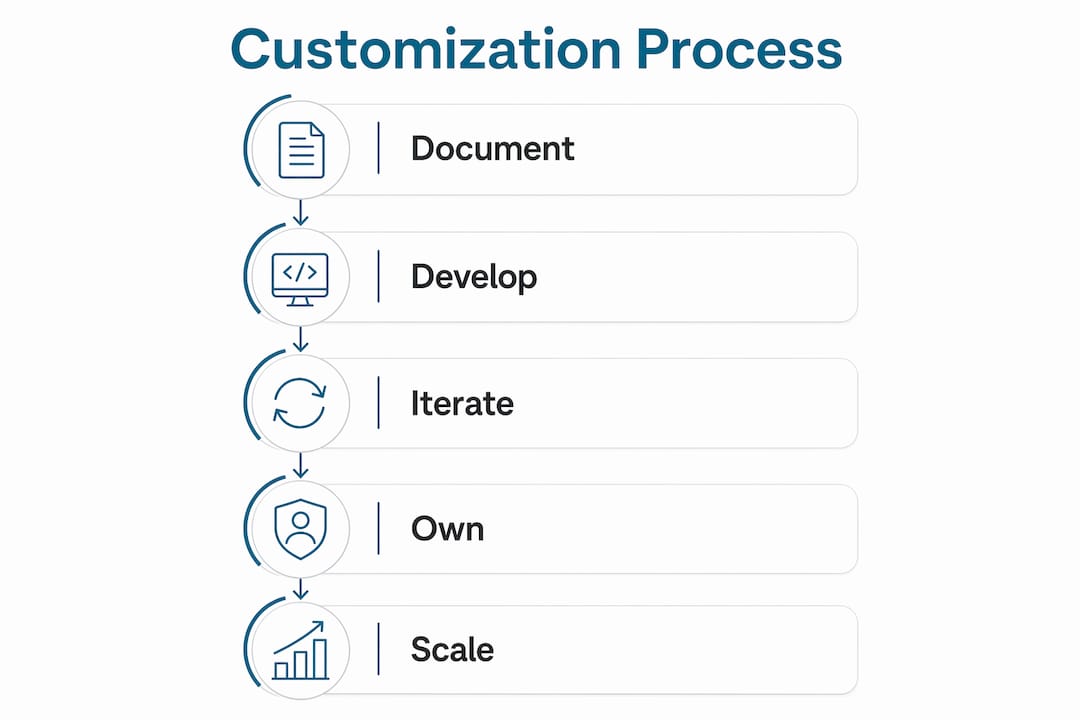
The development process itself requires discipline. Iterative development reduces risk by putting working software in front of your field team early. That early feedback prevents you from building features no one uses, which is the most common and costly mistake in custom software projects.
The discovery phase is where most projects succeed or fail. Document your current workflows in detail before a developer writes a single line of code. Identify the three or four processes that cause the most pain, and prioritize those for the first build cycle. Scope creep kills timelines and budgets. A tight initial scope with a clear roadmap for future phases is the right structure.
Ownership of the software roadmap is itself a competitive advantage. When you own the code, you decide what gets built next. No vendor can discontinue a feature you depend on or raise your price because the market shifted.
Pro Tip: Ask any development partner to show you a working prototype within the first 30 days of the project. If they cannot, the project scope is too vague and your budget is at risk.
Key Takeaways
Custom software customization matters for contractors because it aligns technology directly with field workflows, reduces administrative overhead, and creates scalability that generic platforms cannot match.
| Point | Details |
|---|---|
| Admin time reduction | Custom software cuts administrative time by 30–40%, freeing staff to handle more jobs. |
| Estimate accuracy | Historical data integration improves estimate accuracy by 15–20%, protecting your margins. |
| Generic platform limits | Off-the-shelf tools hit operational ceilings within 12–24 months and force workflow compromises. |
| Break-even timeline | Custom software typically pays for itself within 18–24 months when manual overhead is high. |
| Adoption drives results | Software aligned with your team's existing habits gets used consistently, producing reliable data. |
What I've learned about contractors and software fit
After working with field service contractors across HVAC, plumbing, electrical, and pest control, the pattern is consistent. The contractors who resist custom software almost always cite upfront cost. The contractors who adopt it almost always cite time savings and margin improvement within the first year.
The conventional wisdom says to start with off-the-shelf and upgrade later. I disagree with that for contractors past the ten-technician mark. By the time you hit that ceiling, you have trained your crew on the wrong habits, your job data is fragmented across multiple tools, and switching costs are real. Starting with a platform built for your workflows, even a lean version of one, saves that transition pain.
The other thing I have seen consistently: contractors underestimate how much the discovery phase matters. The firms that invest two or three weeks documenting their actual workflows before development starts end up with software that their crews use every day. The firms that skip that step end up with expensive tools that collect dust.
Software is not a one-time project. The best contractor operations I have seen treat their software as a living system. They add features as the business grows, retire ones that no longer fit, and review the roadmap quarterly. That mindset, more than any single feature, is what separates contractors who scale from those who plateau.
— Blake
Ampleexpress helps contractors find the right software fit
Ampleexpress matches HVAC, plumbing, electrical, and pest control contractors with field service software by trade that fits their crew size, workflows, and budget. The platform ranks over 30 options, flags rollout risk, and highlights which tools offer the customization flexibility your operation actually needs.
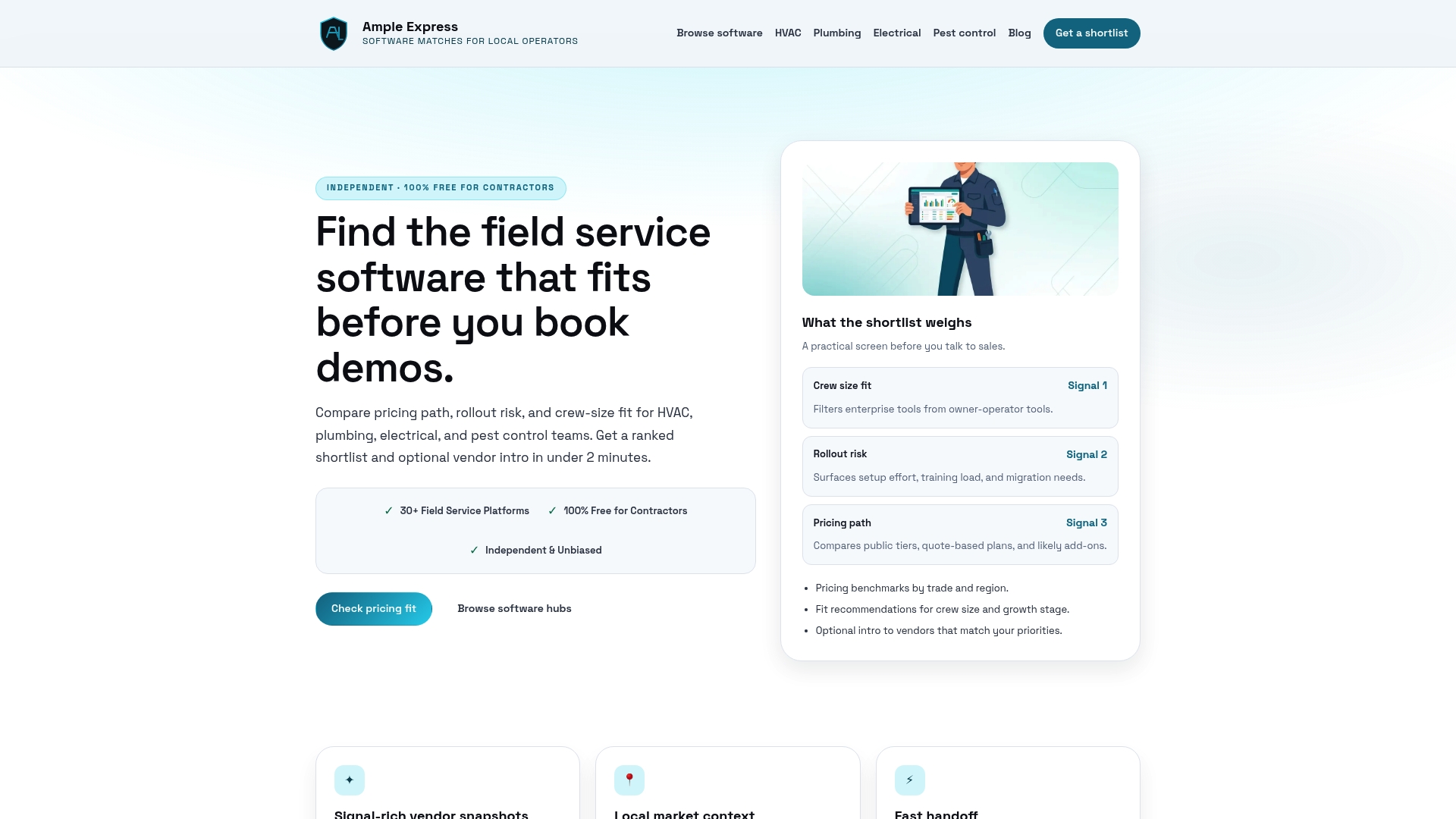
You can use the software cost calculator to estimate your break-even point before committing to any platform. Ampleexpress also provides regional pricing benchmarks and crew size trends so your decision reflects your local market, not just a vendor's marketing sheet. Share your crew size and top priorities, and Ampleexpress returns a ranked shortlist built around your specific operation.
FAQ
What is software customization for contractors?
Software customization for contractors is the process of configuring or building technology to match the specific workflows, billing structures, and field operations of a contracting business. It differs from off-the-shelf software, which requires contractors to adapt their processes to fit the platform.
How much can custom software reduce administrative time?
Custom software reduces administrative time by 30–40% for contracting businesses. That reduction comes from automating repetitive tasks like scheduling, invoicing, and job costing that generic platforms handle inefficiently.
When does custom software pay for itself?
Custom software typically reaches break-even within 18–24 months when manual overhead exceeds 20 hours per week and licensing fees are high. Contractors with fewer than ten technicians may find off-the-shelf tools more cost-effective in the short term.
Why do generic platforms fail growing contractors?
Generic platforms hit operational ceilings within 12–24 months as data volume and crew size grow. The average construction business uses 6.2 different tools, creating integration gaps that custom software eliminates by centralizing workflows in one system.
How should contractors start a custom software project?
Contractors should begin with a discovery phase that documents current workflows and identifies the highest-pain processes before any development starts. Iterative development, with working prototypes reviewed by field teams early, reduces the risk of building features that go unused.