
How to Justify Plumbing Software Spend as an Owner
Learn how to justify plumbing software spend as an owner. Discover the ROI and see how software can recover lost revenue and cut costs.
June 29, 2026
Article

Plumbing software ROI is defined as the measurable revenue recovered and costs eliminated when field service management tools replace manual dispatch, paper invoicing, and missed call workflows. Every plumbing business owner asking whether to justify software spend is really asking one question: does this pay for itself? The answer is yes, and the numbers are specific. A 5-tech crew billing at $125 per hour loses $75,000–$130,000 annually to idle time and inefficient routing alone. Software does not just cut costs. It recovers revenue you are already earning but failing to capture.
***
How to justify plumbing software spend as an owner
The standard industry term for this process is software investment justification, or more broadly, total cost of ownership analysis. Plumbing owners often call it "justifying the spend," which is accurate but undersells the scope. You are not just defending a line item. You are building a financial case that compares current operational losses against projected software gains.
The core claim is straightforward. Plumbing business software pays for itself by recovering billable hours, reducing dispatcher labor, and capturing jobs that currently go to voicemail. The payback period for most mid-tier platforms is measured in weeks, not years. That timeline makes software one of the fastest-returning capital investments available to a plumbing operation.
Three benchmarks anchor every credible justification:
- Billable capacity loss: Manual dispatching costs 15–25% of billable capacity through idle time and poor routing.
- Missed call revenue: Plumbing businesses lose approximately $91,350 annually to unanswered inbound calls.
- Dispatcher labor savings: Automation can redirect dispatcher roles, saving $36,000–$44,000 per year at scale.
These three figures alone dwarf the annual cost of most plumbing software stacks.
***

What hidden costs does manual operation create?
Manual operations bleed revenue in ways that rarely appear on a profit and loss statement. Idle time between jobs, double-booked appointments, and phone calls that go unanswered all represent billable hours that vanish without a trace.
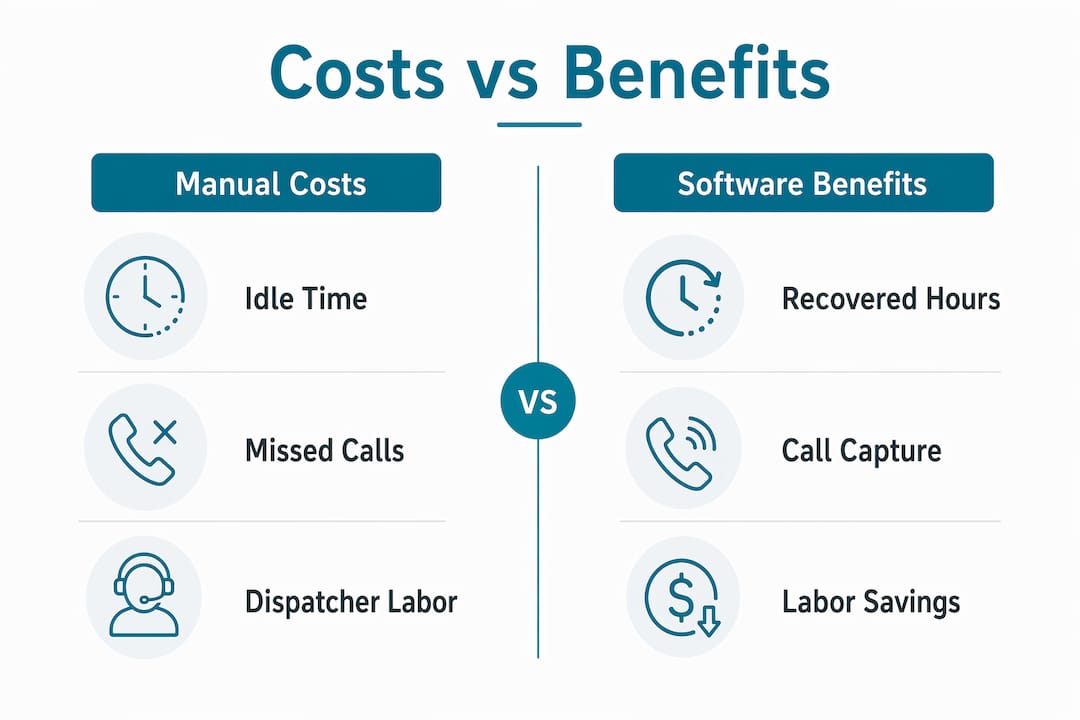
Manual dispatching costs plumbing businesses 15–25% of billable capacity through idle time and inefficient routing. For a 5-tech crew billing at $125 per hour, that translates to $1,500–$2,500 in weekly revenue loss. Annualized, the damage reaches $75,000–$130,000 before you account for a single missed call.
Missed calls compound the problem significantly. Automated call answering software costing $1,788 per year delivers an 18:1 ROI by capturing jobs that would otherwise go to a competitor. Capturing just four extra jobs per year covers the software cost entirely. Most shops capture 6–15 jobs monthly once automated answering is in place.
Employee burnout is a less visible but equally real cost. Inefficient routing forces techs to spend more time in transit and less time on jobs. That frustration drives turnover, and replacing a skilled plumber costs thousands in recruiting, onboarding, and lost productivity. Software that tightens routing and reduces administrative friction directly lowers turnover risk.
The dispatcher labor equation is also worth quantifying directly. Automation can redirect dispatcher roles and save $36,000–$44,000 per year at scale. For many mid-tier platforms, that single line item justifies the entire annual subscription.
***
How do you calculate plumbing software ROI?
ROI calculation for plumbing software follows a straightforward formula: recovered revenue plus cost savings, minus total software cost, divided by total software cost. The result tells you your return as a percentage of what you spent.
Step-by-step for a 5-tech shop billing at $125 per hour:
- Identify your utilization gap. If your techs are billable 6 hours out of an 8-hour day, your utilization rate is 75%. A 15% capacity loss means you are losing roughly 1.2 billable hours per tech per day.
- Calculate weekly revenue loss. 1.2 hours × $125 × 5 techs × 5 days = $3,750 per week in unrecovered revenue.
- Estimate software recovery. A 5-person crew can recover 8–12 billable hours weekly by eliminating idle time through software. At $125 per hour, that is $1,000–$1,500 in additional weekly revenue.
- Add missed call recovery. If automated answering captures 6 extra jobs per month at an average ticket of $350, that is $2,100 in monthly recovered revenue.
- Subtract total software cost. A 1–5 truck shop typically spends $350–$750 per month on an AI-enhanced software stack. Net monthly gain is substantial.
Pro Tip: Factor in a 2–4 month productivity dip during onboarding when projecting first-year ROI. Shops that ignore this often declare software a failure at week six, right before the system starts paying off.
Qualitative gains also belong in your ROI case. Enforced job documentation via software, such as mandatory before and after photos and inspection checklists, reduces costly callbacks and lowers insurance liability. These savings are harder to quantify but real.
| ROI method | What it measures | Best for |
|---|---|---|
| Billable hour recovery | Revenue from reduced idle time | Dispatch-heavy operations |
| Missed call capture | Revenue from automated answering | High inbound call volume shops |
| Dispatcher labor savings | Payroll cost reduction from automation | Shops with dedicated dispatch staff |
| Callback and rework reduction | Cost avoidance from documentation | Quality-focused operations |
| Business valuation growth | Long-term equity increase from systemization | Owners planning to sell or scale |
***
Stack approach versus enterprise platforms: which costs less?
The biggest mistake plumbing owners make is buying enterprise software before their operation is ready for it. Smaller shops achieve higher ROI by sequencing best-of-breed stacks under $300 per month per truck rather than committing to expensive enterprise platforms prematurely.
The cost difference is significant. A 1–5 truck shop spending $350–$750 per month on a modular stack gets scheduling, dispatch, invoicing, and CRM coverage without the complexity of an all-in-one platform. Enterprise platforms, by contrast, deliver positive ROI only beyond 15 technicians and $3 million or more in annual revenue. Below that threshold, the onboarding burden often outweighs the gains.
Onboarding costs for large enterprise platforms can run $500–$2,000 or more, with a 2–4 month implementation period that creates productivity dips. For a 5-tech shop, that lost productivity can offset first-year platform gains entirely. The software fit recommendation for most sub-10-tech operations is a modular stack, not a monolithic platform.
| Approach | Best fit | Monthly cost range | Key risk |
|---|---|---|---|
| Modular best-of-breed stack | 1–14 techs | $350–$750 | Integration gaps between tools |
| All-in-one enterprise platform | 15+ techs, $3M+ revenue | $800–$2,500+ | High onboarding cost and complexity |
Pro Tip: Audit which software features your team actually uses after 90 days. Most shops pay for modules they never activate. Trim unused features before renewing or upgrading.
The state of field service software in 2026 shows a clear trend: mid-market plumbing operations are moving toward modular stacks with AI-enhanced dispatch and automated billing rather than all-in-one platforms. That shift reflects hard lessons about overbuying.
***
How to present software investment to stakeholders
Framing software as a revenue driver, not a cost center, is the single most effective way to build internal support. Successful plumbing owners who adopt this framing recover 25% or more of lost pipeline revenue within three weeks of CRM and dispatch software deployment.
Build your business case around these pillars:
- Revenue recovery: Show the dollar value of billable hours currently lost to idle time and missed calls.
- Labor cost reduction: Quantify dispatcher savings and reduced overtime from tighter scheduling.
- Business valuation: Systemized operations with documented job history and CRM data command higher multiples at sale. This matters if you plan to exit or bring on a partner.
- Customer satisfaction: Faster dispatch, accurate arrival windows, and digital invoicing reduce complaints and increase repeat bookings.
- Scalability: Automation lets you add techs without adding proportional administrative overhead. That is the core of profitable growth.
Set a monitoring period of 90 days before drawing conclusions. Track three key performance indicators from day one: billable utilization rate, missed call conversion rate, and average job cycle time. Review these weekly for the first month, then monthly after that.
Pro Tip: Present your ROI case in dollars per week, not percentages. Owners and partners respond to "$2,100 recovered per month" far more than "a 12% efficiency improvement."
AI and dispatch tools need 6–8 weeks for optimization before positive ROI becomes visible. Evaluating at weeks three or four produces false negatives. Build that timeline into your stakeholder presentation from the start so no one pulls the plug too early.
***
Key Takeaways
Plumbing software pays for itself through recovered billable hours, missed call capture, and dispatcher labor savings that together far exceed typical subscription costs.
| Point | Details |
|---|---|
| Quantify losses first | Manual dispatch costs 15–25% of billable capacity; calculate your weekly revenue loss before buying. |
| Missed calls are expensive | Automated answering at $1,788/year delivers an 18:1 ROI by capturing jobs that go to competitors. |
| Match software to crew size | Stacks under $300/truck/month outperform enterprise platforms for shops with fewer than 15 techs. |
| Allow 6–8 weeks before judging | AI and dispatch tools need an optimization period; early evaluation produces false failure signals. |
| Frame it as revenue, not cost | Presenting software as a revenue driver, not an expense, builds faster stakeholder buy-in. |
***
Why most owners measure ROI wrong and what to do instead
The owners I see struggle most with software justification are not the ones who bought the wrong tool. They are the ones who evaluated it at the wrong time. Three weeks in, dispatch is still messy, the team is complaining about the new workflow, and the owner concludes the software does not work. That conclusion is almost always wrong.
Software is not a switch you flip. It is a system you build. The first four to six weeks are the hardest because you are running two workflows simultaneously: the old habits and the new platform. Productivity dips during that window are normal and expected. The mistake is treating that dip as evidence of failure rather than evidence of transition.
The second error I see constantly is buying for the business you want instead of the business you have. A 6-tech shop does not need an enterprise platform with a dedicated implementation team and a $2,000 onboarding fee. It needs a modular stack that covers dispatch, invoicing, and CRM for under $500 per month. Overbuying creates complexity that slows adoption and inflates the apparent cost of software.
The owners who get this right treat software as a discipline enforcer, not a magic fix. They require techs to complete job documentation before closing a work order. They use the CRM to follow up on every unsold estimate. They review dispatch efficiency weekly. The software makes those disciplines possible at scale. Without the discipline, the software sits idle.
My honest advice: start with the smallest stack that covers your three biggest pain points, run it for 90 days with full team compliance, and then measure. You will have a real ROI number, not a guess.
— Blake
***
How Ampleexpress helps you get the right software fit
Choosing the wrong platform wastes money and time. Ampleexpress takes the guesswork out of that decision by matching plumbing contractors to software that fits their crew size, budget, and operational priorities.
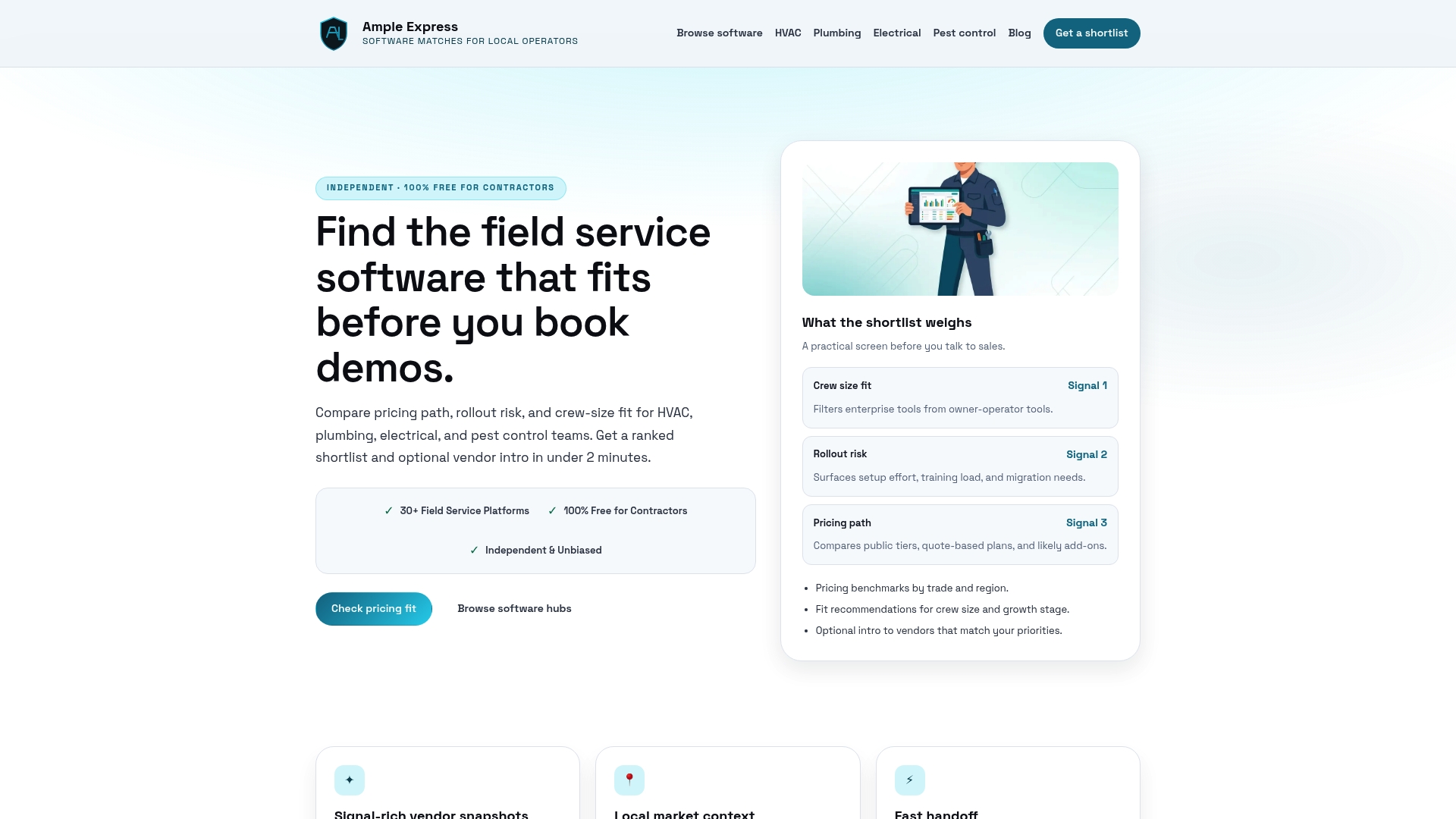
Ampleexpress provides a ranked shortlist of over 30 plumbing field service software options, with pricing paths, rollout risk ratings, and fit recommendations built for 1-truck owner-operators through 20-tech operations. The platform also includes a software cost calculator that lets you model your specific ROI before committing to any subscription. If you want to stop paying for software that does not fit and start building a stack that actually pays back, Ampleexpress is the place to start.
***
FAQ
What is a realistic payback period for plumbing software?
Most plumbing software stacks pay for themselves within weeks, not months. A 5-tech crew recovering 8–12 billable hours weekly at $125 per hour generates enough additional revenue to cover a typical monthly subscription in the first billing cycle.
How much should a small plumbing shop spend on software?
A 1–5 truck shop should budget $350–$750 per month for an AI-enhanced software stack covering dispatch, scheduling, invoicing, and CRM. Enterprise platforms are cost-effective only for operations with 15 or more technicians.
When should I evaluate whether my software investment is working?
Evaluate software ROI no earlier than 6–8 weeks after full deployment. AI and dispatch tools require an optimization period, and assessments at weeks three or four consistently produce false failure signals.
Does software increase the value of my plumbing business?
Yes. Systemized operations with documented job history, CRM data, and automated billing command higher sale multiples. Software adoption is a direct contributor to business valuation growth for plumbing contractors planning to scale or exit.
What is the ROI of automated call answering for plumbers?
Automated call answering software costing $1,788 per year delivers an 18:1 ROI by recovering jobs lost to missed calls. Capturing just four extra jobs per year covers the full annual cost.